


Woodywalls is a reasonable starting point when its wall-panel look matches your plan. The limit comes when appearance alone cannot answer your questions about acoustic treatment, finish choice, and installation. The best Woodywalls alternative in 2026 is Akuwood Panel if you need acoustic wood slat panels; fabric-wrapped absorbers are the better category to investigate if a wood finish is not a priority.
- Akuwood Panel is the best Woodywalls alternative for shoppers comparing acoustic wood slat panels in 2026.
- Choose fabric-wrapped absorbers when acoustic treatment matters more than a wood finish.
- A felt backing does not establish an acoustic rating; request test results for the exact panel and installation.
- Choose plain wood planks for a decorative wood wall, not as a substitute for tested sound absorption.
Why this matters
A wall panel can change how a room looks without solving the reason it feels noisy. Echo inside a room, speech passing through a wall, and noise entering through a door are different problems. The right Woodywalls alternative depends on which problem you have, not just which finish looks closest in a photo.
In 2026, start with the job: decorative cladding, acoustic treatment, or both. If you are specifying panels for a construction project, use this guide to specifying acoustic wall panels to organize the questions before you select a finish. For a home feature wall, the same principle applies on a smaller scale: decide what the panel must do before committing to a surface.
Woodywalls alternatives at a glance
The options below are panel types as well as a supplier. That distinction matters: switching suppliers will not fix a mismatch between the material you chose and the result you need.
| Option | Best for | Standout feature | How it differs from Woodywalls |
|---|---|---|---|
| Woodywalls | Keeping a finish you have already selected | Your existing reference point | Benchmark the exact panel you are considering against the requirements below |
| Akuwood Panel | Acoustic wood slat panels for interior projects | Listed slat, hexagon, fluted, and three-dimensional wood-panel formats | Offers specific formats to compare; verify performance for the chosen product |
| Fabric-wrapped absorbers | Acoustic treatment without a wood-slat appearance | A fabric finish over an absorptive core | Puts the acoustic panel format ahead of a wood feature-wall look |
| PET felt panels | A non-wood felt surface | Felt can serve as the visible face rather than only a backing | Changes the visible material and design approach |
| Plain wood planks | Decorative wood cladding | Continuous wood appearance without a slat-and-felt format | Serves a visual goal; do not treat it as tested sound absorption |
There is no universal winner for every wall. If the room needs a wood feature wall and an acoustic-panel format, compare the acoustic slat wall panel in natural oak with the exact Woodywalls panel on your shortlist. If you need a plain wood surface or do not want visible slats, another format is a better starting point.
1. Akuwood Panel: best for acoustic wood slat walls
Akuwood Panel manufactures and supplies acoustic wood panels for construction and interior applications. Its listed products include acoustic slat wall panels in natural oak, walnut, black oak, and smoked oak, alongside hexagon acoustic panels. The catalog also includes fluted panels and three-dimensional wood panels, giving you ways to pursue a different wall texture without treating every style as acoustically equivalent.
Where Akuwood Panel shines
- Clear format choices: You can compare slat panels with hexagon acoustic panels rather than assuming every wood panel has the same purpose.
- Finish choices within slats: The listed oak and walnut options let you decide whether the wood should read light, dark, or somewhere between.
- Relevant to two buying paths: Individual buyers can plan a feature wall, while construction buyers can evaluate panels against a project specification.
Where Akuwood Panel falls short
- The supplied product information does not establish a tested absorption rating for any specific panel. Do not specify a target acoustic result from the word acoustic alone.
- The range includes decorative formats as well as acoustic ones. Choosing a fluted or three-dimensional panel for its appearance does not establish that it performs like a tested absorber.
- A wood slat finish is a poor fit if you want a continuous fabric or felt surface.
Best for: Buyers who want an acoustic wood slat wall and a choice of listed finishes. Verdict: Buy for the format; verify the exact panel's test data before writing an acoustic requirement into a project specification.
| Decision point | Akuwood Panel | Woodywalls |
|---|---|---|
| Acoustic slat option | Listed in the supplied catalog | Check the exact product under consideration |
| Natural oak option | Listed in the supplied catalog | Compare the finish of the exact product |
| Other wall formats | Hexagon, fluted, and three-dimensional panels are listed | Check the formats relevant to your project |
| Documented acoustic result | Request results for the selected panel and installation | Request results for the selected panel and installation |
That last row is the real head-to-head test in 2026. A product name and a photograph tell you what to inspect, not how much sound a completed wall will absorb.
2. Fabric-wrapped absorbers: best for treatment-first rooms
Fabric-wrapped absorbers make sense when you want to address reflections but do not need a wood-slat feature wall. Their visible face is fabric, so the material choice changes the room's appearance as well as the panel format. For a meeting room, music room, or other echo-prone interior, judge a candidate by its published acoustic test and the proposed installation.
Where fabric-wrapped absorbers shine
- They keep the selection focused on an absorptive panel rather than matching a wood grain.
- A published test for the exact construction gives you a basis for comparing candidates.
- Their fabric face offers a different visual direction if slats compete with the rest of the room.
Where fabric-wrapped absorbers fall short
- They do not deliver the wood-slat appearance that motivates many Woodywalls alternatives searches.
- Fabric, core, thickness, and mounting change the result; a broad product-category label is not a performance specification.
- They still require a separate plan for corners, openings, and how the wall should look as a whole.
Best for: A room where controlling reflections is the main brief and wood is optional. Verdict: Buy only after comparing documented performance and the intended mounting method.
| Decision point | Fabric-wrapped absorbers | Woodywalls |
|---|---|---|
| Visible face | Fabric | Check the exact selected panel |
| Wood-slat look | Not the point of this format | Compare the exact selected panel |
| Acoustic comparison | Ask for results for the proposed assembly | Ask for results for the proposed assembly |
3. PET felt panels: best for a non-wood felt finish
PET felt panels give you another way to make an acoustic surface visible. Instead of selecting wood slats with backing, you select a felt-faced panel as the design element. That makes the choice useful when the visual brief does not call for veneer or a pronounced slat pattern.
Where PET felt panels shine
- The visible material is felt, so you do not need to build the room's look around wood grain.
- Panel shape and placement can become part of the design, subject to the products available from the supplier you choose.
- You can assess acoustic claims against documentation for the exact product.
Where PET felt panels fall short
- PET felt does not give you a real-wood veneer appearance.
- A felt label alone says nothing conclusive about absorption at the frequencies that matter in your room.
- A decorative layout can leave too little useful treatment if you choose placement solely for appearance.
Best for: Buyers who want felt to be the visible finish and will check the selected panel's test results. Verdict: Buy for a non-wood finish, not because every felt panel performs alike.
| Decision point | PET felt panels | Woodywalls |
|---|---|---|
| Visible material | PET felt | Check the exact selected panel |
| Wood finish | Not provided by the felt face | Compare the exact selected finish |
| Performance claim | Verify for the chosen product and mounting | Verify for the chosen product and mounting |
4. Plain wood planks: best for a decorative wood wall
Plain wood planks are the straightforward alternative when the wood appearance is the entire goal. They avoid asking an acoustic product to do a job you do not need. They also make the decision clearer: choose them as cladding, not as a substitute for a tested absorptive assembly.
Where plain wood planks shine
- They put wood grain and surface layout at the center of the project.
- They suit a decorative brief without requiring you to choose a slat-and-felt format.
Where plain wood planks fall short
- A plain wood surface does not establish a useful sound-absorption result.
- If the room has an echo problem, you still need an acoustic plan.
Best for: A wood accent wall with no stated acoustic-performance requirement. Verdict: Buy for appearance; skip it as a stand-alone echo treatment.
| Decision point | Plain wood planks | Woodywalls |
|---|---|---|
| Primary role | Decorative cladding | Check the exact selected panel |
| Acoustic evidence | Requires evidence if performance is claimed | Requires evidence if performance is claimed |
| Surface pattern | Plank layout | Compare the exact selected design |
How to make the acoustic comparison useful
Start by separating absorption from sound isolation. Absorption addresses sound reflecting inside the room; isolation addresses sound passing between spaces. A panel sold for room acoustics does not automatically make a shared wall soundproof. If the complaint is a neighbor's television through a partition, compare the complete wall assembly rather than relying on a surface panel alone.
For an echo problem, ask for test results for the specific panel construction and installation you intend to use. Acoustic results can differ across frequency bands. When reading a test report, look beyond a single summary figure and check reported bands such as 125 Hz, 500 Hz, and 2,000 Hz. Those figures are frequencies, not performance claims for any panel on this page.
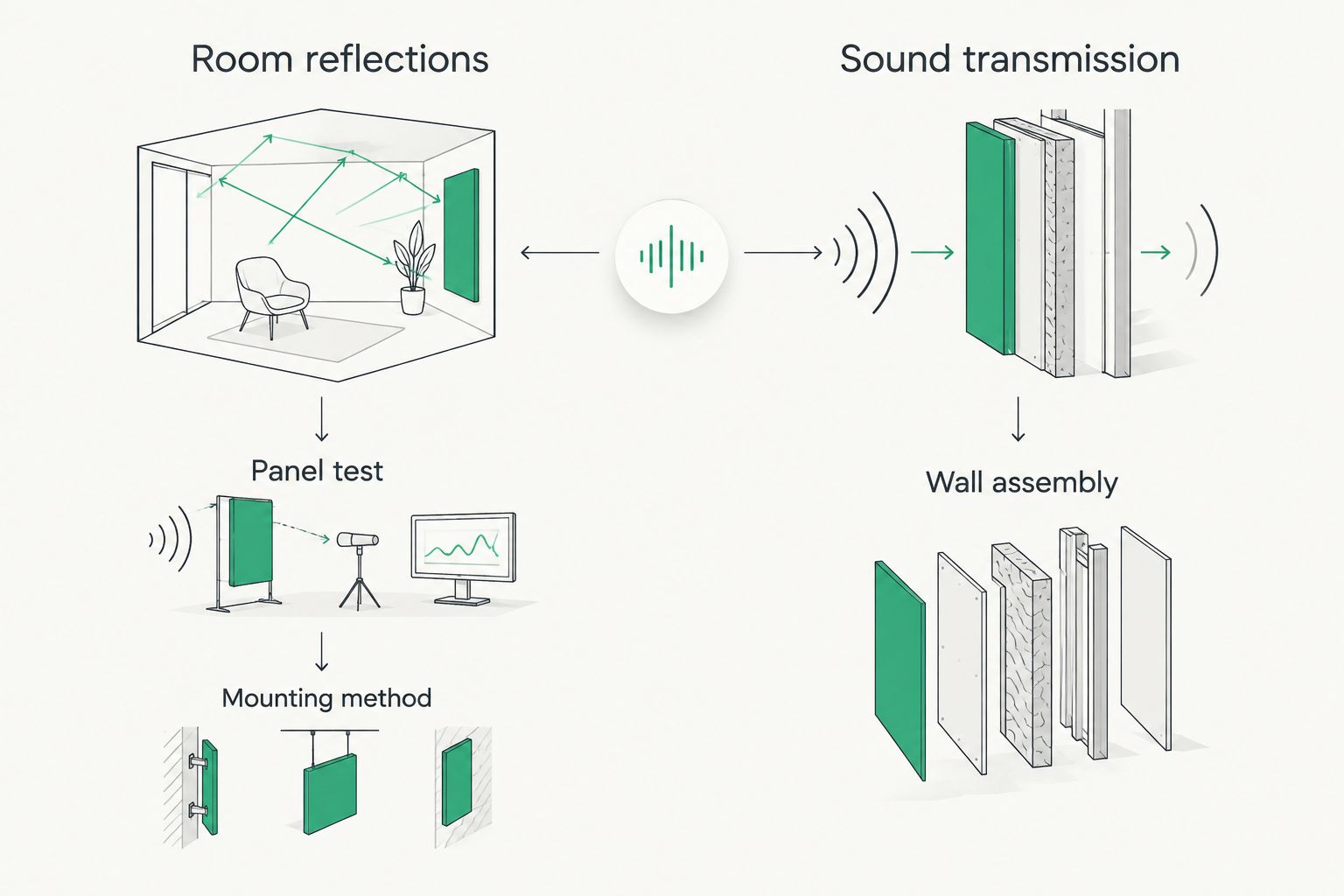
Then check the physical plan. Confirm the area you intend to cover, where panel edges will land, and whether outlets, trim, or openings interrupt the layout. On a commercial job, keep the finish decision separate from required fire and other project documentation. Do not assume a panel meets a building requirement because a similar-looking panel does.
For a smaller interior project, take a sample-based approach when color matters. Wood appearance shifts with the room's light and nearby finishes. The listed full sample box of slat wall panels gives you a product to consider when comparing finishes before committing to a wall layout; check its current contents on the product page.
Compare acoustic slat finishes
Review a listed slat panel before finalizing your wall plan.
Why people switch from Woodywalls
The sound reason to consider a switch is a better fit for the brief, not an assumed problem with Woodywalls. Compare alternatives when you need a particular acoustic-panel format, want to review several wood finishes, or decide that fabric or felt serves the room better than wood. Each is a project requirement you can check against actual products.
For 2026, write down three separate decisions before choosing: the surface you want to see, the acoustic result you need to document, and the installation you can execute. That short list prevents a common mismatch: selecting an attractive acoustic-labeled panel for a sound-isolation problem, or choosing decorative wood for a room that needs reflection control. Neither mistake is fixed by changing supplier names.
If you are comparing suppliers for a build, request the same documents for both shortlisted products. Ask about the exact finish and construction, the test applicable to the proposed mounting, and any documentation your project requires. A comparable specification beats a comparison based on product names.
When staying with Woodywalls is the right call
Stay with Woodywalls if the exact panel you selected matches your finish brief and you can verify every project requirement that applies. A switch adds no value when it changes only the supplier name and gives you no better answer on appearance, acoustic evidence, or installation.
That is especially true for a decorative wall with no acoustic target. If you already like the selected finish and have checked how it will fit the space, you do not need to reopen the decision simply because another brand offers wood panels. For a performance-led project, however, keep the choice open until the relevant documentation is in hand.
FAQ
What is the best Woodywalls alternative in 2026?
Akuwood Panel is the best Woodywalls alternative here for buyers seeking acoustic wood slat panels. Compare the exact finish and request acoustic documentation if your project specifies a performance target.
Is Akuwood Panel better than Woodywalls for acoustic walls?
Akuwood Panel is a relevant choice for acoustic wood slat walls, but the supplied information does not establish a performance winner. Compare test results for the exact panels and mounting methods before specifying either one.
Are wood slat panels the same as soundproofing?
No. Acoustic treatment of reflections inside a room is different from stopping sound passing through a wall. Assess the complete wall assembly when sound isolation is the goal.
Should I choose fabric panels or wood slat panels for echo?
Choose based on documented absorption for the proposed installation and the finish your room needs. Fabric suits a treatment-first brief; wood slats suit a brief that also calls for a wood feature wall.
Do PET felt panels work better than wood panels?
Neither material wins without a comparison of specific tested products. Check results for the frequencies and installation relevant to your room rather than judging by the visible material.
Can plain wood planks replace acoustic panels?
Plain wood planks are a decorative option, not an automatic replacement for tested acoustic panels. If controlling reflections is a requirement, select products with suitable performance evidence.
What should I check before choosing an acoustic wall panel?
Check the exact panel construction, its acoustic test, the proposed mounting method, and the area you plan to cover. Also confirm that the finish and project documentation meet your brief.
One last thing
For 2026, ask the acoustic question before choosing the wood color. If the problem is echo, compare tested absorption for the proposed installation. If the problem is noise through a wall, examine the wall assembly. If there is no acoustic problem, choose the finish you want and stop treating a decorative decision as a soundproofing project.
Share:
Naturewall Alternatives: Akuwood Panel Wins in 2026
Andor Willow Alternatives: Best-Fit Picks for 2026