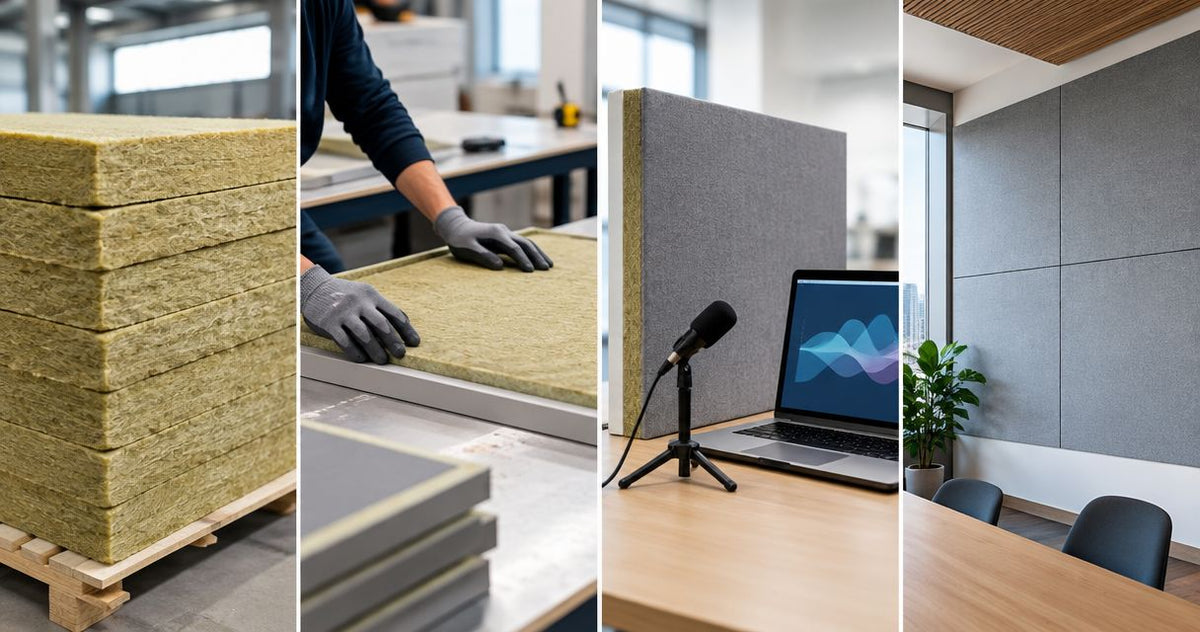
Instead of adding insulation and wall panels by trial and error, use a documented wall-assembly workflow: identify the sound path, select a tested construction, install mineral wool and seals, then add the acoustic finish. Mineral wool supports sound isolation inside a suitable wall assembly; an acoustic panel does not establish that wall’s STC rating. This 2026 guide separates room treatment from soundproofing and shows you where each belongs.
- For mineral wool insulation acoustic panel STC rating decisions, use whole-wall test evidence, not isolated material claims.
- Akustiq USA acoustic wood panels belong in interior finish and room-treatment plans, not as proof of sound isolation.
- Mineral wool, airtight layers, and controlled structural connections serve different roles in a sound-isolating wall.
- Specify STC for sound transmission and NRC for absorption; neither number replaces the other.
Why this matters
A room can sound less echoey while conversations remain audible through its wall. These are different problems. Absorption reduces reflected sound within a room; isolation limits sound traveling into another space.
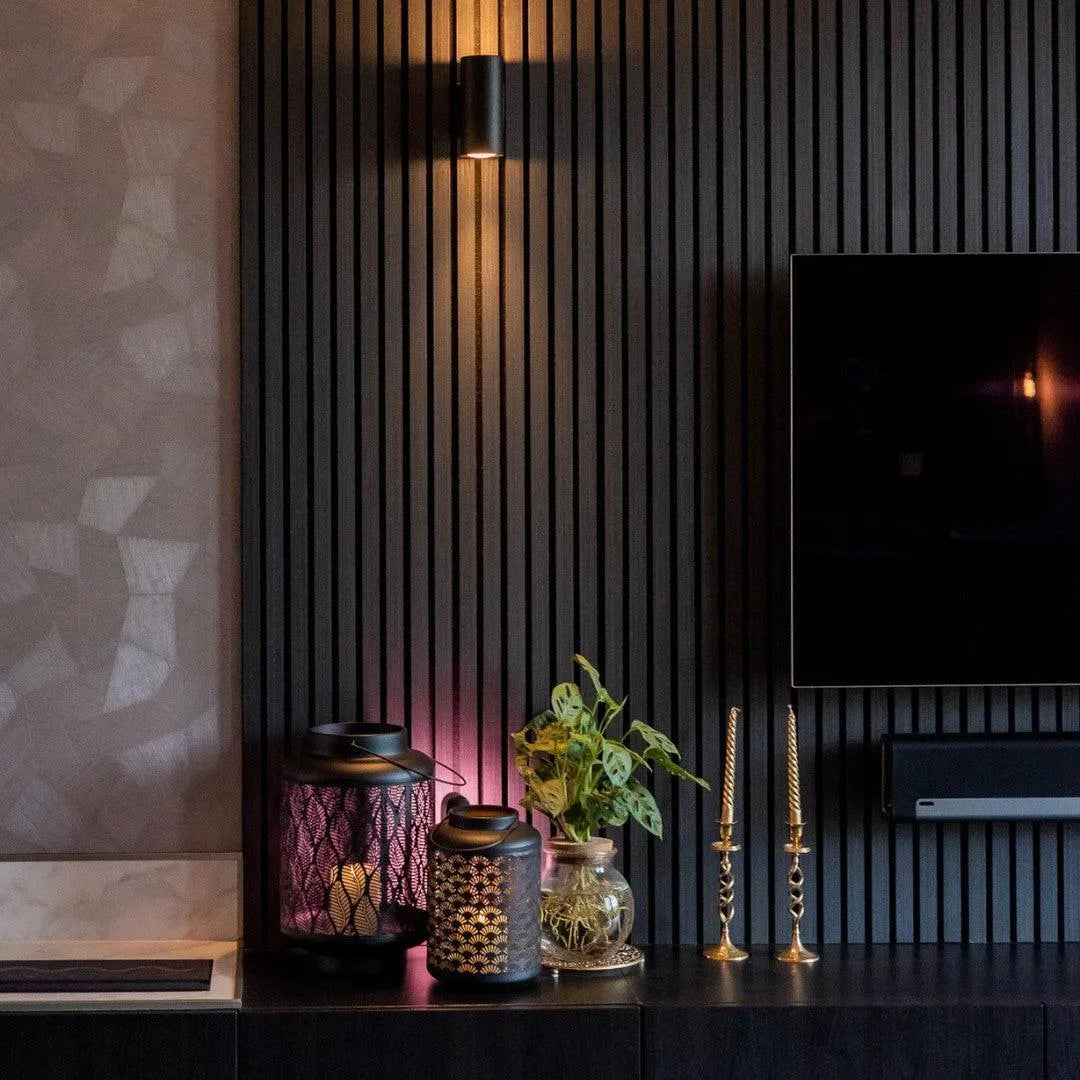
Akustiq USA acoustic wood panels are best used as interior finishes and room treatment, not as evidence of a wall’s STC. Explore Akustiq USA for the visible finish, but specify the separating construction independently.
For a 2026 project, keep two performance records: the wall assembly’s transmission test and the room treatment’s absorption test. Mineral wool inside a closed stud cavity absorbs energy within that cavity. Mineral wool behind an acoustically open room-facing treatment serves a different purpose: absorbing sound from the room.
STC, or Sound Transmission Class, is a single-number classification calculated under ASTM E413 from transmission-loss measurements. Its calculation uses 16 frequency bands spanning 125 Hz to 4,000 Hz. It is not a promise that every sound becomes quieter by the same number of decibels.
NRC, or Noise Reduction Coefficient, summarizes absorption at 250 Hz, 500 Hz, 1,000 Hz, and 2,000 Hz under ASTM C423. An NRC result cannot be converted into an STC rating. Ask for the test method and mounting arrangement before comparing numbers.
Before you start
- Documentation and access: Obtain drawings, permission to alter the wall, installation instructions, and the selected assembly’s acoustic and fire-resistance documentation. Identify framing, utilities, doors, ceiling voids, and adjoining construction before opening anything.
- Materials and protection: Prepare the specified mineral wool, board layers, mounting components, compatible sealants, fasteners, measuring tools, and cutting equipment. Follow the insulation safety instructions for gloves, eye protection, dust control, and respiratory protection.
- The hidden gotcha: Decorative-panel fasteners can bridge an isolated wall lining if they extend into framing behind it. Resolve fastening depth, support, and electrical-box extensions before installation—not after the finished wall needs holes.
Do not cut into an existing wall until you have checked concealed services and any applicable hazardous-material requirements. Use qualified trades for electrical alterations and an appropriate design professional for rated or structurally significant construction.
Wall target and assembly selection
- Define the complaint. Record whether you hear speech through the wall, a ringing echo inside the room, footsteps through the structure, or bass from another space. Identify the source room and receiving room. These observations establish the problem, not a measured rating.
- Map the sound paths. Inspect the separating wall alongside doors, glazing, ducts, ceiling voids, floor junctions, and service penetrations. Sound traveling around the wall is flanking transmission. Improving only the visible wall does not address those routes.
- Select a tested assembly. Match the proposed framing, cavity depth, insulation, board thickness, board layers, isolation components, and perimeter details to a documented construction. For laboratory transmission testing, look for ASTM E90 data classified under ASTM E413.
- Record the acceptance requirement. Put the required rating, test method, assembly reference, and verification approach in the project specification. Distinguish a laboratory STC requirement from field performance in the completed building.
Expected result: You have an identifiable wall construction and a defined acceptance requirement, rather than a collection of materials with unrelated acoustic claims.
Do not select mineral wool by density alone. Its thickness and installation must suit the selected construction. A different insulation product, extra board layer, or altered mounting detail creates a different assembly; retain the documented specification or obtain approval for the substitution.
For 2026 specifications, record the applicable standard edition and the actual test-report date from the documents you receive. A product description is not a substitute for that report.
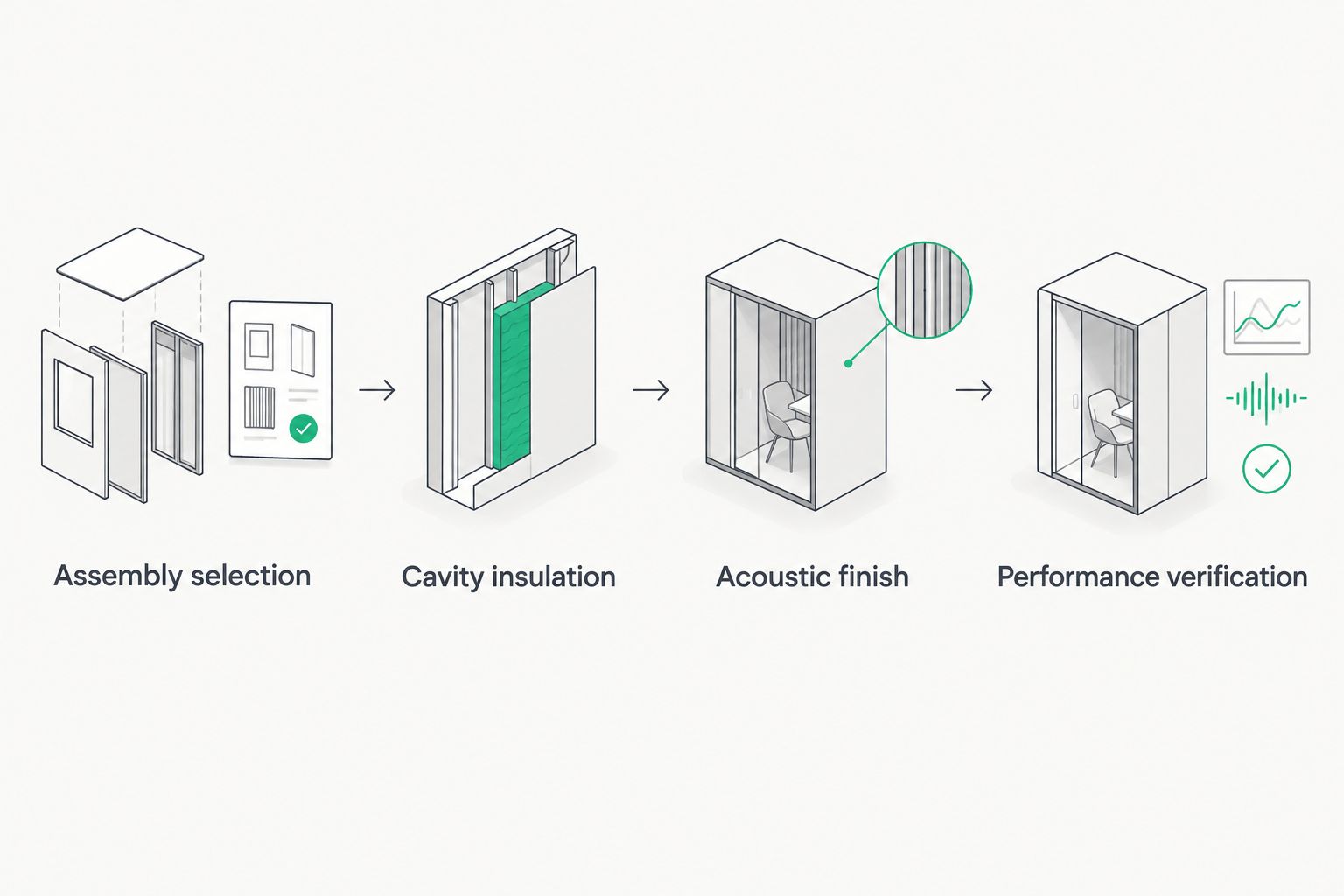
The process has a fixed order. Assembly selection comes before insulation, and verification comes after construction—not after an assumed improvement.
Cavity insulation and airtight layers
- Prepare the construction. Repair substrate defects and resolve moisture problems before enclosing the wall. Confirm the framing and isolation components match the approved detail. Do not improvise bracing, blocking, or attachments that connect separated elements.
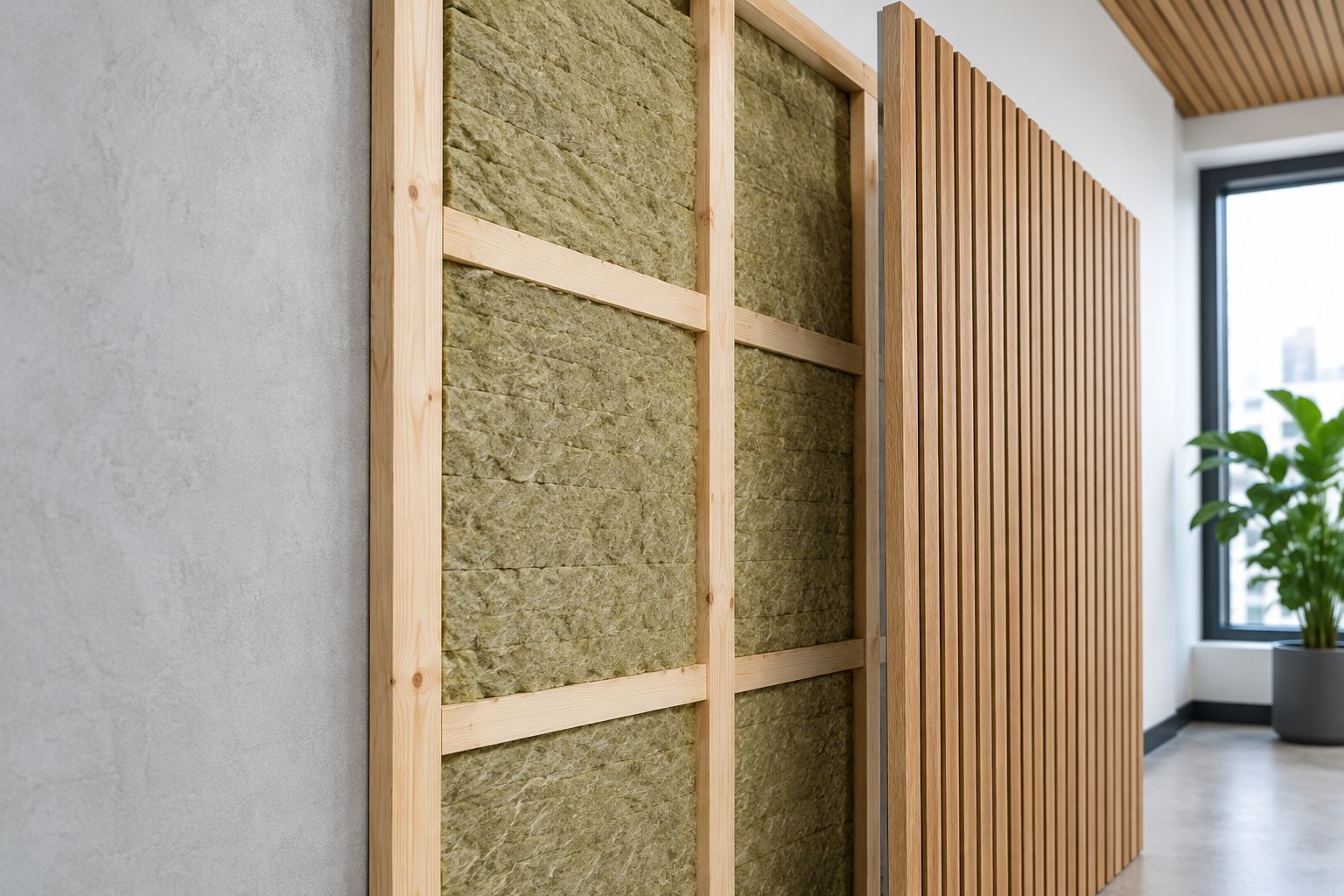
- Fit the mineral wool. Cut and place the specified insulation so it fills the intended cavity without unintended gaps, slumping, or compression. Fit around services according to the insulation instructions and assembly details. Do not force an oversized batt into a shallower cavity.
- Install the board layers. Follow the documented board type, thickness, layer arrangement, joints, and fastening schedule. Where the design includes resilient channels or isolation clips, follow their orientation and fastening requirements exactly.
- Seal the specified junctions. Complete perimeter and penetration details with compatible materials. Keep electrical boxes accessible and use the required firestopping systems for rated penetrations. Acoustic sealant does not automatically qualify as firestopping.
Expected result: The cavity treatment and enclosing layers match the selected assembly, with completed seals and no unintended rigid connections.
Mineral wool is not an airtight barrier. Packing it into an opening does not replace the board, backing, sealant, or firestop detail required there.
Photograph the cavity, isolation components, service details, and board installation before concealing them. Include material labels and locations in the project record. These photographs support inspection and future repairs; they do not certify an STC rating.
Acoustic finish and mounting layout
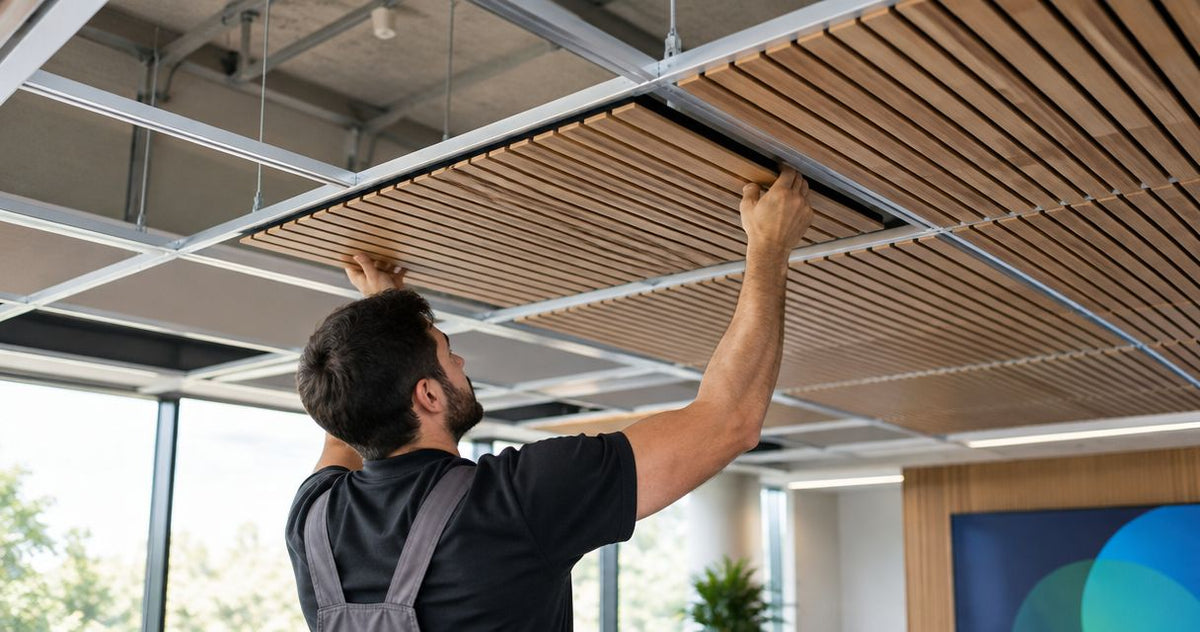
- Confirm the finish’s role. Treat room-facing acoustic wood panels as a separate finish and absorption decision. If the complete wall’s claimed rating includes a particular finish, reproduce that tested detail rather than assuming another panel is equivalent.
- Check mounting evidence. For an absorption claim, request the test report showing the panel, backing, insulation, and mounting arrangement. Direct mounting and mounting over a cavity are not interchangeable test conditions.
- Plan support and services. Set out panel joints, trim, outlets, switches, and access points. Confirm the support and fasteners can carry the finish without bridging isolated construction. Have electrical devices correctly extended where wall thickness changes.
- Install to the approved detail. Follow the panel manufacturer’s fastening, cutting, and handling instructions. Keep designated joints and service access clear. Do not add openings through the separating wall simply to accommodate a decorative layout.
Expected result: The finish is securely supported, serviceable, and compatible with the wall’s isolation strategy.
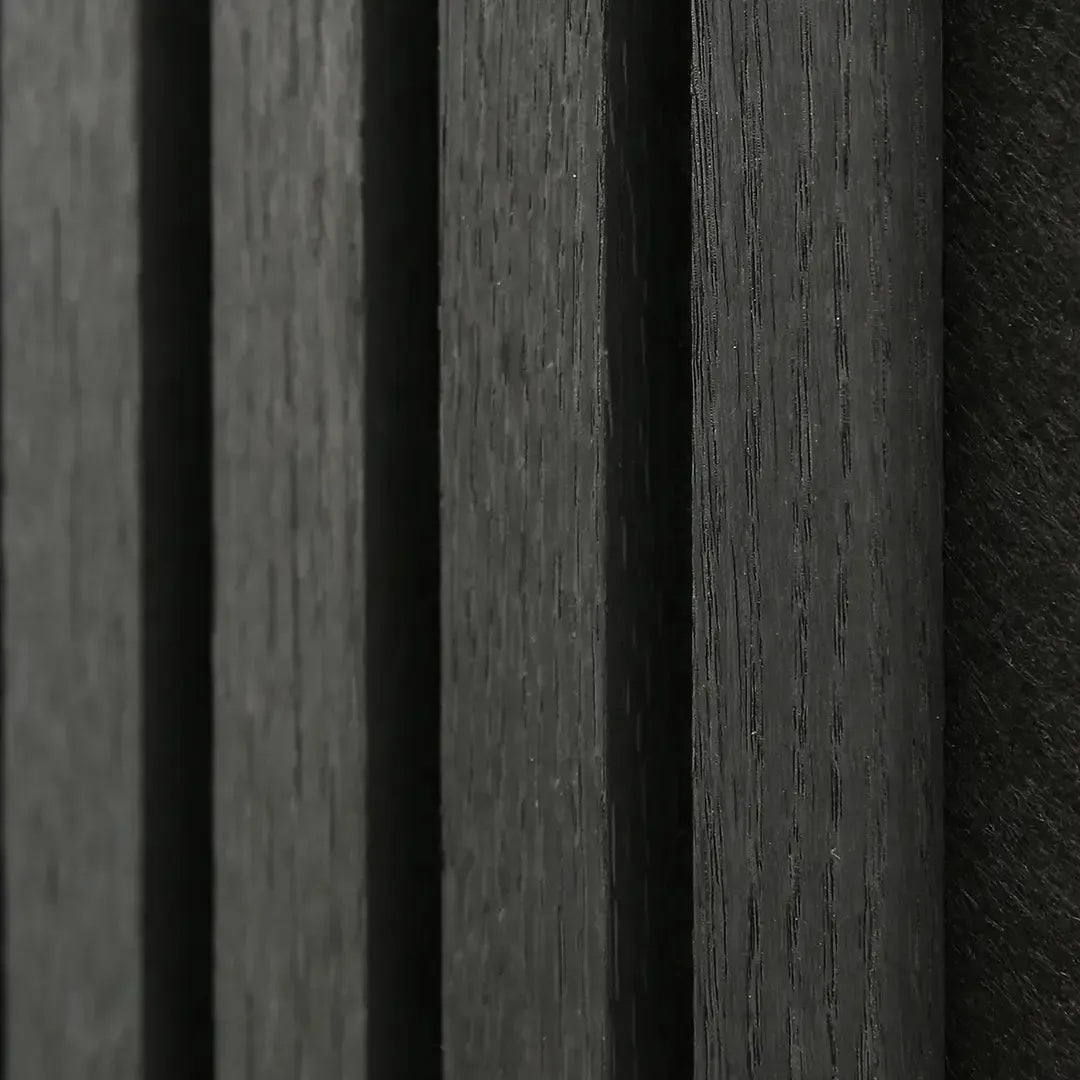
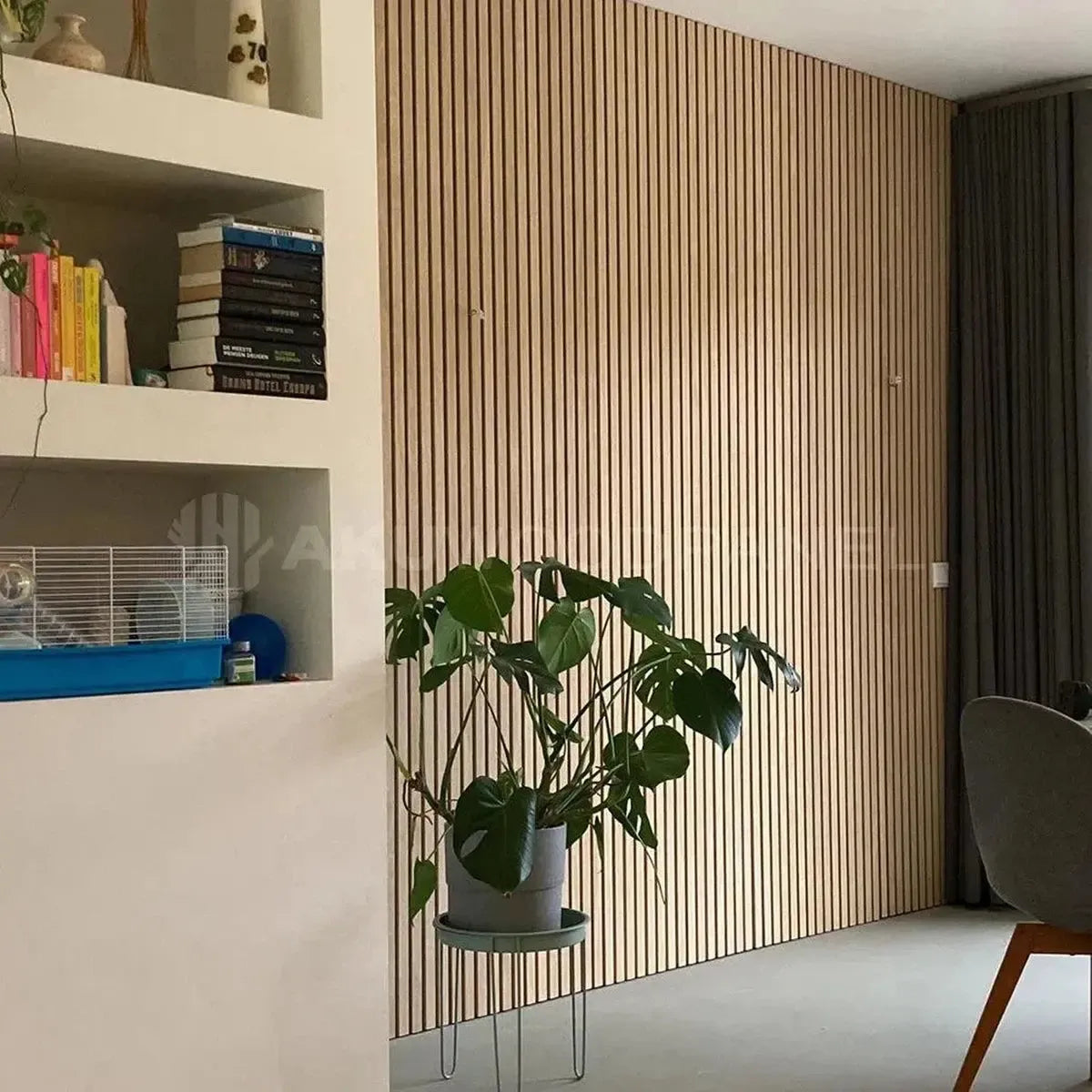
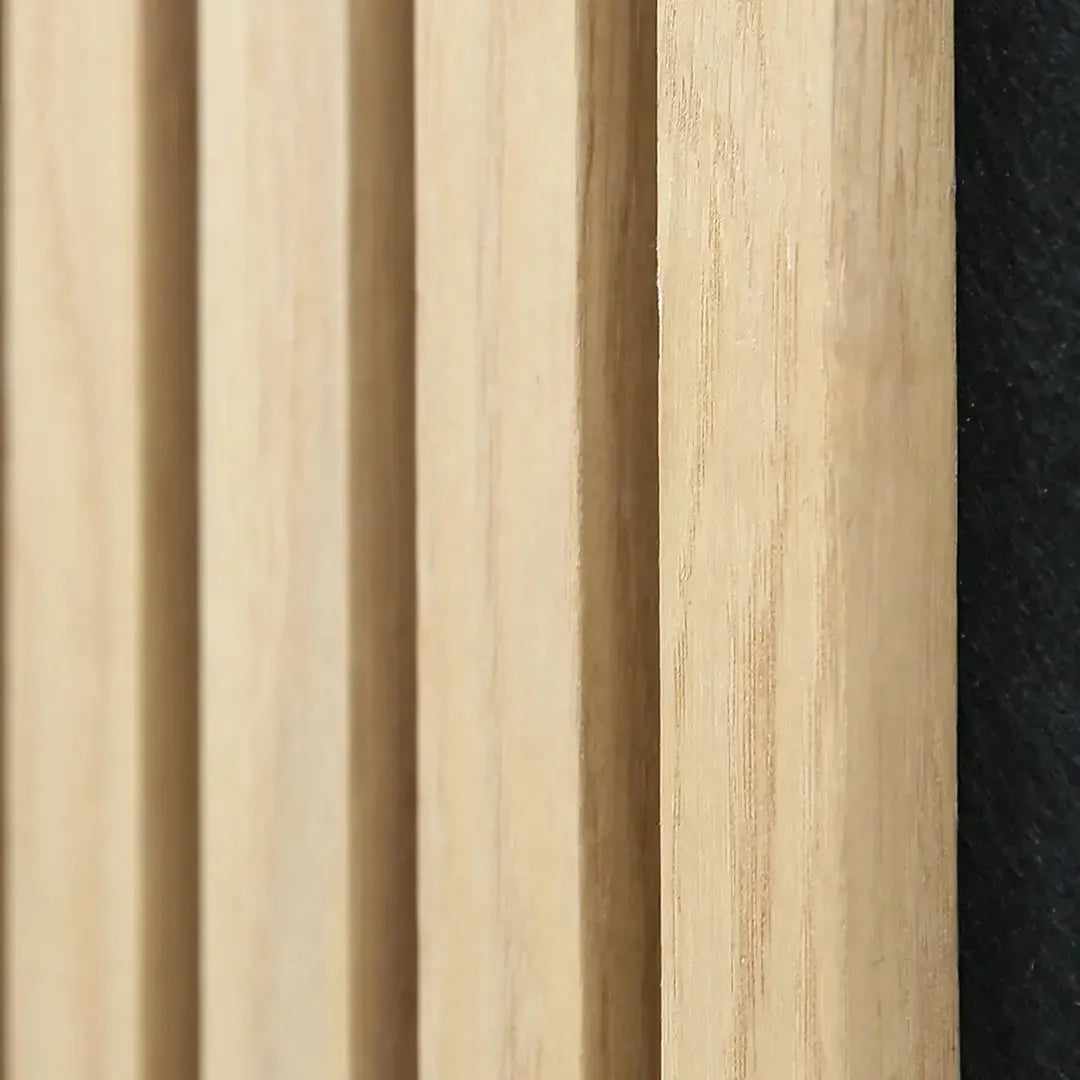
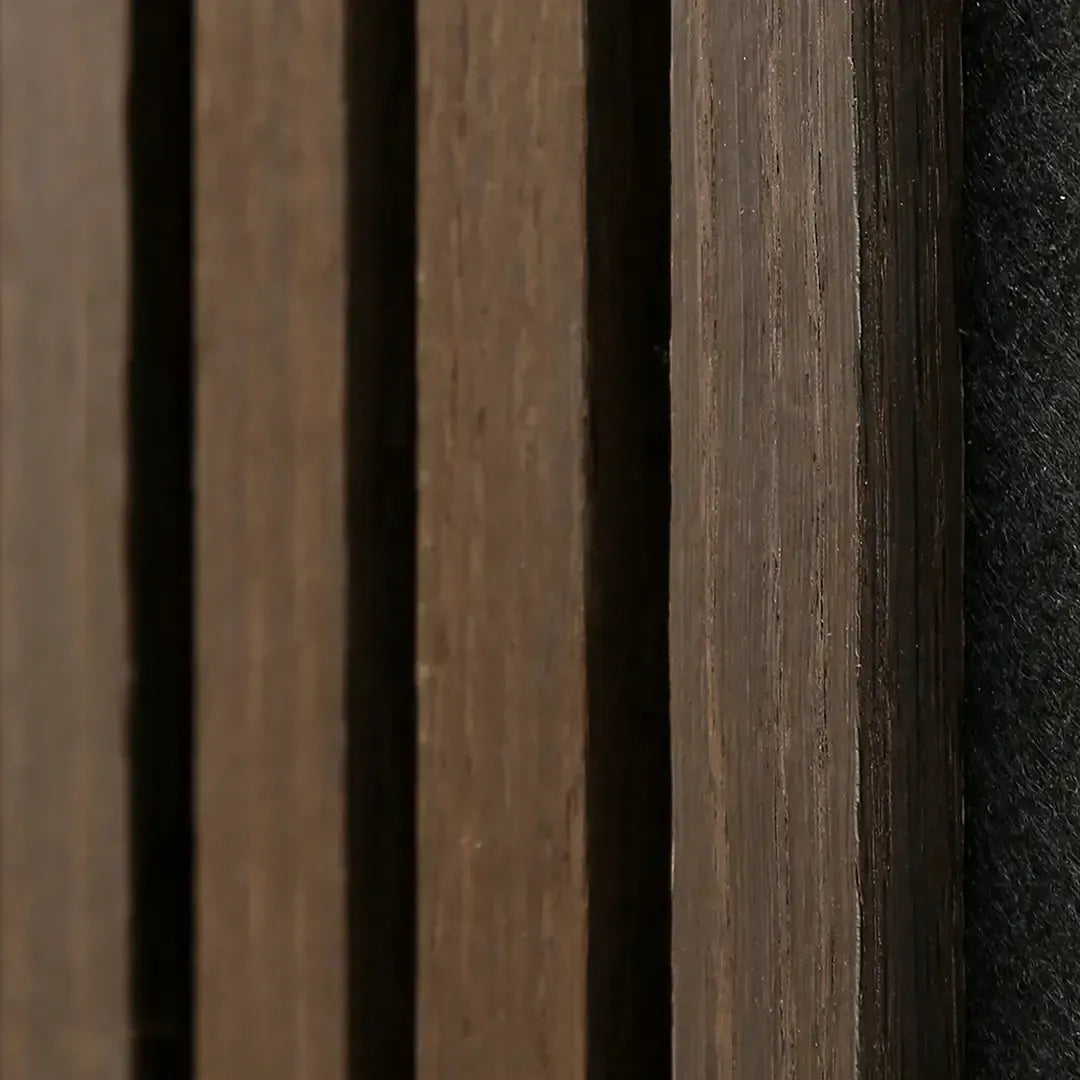
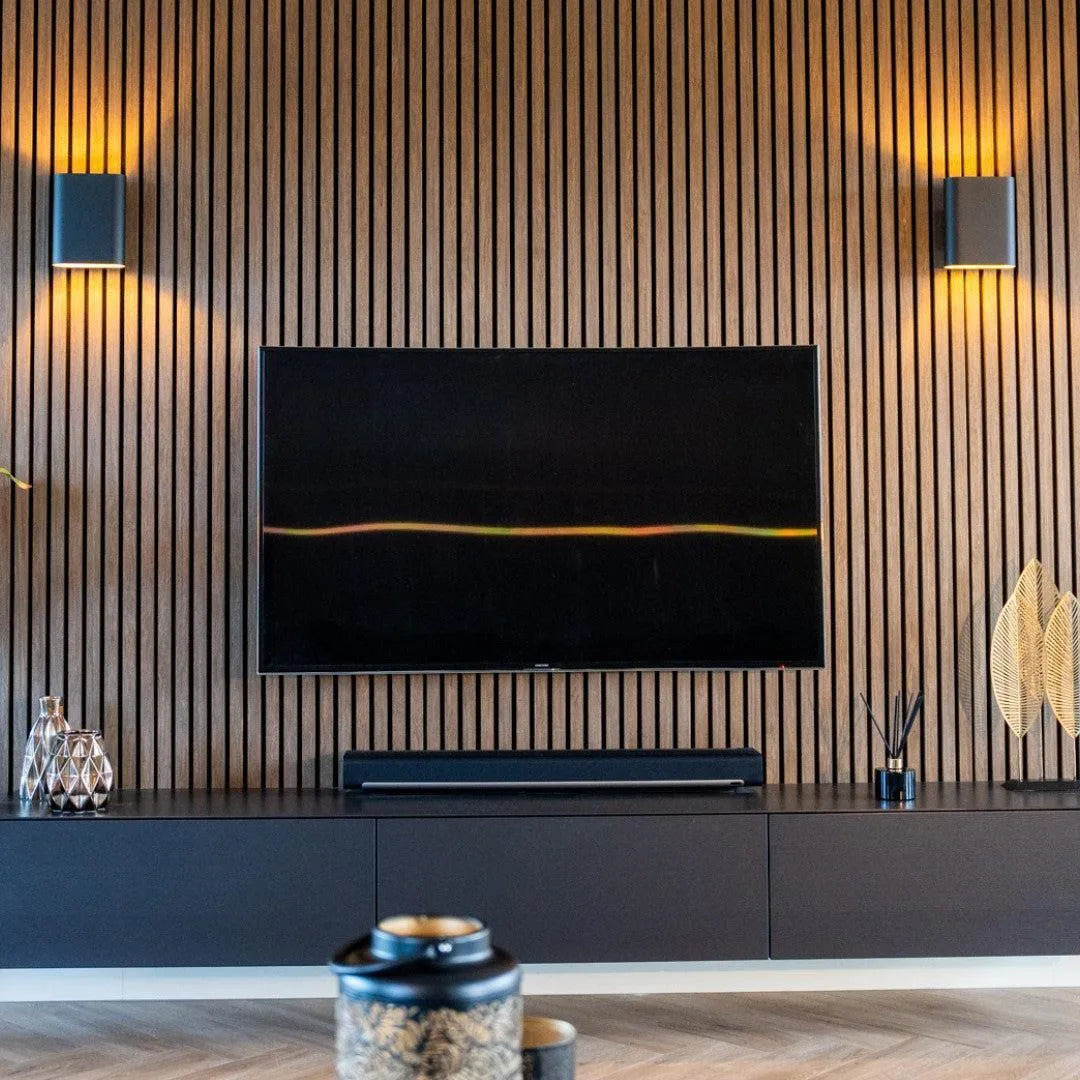
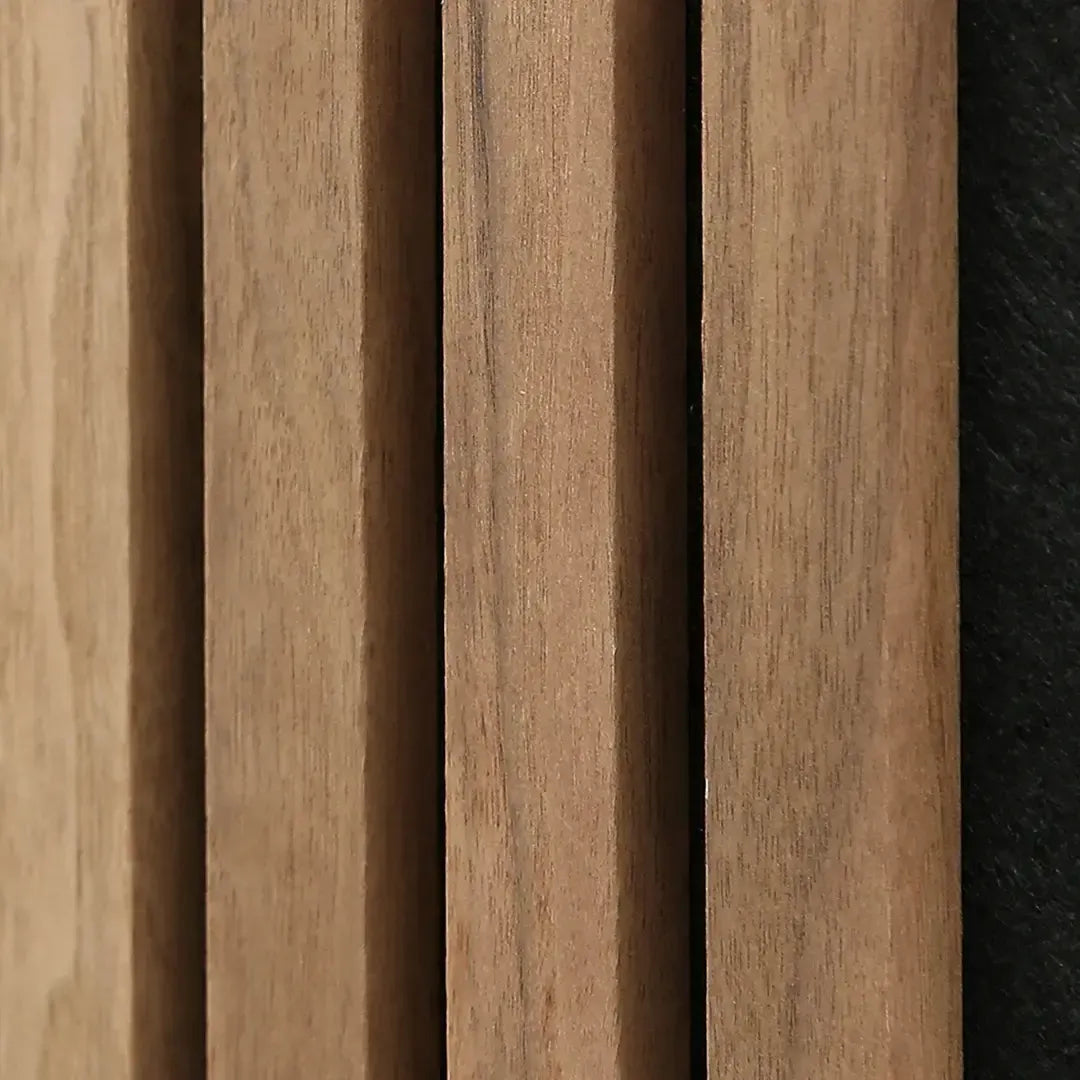
For a wood-slat finish, the Natural Oak acoustic slat wall panel is a catalog option to evaluate. Best for: projects seeking a natural-oak slat finish. Its named finish does not establish absorption performance, fire suitability, or an assembly STC; check the relevant documentation before specification.
Akustiq USA acoustic wood panels provide an interior-finish option. Their limitation in this workflow is equally important: the panel choice alone cannot verify between-room isolation.
Performance verification
- Inspect before handover. Check perimeter details, penetrations, doors, adjoining surfaces, and finish attachments against the approved drawings. Resolve departures while the installer can still correct them.
- Separate listening from testing. Repeat the original listening conditions to check whether the complaint remains. Keep the source position, doors, and room use consistent. This practical check identifies problems but does not produce a standardized rating.
- Arrange formal testing when required. Use a qualified acoustical professional for field airborne sound-isolation measurements. ASTM E336 addresses measurements in buildings; the reported field metric must match the project’s acceptance requirement.
- Close the documentation record. Retain drawings, approved substitutions, photographs, installation instructions, test reports, and defect corrections together. Identify the construction actually installed, not just the construction originally proposed.
Expected result: You can distinguish a documented assembly, an inspected installation, and a measured field result.
For a 2026 handover, do not write a higher STC into the record because the wall contains mineral wool. Laboratory results describe the tested specimen. Field results reflect the installed separation and the sound paths included in the measurement.
A phone recording, clap test, or consumer sound-meter reading is useful for observation only. None establishes STC.
Retrofit variant: treat echo without rebuilding the wall
If your main complaint is reverberation, an absorption retrofit is a different workflow. Keep the existing separating wall intact and design the room treatment around its surfaces and use. Do not describe the retrofit as an STC upgrade without transmission-test evidence.
Choose the route by the problem, not by whichever material is easiest to install.
| Workflow | Best for | Main advantage | Main limitation | Evidence to request |
|---|---|---|---|---|
| Insulated separating assembly | Airborne sound traveling between enclosed rooms | Addresses transmission through the wall construction | Requires coordinated construction and control of flanking paths | Complete assembly transmission report |
| Room-facing absorption treatment | Echo and reflected sound within a room | Can treat room acoustics without rebuilding the separation | Does not establish a higher wall STC | Absorption report with mounting details |
| Combined isolation and treatment | Rooms with both transmission and reverberation problems | Addresses the two problems separately | Requires separate specifications and verification | Transmission and absorption documentation |
For the absorption route, follow this sequence:
- Identify reflective areas. Consider the occupied positions, sound sources, and large hard surfaces. Keep circulation, ventilation, and access clear.
- Choose a documented treatment. Specify the panel and mounting arrangement together. If the design includes mineral wool behind the finish, use a suitable, documented configuration rather than an improvised exposed batt installation.
- Coordinate the mounting. Confirm substrate suitability, support, material containment, and fire requirements. Do not disturb a rated separation or conceal damp surfaces.
- Evaluate the room. Compare normal speech and room use before and after treatment. Use professional reverberation measurements where the project requires objective acceptance.
This route suits an existing room whose wall must remain intact. Its trade-off is clear: better room acoustics are not proof of better sound isolation.
Troubleshooting
Speech remains audible through the separation
Inspect doors, perimeter gaps, ducts, service penetrations, and ceiling paths before adding more panels. A sound path around the treated wall requires its own correction. Use a qualified acoustical professional when the route is unclear.
Mineral wool is present, but the rating is unverified
Obtain the complete assembly report and compare it with the installed construction. Insulation alone does not supply an STC value. If performance acceptance depends on the finished building, arrange the specified field measurement.
The finish bridges an isolated lining
Check whether panel screws, blocking, or supports connect the isolated lining to the structure behind it. Have the attachment detail reviewed and corrected before concealing it. Shorter screws are not an automatic fix unless they also provide adequate support.
The room still echoes after panel installation
Check the treatment area and whether the installation matches the absorption report’s mounting conditions. Review untreated ceilings and other reflective surfaces. Changing wood color is not a documented acoustic adjustment.
Bass or footsteps remain intrusive
Review the frequency content and transmission route separately. STC starts at 125 Hz, so it does not summarize lower-frequency bass, and airborne STC is not an impact-noise rating. More room absorption does not resolve every structural noise problem.
Customize your workflow
Expand the specification before expanding the treatment. A home office needs a different acceptance brief from a music room, even when both use mineral wool and wood panels.
- Speech privacy: Coordinate the wall with doors, glazing, ducts, and adjoining construction.
- Recording or listening: Address isolation and room response separately; include low-frequency assessment where relevant.
- Commercial interiors: Confirm acoustic, fire, electrical, accessibility, and maintenance requirements together.
Keep the 2026 project record organized under Assembly, Absorption, and Installation. Put each claim beside its supporting document. This prevents an absorption result from being copied into a sound-isolation specification.
FAQ
Does mineral wool behind acoustic panels increase STC?
Mineral wool behind acoustic panels does not establish an STC increase by itself. It can serve an absorption role, while a documented separating assembly determines the transmission rating.
What is the difference between STC and NRC?
STC classifies airborne sound transmission through a tested assembly; NRC summarizes sound absorption. Use STC evidence for separation between rooms and NRC evidence for room-facing treatment.
Can I add the mineral wool rating to the acoustic panel rating?
No, you cannot add material ratings to calculate a wall’s STC. Use transmission measurements for the complete construction, including its framing, boards, insulation, and mounting details.
What thickness of mineral wool should I use?
Use the mineral wool thickness specified for the selected assembly or documented absorption configuration. Do not choose thickness independently of cavity depth, product instructions, and the tested construction.
Are Akustiq USA acoustic wood panels a soundproof wall?
Akustiq USA acoustic wood panels are not evidence of a soundproof wall. Specify the separating construction independently and request relevant absorption documentation for the panel installation.
Can I check STC with my phone?
A phone recording or sound-meter app cannot establish STC. Standardized transmission measurements and classification require an appropriate test procedure and equipment.
Why can I still hear bass after adding acoustic panels?
Room-facing acoustic panels do not necessarily address the path carrying bass into another room. STC excludes frequencies below 125 Hz, so low-frequency isolation needs separate assessment.
One last thing
The most useful photograph is the wall before it closes. Once the finish is installed, you cannot visually confirm insulation coverage, concealed connections, or many penetration details.
Make pre-close inspection a project hold point. Check the construction against the approved assembly, photograph it, and resolve defects before adding the visible finish.


 Better performance and aesthetic appeal
 In Stock