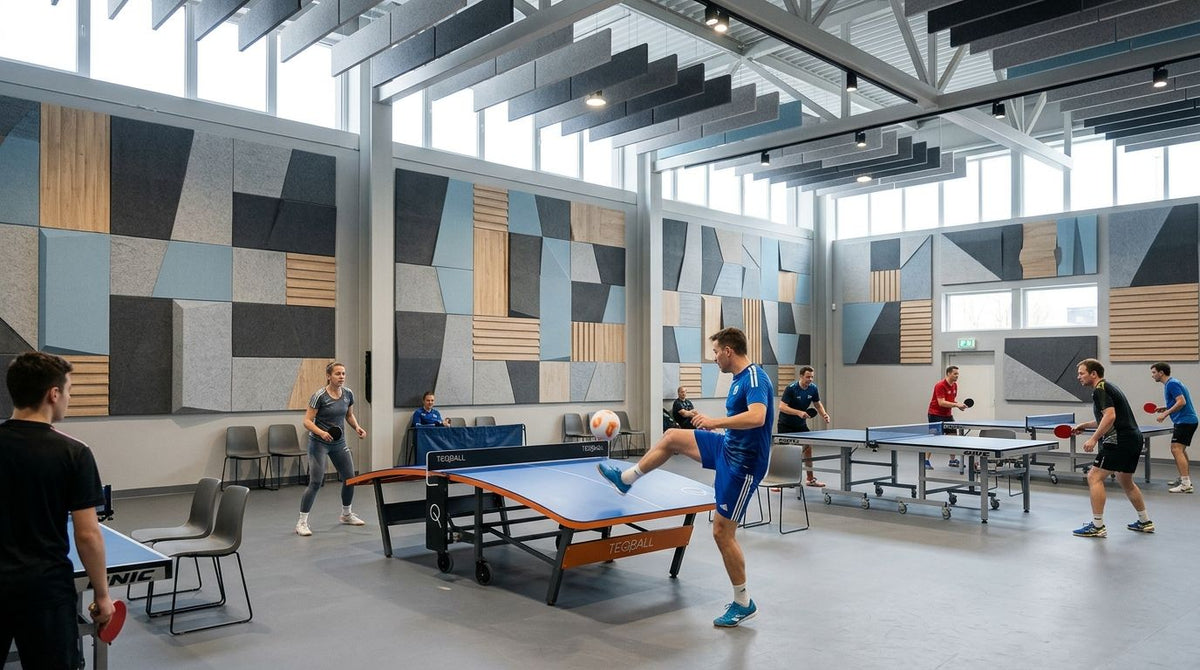
Acoustic panels for table tennis club halls solve one specific problem: hard floors, block walls, and high ceilings turn every rally into an echo chamber. Teqball venues share the exact same physics — a harder ball, a metal-frame table, and the same reverberant shell — so the fix is identical whether your members are playing ping pong or teqball.
- Hexagon Acoustic Panel Natural Oak carries an NRC 0.75 rating — install it on side and end walls facing the tables.
- Acoustic panels for a table tennis club work best on the walls players face, not the walls behind spectator seating.
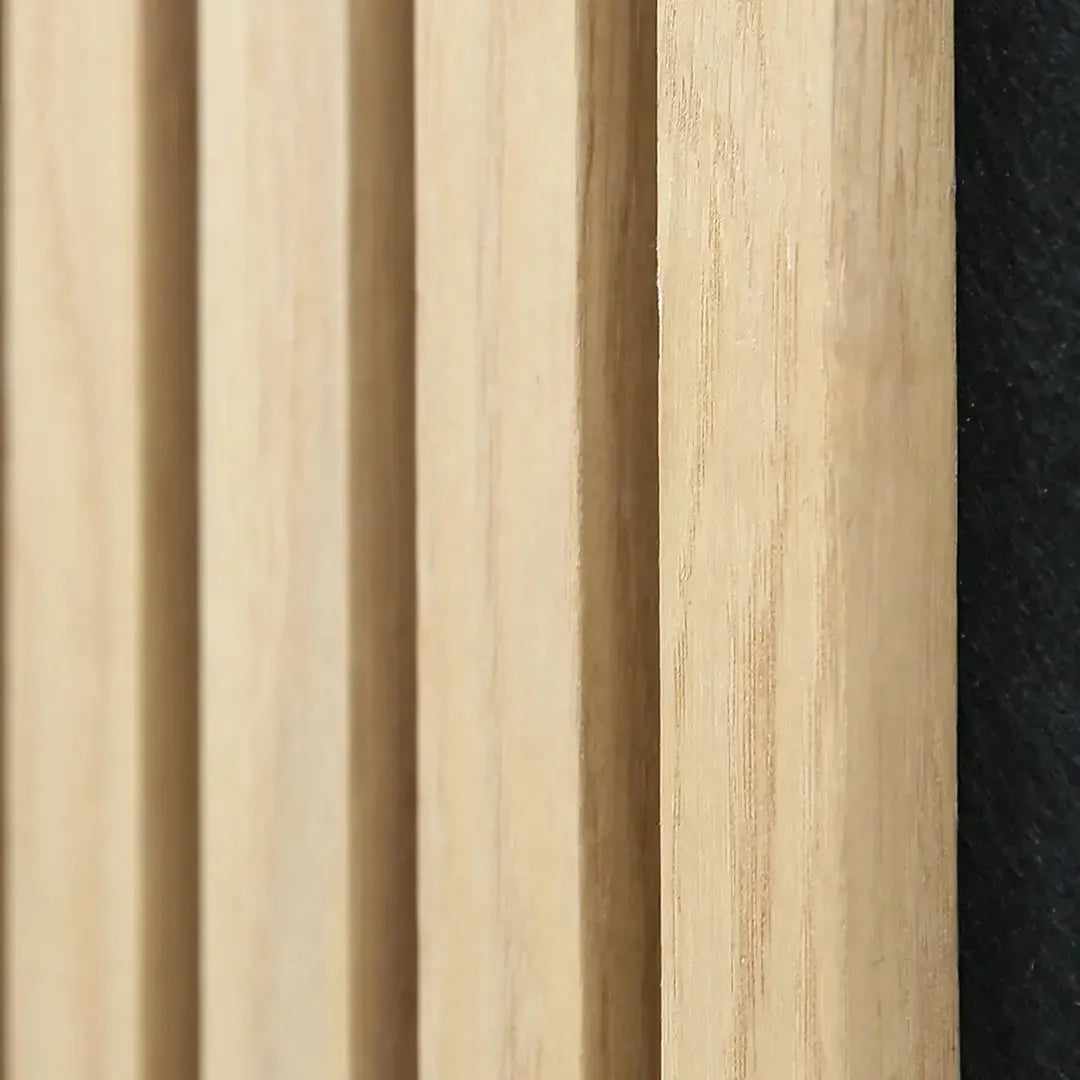
- A Full Sample Box lets a club test finishes before committing to a full-hall order in 2026.
- Fluted panels look sharp but carry less acoustic mass than slat or hexagon panels — treat them as accent, not primary treatment.
Why acoustic panels matter for table tennis and teqball clubs
Most table tennis and teqball halls get built cheap: painted block or drywall, concrete or sprung-vinyl floor, and a ceiling 16 to 24 feet up. None of that absorbs sound. The result is a room where the crack of a teqball off the table, the squeak of shoes, and a coach shouting instructions all bounce two or three times before they die out.
Players lose the ability to judge ball speed by ear — a real skill in competitive teqball and table tennis, where the sound of contact tells you spin and pace half a second before your eyes confirm it. The same complaint shows up at nearly every multi-court facility: members can't hear a rally two courts over, and coaches lose their voice by the third session of the day. Akuwood Panel builds wood acoustic panels for rooms with this profile — hard surfaces, tall ceilings, high foot traffic — rather than the softer residential rooms most acoustic panel lines target.
A well-planned acoustic treatment doesn't need to cover every wall. It needs to hit the surfaces that reflect sound directly back into the play area, which is a narrower target than most clubs assume going into their first quote in 2026.
How to plan acoustic treatment for your hall
Identify where the sound actually bounces
Walk the hall during peak hours and note where sound hits hardest — usually the end walls behind each table and any wall directly opposite a run of courts.
- Stand at the baseline of each table and clap once; listen for the slap-back
- Flag any wall within 15 feet of a table as a direct-reflection surface
- Note ceiling height at each court — taller ceilings need wider coverage, not just wall panels
- Mark walls carrying HVAC or lighting fixtures, since panels need clearance around those
Prioritize player-facing walls over spectator walls
A club with a fixed acoustic budget should treat the walls players stare at mid-rally before it treats the entrance lobby or the spectator bleachers.
- End walls behind each table take priority — that's where ball-strike echo returns fastest
- Side walls between adjacent courts come second, since cross-court noise bleed is the most common member complaint
- Reception and lobby walls come last unless noise there interferes with front-desk phone calls
- Skip ceiling treatment on the first pass unless the room exceeds 20-foot clear height
Choose a panel type rated for high-traffic sports facilities
A table tennis or teqball hall runs longer hours and takes more incidental contact than a living room, so the panel needs real wood veneer and a mounting system built for repeat use, not a decorative foam tile.
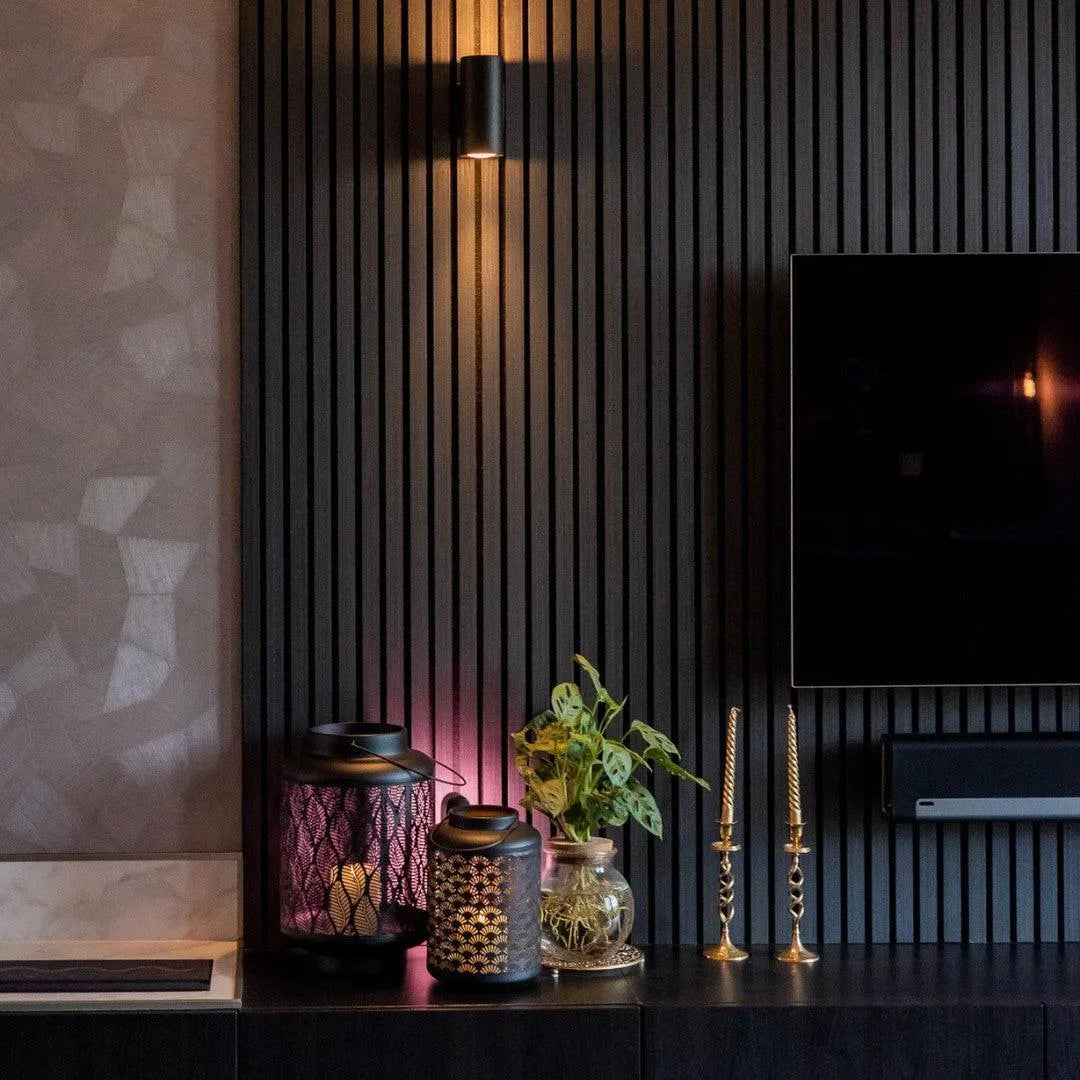
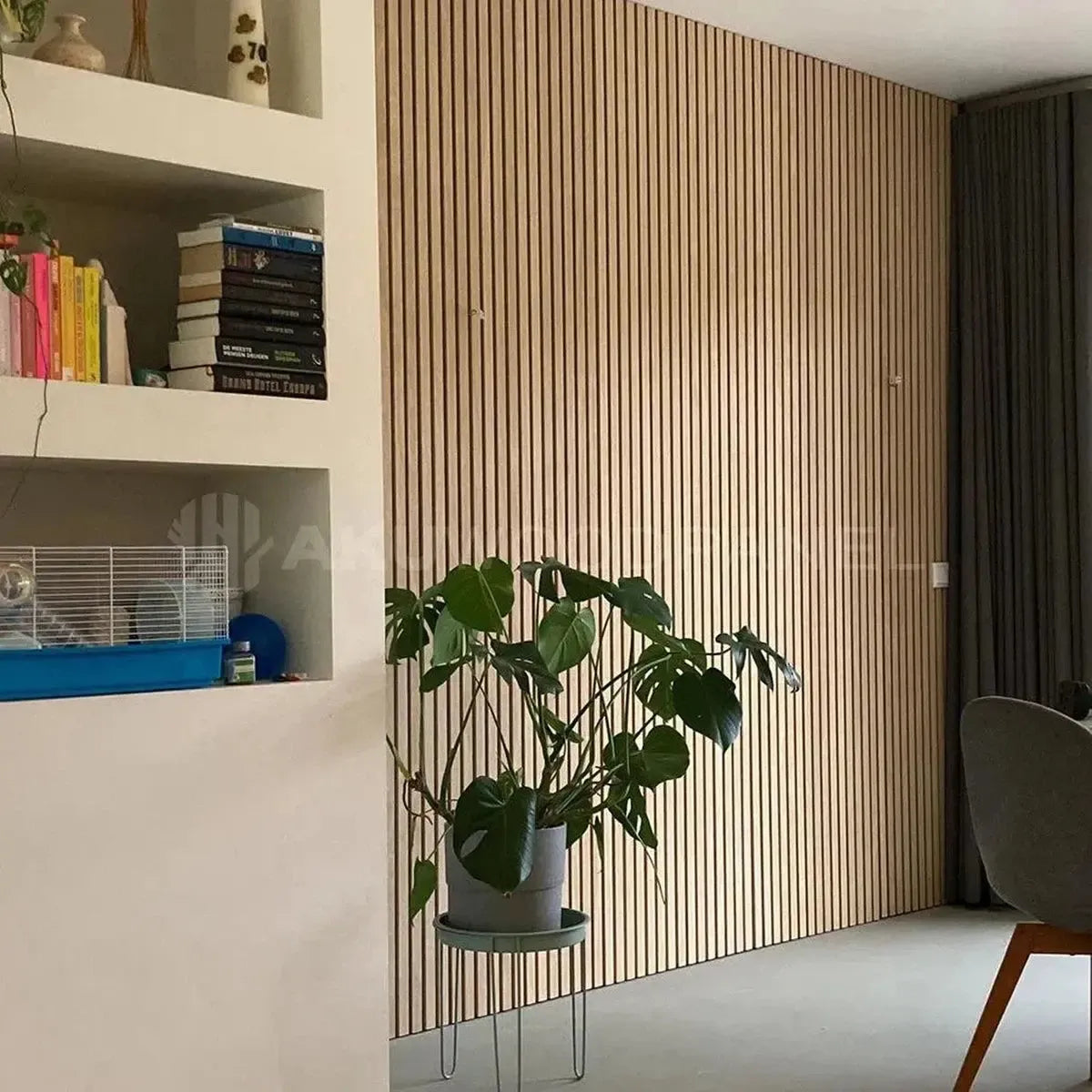
- Acoustic slat wall panels give continuous coverage across long, flat walls — the standard choice for full end-wall treatment
- Hexagon acoustic panels break coverage into a repeating pattern that reads as wall art while still absorbing sound; the Hexagon Acoustic Panel Natural Oak carries an NRC 0.75 rating
- Fluted wall panels add texture with less acoustic mass — good for accent zones near a lobby, not a primary treatment wall
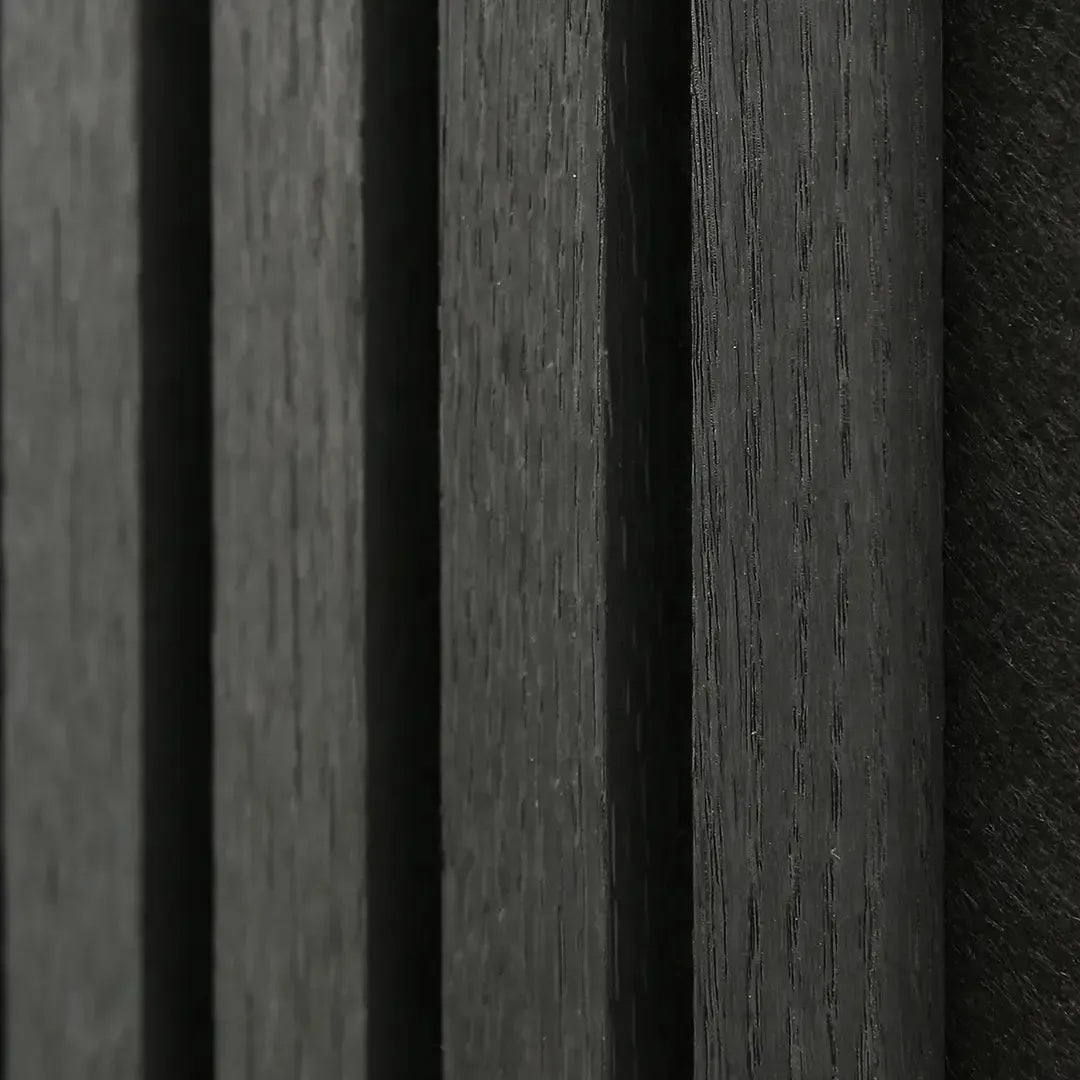
- A felt-backed slat option adds an extra absorption layer where the base wall is solid block
Calculate coverage before you order
Skipping this step is the single most common reason clubs run short mid-install or over-order and eat the difference.
- Measure total square footage of every wall flagged as a direct-reflection surface
- Subtract door, window, and fixture area from that total
- Add 5-10% for cut waste around outlets, trim, and corners
- Confirm panel dimensions per box against your measured wall run before ordering the full quantity
Install away from ball-strike zones
Mounting hardware and finished veneer both take damage from direct ball contact, so keep panels clear of the strike zone even on a treated wall.
- Hold the lowest panel row at least 3 feet above finished floor on any wall within active play range
- Use end-piece trim on exposed edges to prevent chipping from stray balls or rolling equipment
- Avoid mounting directly behind a table's exact center line where mis-hits land most often
- Reinforce mounting on walls shared with equipment storage or ball machines
Add trim for a clean finish
A hall used by the public daily needs finished edges, not raw panel cuts, or the install looks unfinished within a season.
- End pieces close off exposed slat edges at doorways and corners
- Corner trim wraps panels cleanly around columns and door frames
- Matching finish trim keeps color continuity across adjoining walls
- Plan trim quantity alongside panel quantity, not as an afterthought
Budget for a phased rollout across multiple courts
Multi-court facilities rarely treat every hall at once — phase the work by court usage and reassess after the first phase settles.
- Treat the highest-traffic court first and judge the difference before committing further budget
- Stagger installs around your competition and league schedule to avoid closing courts during peak season
- Reorder the same finish for later phases to keep wall continuity across the facility
- Revisit ceiling treatment only after wall coverage is complete and reflection is still an issue
Comparing panel options for a table tennis or teqball hall
| Option | Best for | Key limitation |
|---|---|---|
| Acoustic slat wall panels | Full-wall coverage on long end walls | Needs a flat, continuous run to look intentional |
| Hexagon acoustic panels | Accent zones and side walls near the play area | Pattern install takes more layout planning than a straight slat run |
| Fluted wall panels | Lobby and non-strike accent walls | Lower acoustic mass than slat or hexagon for direct reflection control |
| Full Sample Box | Testing finish and grain before a full-hall order | Covers finish choice only, not coverage planning |
Verdict: for a table tennis or teqball club, Akuwood Panel's hexagon and slat acoustic panels are the right fit on player-facing walls, and fluted panels belong in the lobby.


Common mistakes table tennis and teqball clubs make
- Treating only the show wall. The wall behind the main court gets panels for looks while the end walls behind the other tables — the ones actually causing echo — stay bare.
- Choosing decorative-only panels for a hard-floored hall. A fluted panel with low acoustic mass on a concrete-block wall barely moves the reverberation needle in a room this hard.
- Mounting into the strike zone. Panels installed at table height near an active court take repeated ball hits and chip within a season.
- Skipping the coverage calculation. Clubs that eyeball square footage instead of measuring run short mid-install and end up with a mismatched second order.
- Ignoring public-facility fire ratings. A hall open to paying members and league play needs panels that meet the same fire-rating standard as any other public commercial space, not a residential-grade product.
FAQ
What's the best acoustic panel for a table tennis club?
For direct-reflection walls behind and beside the tables, a slat or hexagon wood acoustic panel with a rated NRC value performs best — the Hexagon Acoustic Panel Natural Oak carries an NRC 0.75 rating. Fluted panels work better as accent treatment away from the play area.
Do teqball halls need different acoustic treatment than table tennis clubs?
No. Teqball and table tennis halls share the same construction profile — hard floors, block walls, high ceilings — so the same panel placement strategy applies to both. Teqball's harder ball contact makes mounting height and edge trim more important.
How much wall coverage does an indoor table tennis hall need?
Coverage depends on how many walls sit within 15 feet of a table, not total room square footage. Measure every direct-reflection wall, subtract doors and fixtures, then add 5-10% for cut waste before ordering.
Is NRC rating important for sports hall acoustic panels?
Yes. NRC (Noise Reduction Coefficient) tells you how much sound a panel absorbs versus reflects. A panel with a stated value, like 0.75, gives a club a real benchmark instead of a marketing claim.
Can wood acoustic panels handle ball impacts in a sports hall?
Wood veneer panels hold up fine outside the direct strike zone, but mounting at table height within active play range risks chips and hardware damage over a season. Keep the lowest panel row at least 3 feet above the floor near active courts.
Should a club order a sample box before a full hall order?
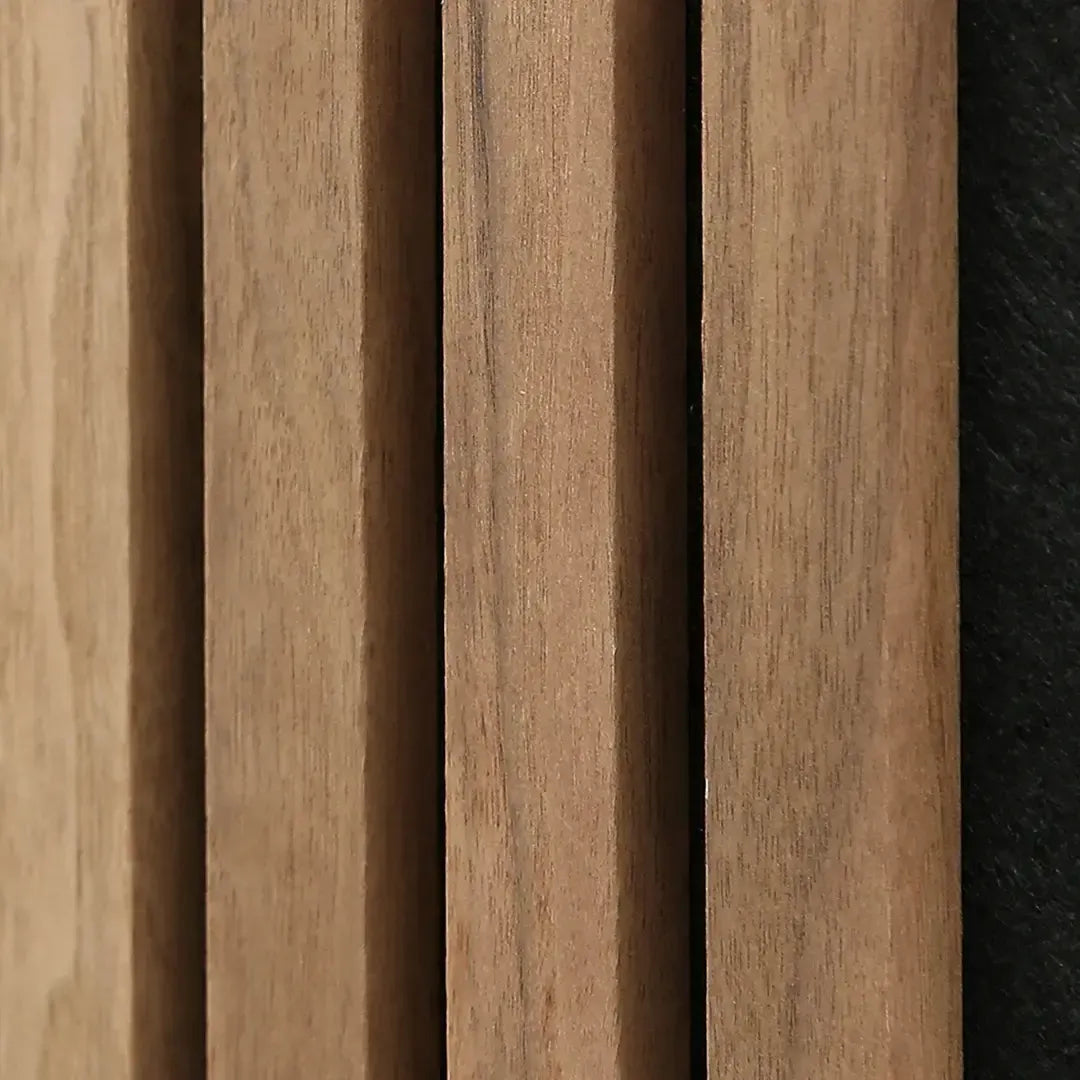
Yes. A sample box lets a facility manager compare finish and grain under the hall's actual lighting before ordering enough panels to cover multiple courts. It avoids a costly reorder if the finish reads differently at scale.
How do acoustic panels help players during a match?
Panels cut the slap-back echo that delays and distorts the sound of ball contact, which players use to judge spin and pace in real time. Reducing that echo also makes coaching instructions audible across a multi-court facility.
Are wood acoustic panels better than foam for a club setting?
Wood veneer panels hold up to daily public use and repeated cleaning better than foam, which compresses and discolors under high foot traffic. Foam is cheaper per square foot but degrades faster in a facility running long hours seven days a week.
One last thing
Most clubs treat every wall in the hall the same way and over-buy as a result. The walls that matter are the ones within roughly 15 feet of a table — treat those first, judge the difference in playability, then expand instead of committing a full facility budget to one order in 2026.

 Better performance and aesthetic appeal
 In Stock