


Best overall for a wood-finish echo treatment: Natural Oak acoustic slat panels. Best for a geometric feature wall: Black hexagon acoustic panels. Best for blocking neighboring noise: a tested sound-isolating wall assembly, not decorative panels alone. This 2026 guide separates soundproof wall panels from sound-absorbing treatments so you choose the right solution for your room.
- Soundproof wall panels must address sound transmission; acoustic wall panels primarily address reflections inside your room.
- Akustiq USA Natural Oak acoustic slat panels suit homeowners who want wood-finish acoustic treatment.
- Black hexagon acoustic panels list NRC 0.75, an absorption rating, not a sound-blocking score.
- Choose a tested wall assembly for neighboring voices, and acoustic treatment for room echo.
Why this matters
An echoey living room and a bedroom disturbed by neighboring voices need different work. Absorptive panels treat reflected sound inside a room. Sound isolation addresses sound traveling through walls, doors, ceilings, and other paths.
Buying absorption when you need isolation leaves the main problem untreated. Start with that distinction before choosing a finish, mounting method, or panel layout. The guide to whether acoustic wood panels reduce noise or add texture provides a useful next read.
For your 2026 project, describe the problem in plain language: conversations sound harsh inside the room, or conversations travel into it. That description determines which recommendation below belongs on your shortlist.
What makes the best soundproof wall panels?
Judge the solution against your actual complaint, not the word acoustic on a product listing. These criteria keep decorative treatment and construction work in their proper roles:
- Correct function: Choose absorption for room reflections and a sound-isolating assembly for sound transmission.
- Relevant evidence: Use absorption data for acoustic treatment and transmission-loss testing for isolation.
- Installation match: Compare the tested mounting arrangement with the installation you intend to build.
- Useful coverage: Plan exposed treatment around the room layout rather than squeezing panels behind furniture.
- Finish and format: Choose linear slats or geometric panels according to the wall design you want.
- Complete project scope: Include edges, electrical details, fastening, and any required construction work before ordering.
An attractive finish earns a place in the decision, but it cannot substitute for acoustic evidence. Likewise, a strong absorption rating cannot establish how much neighboring speech a finished wall will block.
Soundproof wall panel options at a glance
The order below follows distinct needs, not a claimed laboratory performance ranking. The decorative products are acoustic treatments; the construction option addresses a different job.
| Option | Best for | Standout feature | Key limitation |
|---|---|---|---|
| Natural Oak acoustic slat wall panel | A continuous wood-finish acoustic feature wall | 3-sided wood veneer | Decorative acoustic treatment is not proof of sound isolation |
| Black hexagon acoustic panel | A geometric acoustic wall composition | Listed NRC 0.75; 32-inch format; 4 panels per box | NRC does not rate sound transmission through a wall |
| Tested sound-isolating wall assembly | Reducing airborne sound between rooms | Addresses the wall construction and its connections | Requires construction planning, not simply surface decoration |
1. Natural Oak slat panels: best for a wood-finish acoustic wall
The Natural Oak acoustic slat panel combines a linear wood appearance with an acoustic wall-panel format. Its product specification identifies 3-sided wood veneer, giving you a concrete material detail to compare rather than relying on a room photograph.
Akustiq USA acoustic slat panels are best for homeowners who want wood-finish acoustic treatment, not a standalone barrier against neighboring noise. Choose this option when the room itself sounds reflective and a continuous slatted feature wall fits your design.
Natural Oak acoustic slat panel pros
- The linear format suits a continuous feature-wall composition.
- The specified wood veneer gives you a defined material finish to assess.
- The wood surface serves a decorative purpose alongside the acoustic-treatment role.
- A named Natural Oak sample lets you assess the finish before committing to the wall.
Natural Oak acoustic slat panel cons
- Surface acoustic treatment does not establish the sound isolation of the underlying wall.
- Veneer coverage does not tell you the panel's absorption performance.
- Cuts, exposed edges, and interruptions need planning before installation.
For a living room, begin with the surfaces around the seating and listening area. Keep the proposed treatment visible and exposed rather than covering it with a large cabinet. For a home office, consider the room surfaces around your speaking position and microphone, not only the background visible on camera.
Ask for acoustic documentation that matches your intended mounting arrangement. A result from an installation with a cavity or additional absorptive material does not automatically describe a panel attached directly to an existing wall.
Best for: A living room or home office where acoustic treatment must also work as a wood feature wall.
Verdict: Buy for the wood-finish acoustic-treatment role; skip as the sole answer to noise through a shared wall.
2. Black hexagon panels: best for a geometric acoustic feature
The Black hexagon acoustic panel gives you a geometric alternative to continuous slats. The product title specifies a 32-inch format and 4 panels per box, while the description lists an NRC value of 0.75.
NRC describes sound absorption under test conditions. NRC 0.75 is not a promise that neighboring noise will fall by 75%. It does not describe the transmission performance of your existing wall.
Black hexagon acoustic panel pros
- The hexagon shape supports a geometric composition rather than a striped wall.
- The listed NRC provides an absorption metric to investigate.
- The wood veneer finish offers an alternative to a plain fabric appearance.
- The stated box quantity helps you begin a layout plan.
Black hexagon acoustic panel cons
- An NRC value cannot establish privacy between adjoining rooms.
- Separated decorative clusters leave untreated wall between panels.
- The shape requires careful layout around outlets, corners, and wall edges.
For a 2026 gaming-room or media-room project, sketch the arrangement before ordering. Mark the display, desk, speakers, and furniture on the same drawing. A composition that looks balanced on an empty wall can become partly hidden after the room is furnished.
The 32-inch product format is a planning reference, not a reason to assume square coverage. Confirm the exact dimensional drawing and usable coverage before calculating quantities, particularly when arranging hexagons with deliberate gaps.
Choose Black hexagon panels because you want a geometric acoustic treatment. Do not choose the shape on the assumption that hexagons block sound better than slats; shape alone does not establish that comparison.
Best for: A gaming room, media room, or creative workspace where geometric wall decor is part of the brief.
Verdict: Buy for geometric sound absorption; skip for a guaranteed reduction in noise from the next room.
3. Tested wall assemblies: best for blocking neighboring voices
A sound-isolating wall assembly addresses the construction separating spaces. Depending on the design, it combines appropriate wall layers, cavity absorption, structural separation, and sealed connections rather than relying on an exposed decorative surface.
This is the relevant category when your complaint is speech traveling through a partition. Select the complete tested assembly, not an isolated ingredient with an impressive-sounding description.
Tested sound-isolating wall assembly pros
- Addresses airborne sound transmission rather than only room reflections.
- Allows the wall layers and connections to be specified together.
- Gives contractors a defined construction detail to follow.
- Can accommodate a decorative finish after the isolation work is designed.
Tested sound-isolating wall assembly cons
- Requires more construction involvement than surface-mounted acoustic treatment.
- Doors, ducts, floors, and adjoining structures can remain transmission paths.
- Laboratory performance does not guarantee the same result in a finished building.
Sound Transmission Class, or STC, summarizes airborne sound-isolation performance using standardized testing and classification. ASTM E90 concerns laboratory transmission-loss measurement; ASTM E413 concerns the classification used to derive ratings such as STC. Neither makes an absorption rating interchangeable with an isolation rating.
For a 2026 bedroom renovation, identify the dominant path before changing the wall. Sound entering around a door will not be solved by treating a separate wall surface. Footfall and structure-borne vibration also need a different investigation from ordinary airborne speech.
Ask a qualified contractor or acoustical consultant to connect the proposed assembly to the actual building conditions. Decorative panels can follow, but they should not dictate a construction detail intended to provide isolation.
Best for: A bedroom, meeting room, or adjoining workspace where reducing airborne sound transfer is the main requirement.
Verdict: Buy the assembly approach for isolation; wait on decorative panels until the sound path is understood.
Plan the installation before choosing the finish
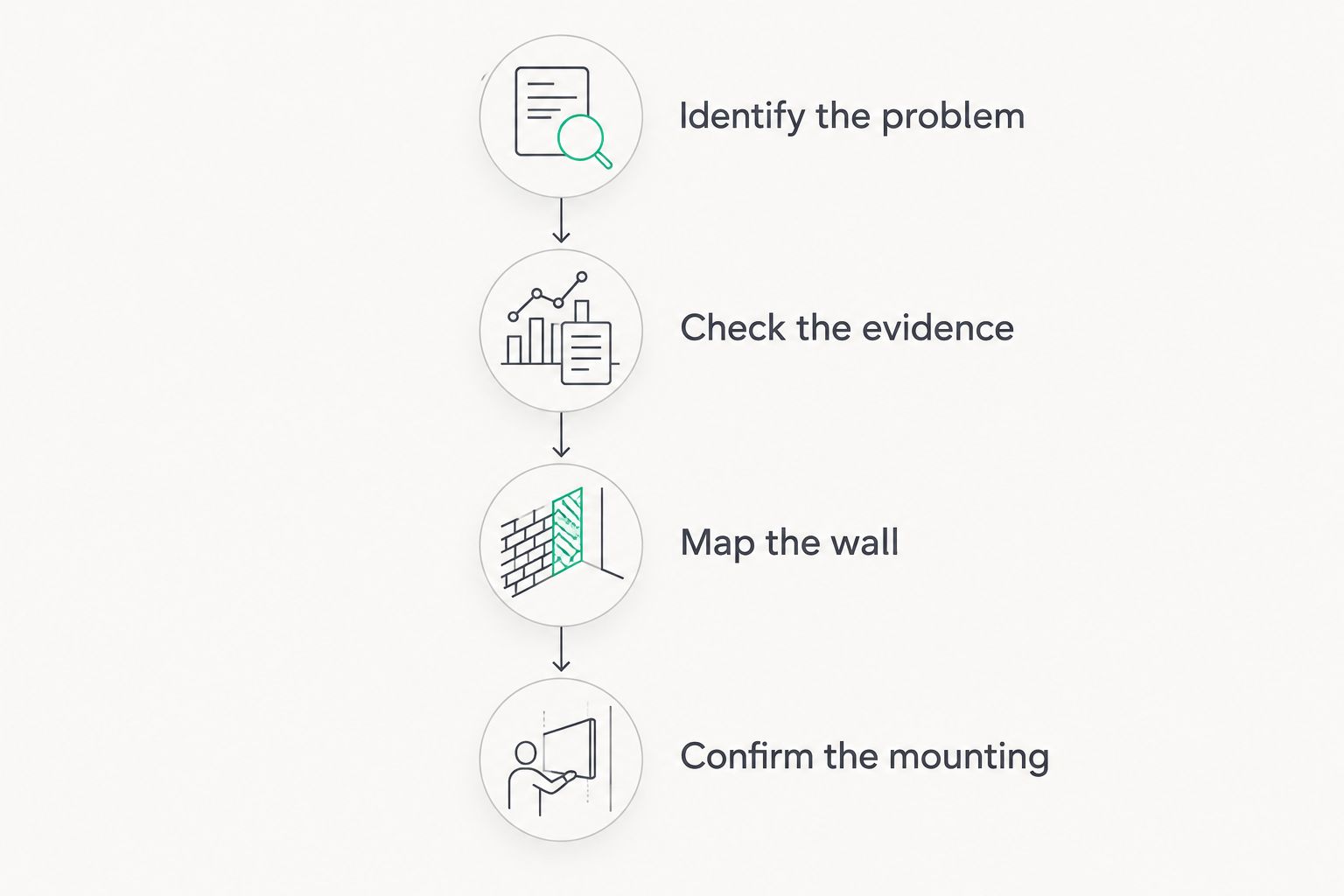
A useful panel plan starts with the complaint and ends with a mounting detail. Follow this sequence before turning a visual preference into an order:
- Identify the problem: Separate room echo from sound entering or leaving the space.
- Check the evidence: Match absorption or transmission documentation to that problem.
- Map the wall: Record furniture, openings, outlets, and exposed treatment areas.
- Confirm the mounting: Check the substrate, fastening method, edges, and tested arrangement.
The sequence matters because installation affects both the finished appearance and acoustic behavior. A panel selected for its photograph still needs a workable mounting plan.
For commercial work, confirm the required fire documentation and installation requirements for the actual project. A decorative panel description does not establish approval for every occupancy or location.
For rented rooms, agree on fixing methods before installation. Do not assume an adhesive or removable mounting method will leave the wall undamaged, and do not substitute a different mounting method without checking its suitability.
Compare the decorative acoustic options
Akustiq USA offers both slat and hexagon acoustic panels. Use the cards below to compare the exact products discussed here, then check samples and installation details before choosing your finish.


How these recommendations are ranked
This 2026 shortlist ranks suitability for distinct jobs: a continuous wood feature wall, a geometric acoustic composition, and airborne sound isolation. It does not rank veneer colors as though they establish acoustic performance.
Natural Oak slats take the default decorative-treatment position because the linear format suits a continuous wood wall. Black hexagons take the geometric-design position. A tested wall assembly takes the isolation position because construction, not surface styling, determines that specification.
The comparison uses the stated product formats and specifications alongside established distinctions between absorption and isolation. No room-specific sound reduction is assigned to either decorative product.
Which soundproof wall panels should you choose?
Choose Natural Oak slat panels if your priority is a wood-finish acoustic feature wall. Choose Black hexagon panels if you want a geometric treatment. Choose a tested wall assembly if neighboring sound is the problem. These are separate decisions, not interchangeable upgrades.
For an undecided homeowner, resolve the acoustic function first. If you need both isolation and a decorative acoustic finish, plan the isolation work before the visible panel layer. Akustiq USA acoustic wall panels belong in the finish-and-treatment decision, not as a substitute for a sound-isolation design.
FAQ
What's the best type of soundproof wall panel for noisy neighbors?
A tested sound-isolating wall assembly is the appropriate starting point for neighboring airborne noise. Decorative acoustic panels primarily treat reflections inside your room, so investigate walls, doors, and other transmission paths first.
Do acoustic wood panels actually soundproof a room?
Acoustic wood panels are not a standalone soundproofing system. They serve an acoustic-treatment role, while sound isolation depends on the complete room construction and its openings.
Is NRC 0.75 the same as blocking 75% of noise?
No, NRC 0.75 is an absorption rating, not a percentage reduction in sound transmitted through a wall. The Black hexagon acoustic panel lists that NRC value, but it does not establish the isolation of your room.
Are slat panels better than hexagon acoustic panels?
Neither shape is automatically better acoustically. Choose Natural Oak slats for a linear feature wall and Black hexagons for a geometric composition, then compare acoustic documentation for the intended mounting arrangement.
Can I put acoustic panels behind my couch?
Yes, provided the mounting is suitable and the treatment remains exposed to room sound. A panel hidden behind a large upholstered couch does not offer the same exposed treatment area as one mounted above it.
How many soundproof wall panels do I need?
Panel quantity depends on your room, the exposed treatment area, the product coverage, and the acoustic objective. For sound isolation, specify the complete construction rather than calculating decorative panel quantity alone.
Can acoustic panels stop bass from another apartment?
Decorative acoustic panels are not a dependable standalone solution for bass arriving from another apartment. Low-frequency transmission requires investigation of the separating construction and adjoining sound paths.
One last thing
Before buying, listen from outside the room as well as inside it. If the room sounds less echoey after treatment, that does not prove less sound is reaching the hallway or neighboring space. Judge success where the original problem occurs.
Share:
Best wood ceiling panels in 2026
Best oak wall panels in 2026