

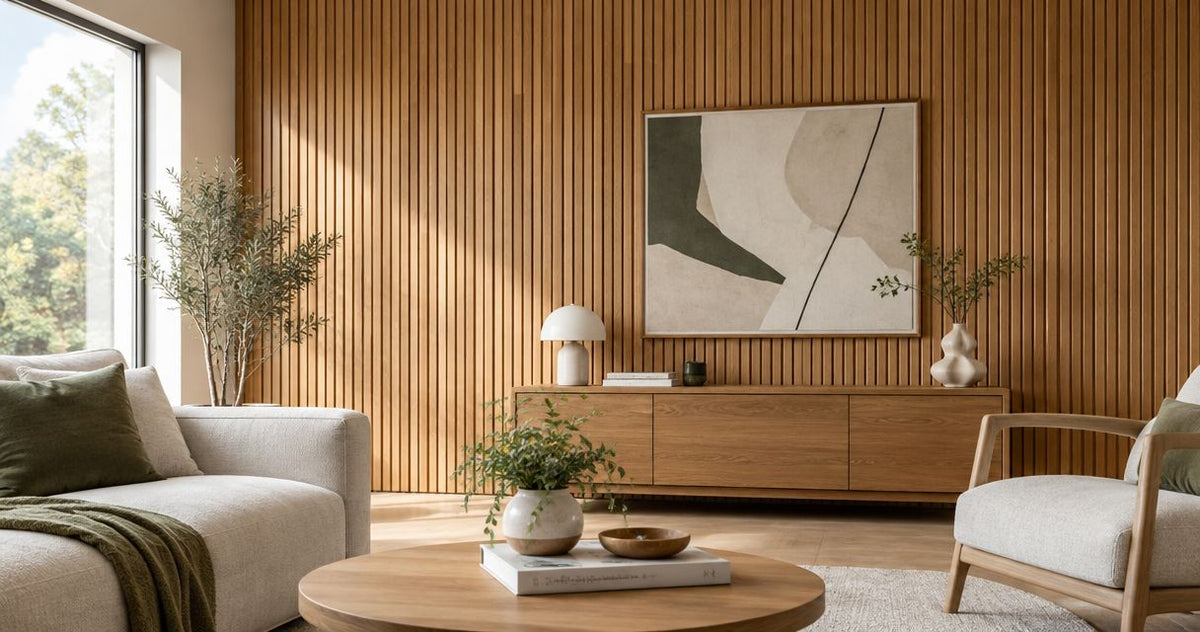
Best overall: Natural Oak Acoustic Slat Wall Panel. Best for curved decorative surfaces: Natural Oak Fluted Wall Panel. Best for geometric layouts: Natural Oak Hexagon Acoustic Panel. Best for outdoor walls: Exterior Wall Panel Oak. This 2026 guide compares oak wall panels by construction, acoustic purpose, layout, and installation setting.
- Akustiq USA oak wall panels: choose Natural Oak Acoustic Slat Wall Panel for a straight indoor feature wall.
- Choose Natural Oak Fluted Wall Panel for flexible MDF backing and a decorative fluted profile.
- Natural Oak Hexagon Acoustic Panel lists NRC 0.75; confirm the tested mounting assembly before specifying acoustic treatment.
- Choose Exterior Wall Panel Oak for outdoor applications, not an indoor panel selected only for its color.
Why this matters
Oak wall panels describe a look, not a single construction. A wood-veneer slat panel, a flexible fluted panel, and an exterior wood-grain panel solve different problems. Choosing by color alone leaves the important decisions unfinished.
Akustiq USA oak wall panels are best for buyers who want to compare acoustic slats, decorative fluting, geometric panels, and exterior wood-grain options by application. This is a comparison within that range, not a claim that every product has been tested against every other supplier.
For your 2026 project, decide whether the priority is appearance, room acoustics, or outdoor exposure before choosing a finish. Those requirements determine which product belongs on your shortlist.
What makes the best oak wall panels?
Use these criteria before comparing products:
- Construction: Separate real wood veneer, solid wood, and wood-grain finishes. An oak name alone does not establish the material underneath.
- Acoustic purpose: Choose acoustic products for room treatment. A decorative profile is not evidence of measured sound absorption.
- Surface shape: Match straight slats, flexible fluting, or hexagons to the wall geometry and intended pattern.
- Installation setting: Keep indoor decorative panels separate from products intended for weather exposure.
- Edge planning: Include exposed sides, corners, sockets, and transitions in the layout before ordering.
- Finish approval: Judge a physical sample beside your flooring, paint, and lighting rather than relying only on a screen.
A panel wins when its construction matches the job. A more elaborate profile does not automatically make it a better choice.
Oak wall panels at a glance
| Oak panel option | Best for | Standout feature | Key limitation |
|---|---|---|---|
| Natural Oak Acoustic Slat Wall Panel | Straight indoor feature walls | Premium 3-sided wood veneer | Veneer construction is not solid oak throughout |
| Natural Oak Fluted Wall Panel | Curved decorative surfaces | Real wood veneer with flexible MDF backing | Flexibility does not establish an unrestricted bend radius |
| Natural Oak Hexagon Acoustic Panel | Geometric acoustic layouts | 32-inch format; listed NRC 0.75 | Separate shapes require deliberate pattern and coverage planning |
| Exterior Wall Panel Oak | Outdoor wood-grain cladding | 94.5-inch panels; 2 panels per box | Oak wood-grain styling is not proof of solid oak construction |
The 2026 shortlist separates products by purpose rather than treating unlike materials as interchangeable. Read the limitation column first if you already know where the panels will go.
1. Natural Oak Acoustic Slat Wall Panel: best for indoor feature walls
Natural Oak Acoustic Slat Wall Panel combines a linear slat design with premium 3-sided wood veneer. Choose this format when you want a continuous wood-slat feature rather than individual geometric shapes or a fluted surface.
It is the default pick for a straight living-room, bedroom, or office feature wall. The acoustic product category also makes it the appropriate starting point when your brief includes room treatment, subject to the mounting and performance information required for your project.
Natural Oak Acoustic Slat Wall Panel pros:
- Real wood veneer provides a wood surface rather than a printed wood-effect finish.
- The specified 3-sided veneer construction addresses more than the front face of the slats.
- A linear format suits a consistent wall-wide pattern.
Natural Oak Acoustic Slat Wall Panel cons:
- Wood veneer is not solid oak throughout the panel.
- Continuous slat lines make socket positions, cuts, and exposed edges part of the visible design.
- An acoustic panel does not replace a sound-isolating wall assembly.
Best for: A straight indoor accent wall where you want natural oak veneer and a regular slat pattern.
Before choosing this panel for a TV wall, resolve cable access and mounting support separately. Decorative cladding is not a substitute for a suitable structural fixing point.
Verdict: Buy for a straight indoor feature wall; do not select it as a stand-alone soundproofing solution.
2. Natural Oak Fluted Wall Panel: best for curved decorative surfaces
Natural Oak Fluted Wall Panel uses real wood veneer with flexible MDF backing. Its fluted profile adds a different surface rhythm from open slat arrangements, making appearance and surface geometry the main reasons to choose it.
For a 2026 renovation involving a curved feature, this is the relevant option to investigate first. Confirm the permitted bend direction, minimum radius, substrate, and fixing method before designing around its flexibility.
Natural Oak Fluted Wall Panel pros:
- Real wood veneer supplies the visible wood finish.
- Flexible MDF backing distinguishes it from a rigid decorative board.
- A fluted profile offers an alternative to straight acoustic slat styling.
Natural Oak Fluted Wall Panel cons:
- Flexible backing does not mean the panel fits every curve.
- Decorative fluting alone does not establish acoustic performance.
- Curved work requires careful planning at starts, stops, and adjoining flat surfaces.
Best for: A decorative curved wall or feature surface where the specified bending limits match the design.
Keep the substrate in the decision. A panel that follows a curve still needs an appropriate surface and an approved attachment method; flexibility does not correct an unsuitable base.
Verdict: Buy for decorative shaping after confirming the installation limits; skip it when measured absorption is your deciding requirement.
3. Natural Oak Hexagon Acoustic Panel: best for geometric layouts
Natural Oak Hexagon Acoustic Panel is listed in a 32-inch format with 4 panels per box. Its product description specifies a wood-veneer finish and an NRC value of 0.75.
Choose hexagons when you want the panel arrangement itself to form the feature. Unlike a continuous slat wall, the composition includes the outlines of individual shapes and any exposed wall between them.
Natural Oak Hexagon Acoustic Panel pros:
- Hexagonal shapes support a geometric composition.
- The wood-veneer finish keeps a visible wood surface in the design.
- A listed NRC value gives you a specific acoustic detail to investigate.
Natural Oak Hexagon Acoustic Panel cons:
- Separate shapes need layout planning around furniture and wall boundaries.
- Gaps between panels remain untreated wall area.
- NRC 0.75 does not mean the finished room becomes 75% quieter.
Best for: A geometric feature wall where acoustic treatment and visible pattern both belong in the brief.
For a 2026 acoustic specification, ask for the test report and mounting configuration associated with NRC 0.75. NRC describes sound absorption under test conditions, not the amount of sound blocked from a neighboring room.
Verdict: Buy for a planned geometric acoustic feature; skip it if you want uninterrupted vertical lines.
4. Exterior Wall Panel Oak: best for outdoor wood-grain cladding
Exterior Wall Panel Oak is listed as a 94.5-inch garden panel with a 3D wood-grain design and 2 panels per box. Its description identifies UV and weather resistance, which makes outdoor use the reason to choose it over the indoor options above.
Treat the oak designation as a finish description unless the material specification establishes more. An exterior wood-grain product and an indoor oak-veneer product should not be compared as though they share the same construction.
Exterior Wall Panel Oak pros:
- The product is intended for exterior applications.
- Its description specifies UV and weather resistance.
- A 3D wood-grain surface provides an oak-style appearance outdoors.
Exterior Wall Panel Oak cons:
- Wood-grain styling does not establish a real oak surface.
- Exterior suitability does not establish acoustic absorption.
- Outdoor detailing still requires suitable support, fixings, edges, and water management.
Best for: Outdoor wall cladding where you want an oak-style finish and an exterior-designated product.
Compare the full installation system, not just the panel face. Corners, terminations, and penetrations need to work with the supporting wall and the manufacturer's instructions.
Verdict: Buy for an exterior cladding project after confirming the assembly; skip it for an indoor acoustic brief.
How to choose the right finish and layout
Compare the whole wall, not just the sample
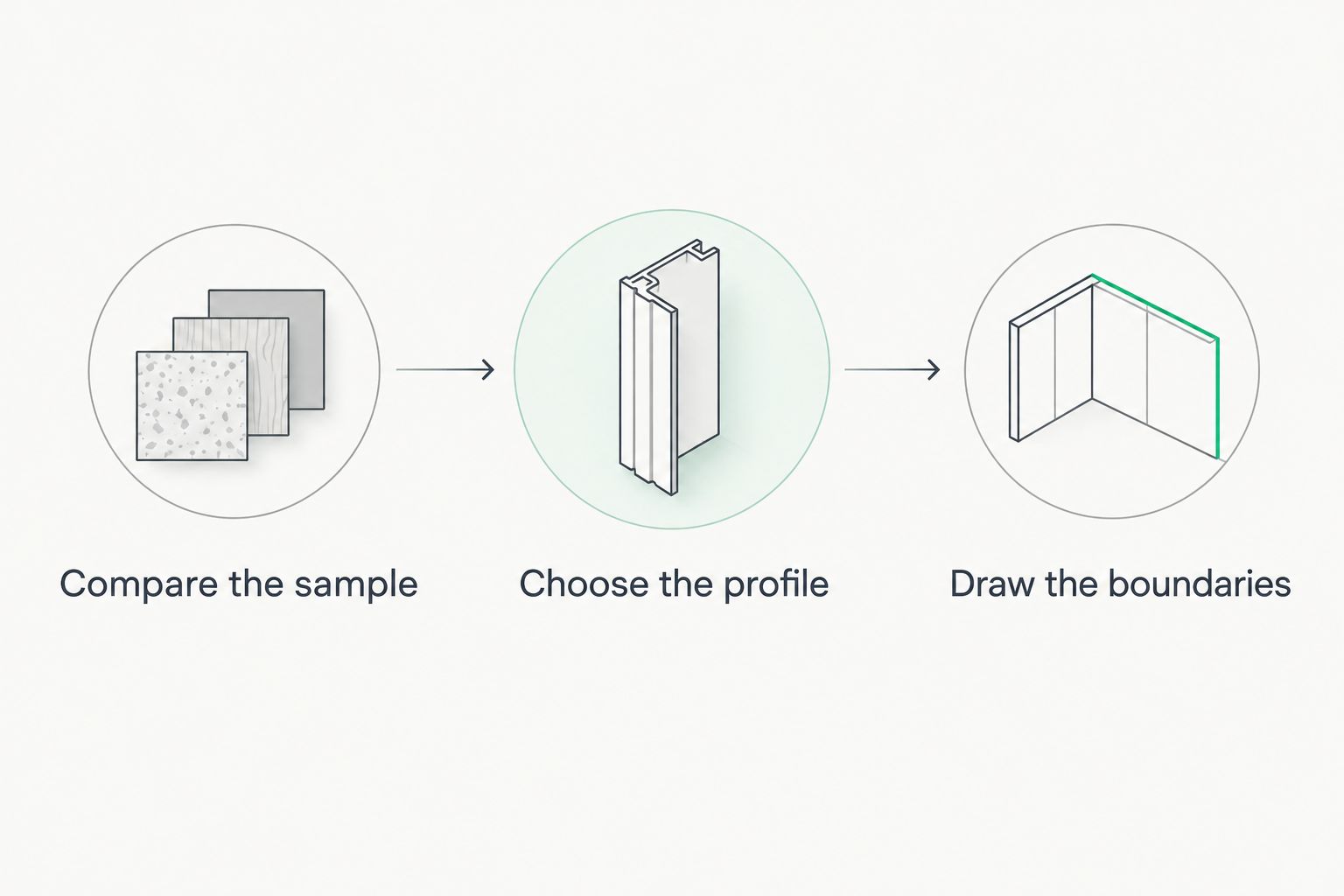
Hold a sample vertically against the intended wall. Compare it with the floor and any large adjacent cabinet, then repeat the check with the room's evening lighting switched on.
Your goal is a deliberate relationship between materials, not an exact match between every wood surface. If the floor already has a strong grain pattern, decide whether the wall should repeat that emphasis or provide a quieter backdrop.
Separate surface pattern from physical depth
For a farmhouse-style room, wood-effect wallpaper belongs in a different comparison from veneer panels: a printed wood pattern and a physical slat or fluted profile create different wall treatments. Decide whether you want the image of wood, a real wood surface, or a shaped panel before comparing finishes.
That distinction also keeps the acoustic brief clear. Do not transfer an absorption claim from an acoustic panel to another covering because both share a wood appearance.
Draw the boundaries first
Mark where the installation starts and stops before choosing the pattern. Include skirting, ceilings, door casings, switches, sockets, and furniture that will sit in front of the wall.
For slats, check how the final edge will look. For hexagons, map the complete arrangement before fixing any pieces; the surrounding blank wall is part of the composition.
Compare the indoor panel constructions
Akustiq USA offers both the natural oak acoustic slat panel and the natural oak flexible fluted panel. Choose between these constructions before comparing small differences in finish: the slat option serves a linear acoustic-panel brief, while the fluted option emphasizes decorative profile and flexibility.


What to confirm before ordering oak wall panels
A purchase-ready specification needs more than a finish name. Write down the exact product, application, approved mounting method, required coverage, and edge treatment so the installer and buyer are working from the same brief.
- For acoustic work: Request the relevant absorption test and match its mounting arrangement to the proposed installation.
- For curved work: Confirm bend direction and radius before making a template.
- For exterior work: Confirm substrate requirements, fixing details, clearances, and water-management instructions.
- For commercial work: Request the documentation required by the project's designer and applicable code; do not assume an appearance-led product meets a fire specification.
Do not calculate quantities from package count alone. Use the exact panel dimensions and usable coverage for the selected product, then draw the cuts and joints. A box quantity tells you how many pieces arrive, not how those pieces fit your wall.
How we ranked
The 2026 ranking prioritizes application fit, stated construction, acoustic information, surface geometry, and installation setting. It is a specification-based shortlist, not a hands-on performance test or an independent market-wide ranking.
Natural Oak Acoustic Slat Wall Panel takes the default position because it directly matches a straight indoor oak-veneer feature-wall brief. The other recommendations win distinct jobs rather than competing for the same use case.
Which oak wall panels should you choose?
Choose Natural Oak Acoustic Slat Wall Panel if you are undecided and your project is a straight indoor feature wall. Move to Natural Oak Fluted Wall Panel for a suitable curved decorative surface, Natural Oak Hexagon Acoustic Panel for a geometric acoustic layout, or Exterior Wall Panel Oak for outdoor cladding.
For your 2026 project, settle the application first and the shade second. That order prevents a finish preference from overriding the construction your wall needs.
FAQ
What's the best oak wall panel for a living-room feature wall?
Natural Oak Acoustic Slat Wall Panel is the default choice here for a straight indoor feature wall. It specifies premium 3-sided wood veneer and a linear slat design; confirm the mounting details for your wall.
Are oak wall panels made from solid oak?
Not all oak wall panels are solid oak. The recommended natural oak slat panel specifies wood veneer, the fluted panel specifies veneer with flexible MDF backing, and the exterior option describes an oak wood-grain finish.
Do acoustic oak panels soundproof a room?
Acoustic absorption and soundproofing are different jobs. Absorptive panels treat sound within a room, while sound isolation depends on the wall assembly, openings, and other transmission paths.
Is a fluted oak panel better than a slat panel?
A fluted oak panel is the better fit when decorative profile and suitable flexibility are your priorities. Choose an acoustic slat product when your brief calls for that construction, and verify the performance evidence separately.
What does NRC 0.75 mean for the hexagon panel?
NRC 0.75 is the absorption rating listed for Natural Oak Hexagon Acoustic Panel. It is not a promise that a room becomes 75% quieter; request the test report and mounting conditions before specifying it.
Can indoor oak wall panels be used outside?
Do not substitute an indoor oak panel for an exterior-designated product without explicit manufacturer approval. Exterior Wall Panel Oak is the outdoor option in this shortlist, with UV and weather resistance stated in its description.
Should I order a sample before choosing oak wall panels?
Approve a physical sample before committing to a finish. Compare it vertically beside your flooring, paint, and furniture under daylight and the lighting you use at night.
One last thing
Approve the exposed edge, not just the front face. A wall can look convincing head-on and unfinished from the doorway if the final panel edge has no planned termination.
Ask the installer to show how the first edge, last edge, and socket cuts will finish before work starts. That small layout decision belongs at the beginning, not on the final installation day.
Share:
Best soundproof wall panels in 2026
Best felt wall panels in 2026