

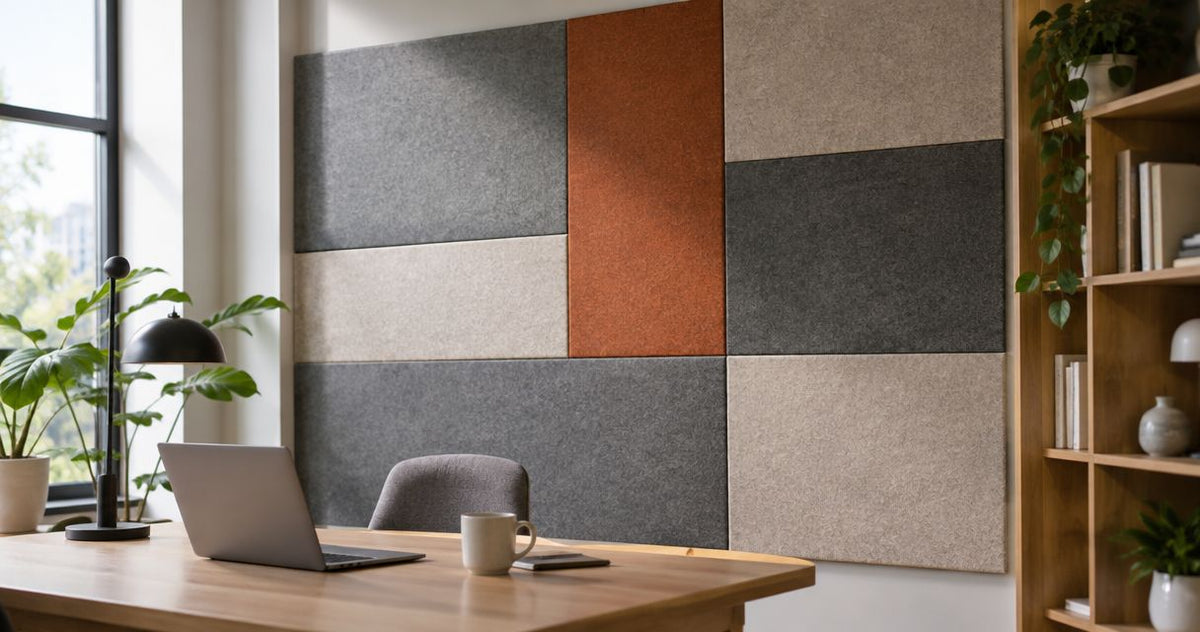
Best overall for a light wood feature wall: Natural Oak with Gray Felt slat panels. Best for a darker linear design: Smoked Oak with Gray Felt slat panels. Best for a geometric layout: Natural Oak with Gray Felt hexagon panels. This 2026 guide compares felt-backed wood options from Akustiq USA, rather than plain, exposed-felt tiles.
- For felt wall panels with a wood finish, Akustiq USA Natural Oak with Gray Felt slats are the default pick.
- Choose Smoked Oak with Gray Felt slats when you want a darker, linear feature wall.
- Choose Natural Oak with Gray Felt hexagons for a geometric arrangement rather than continuous slat lines.
- Compare acoustic test conditions and mounting details; felt backing alone does not establish room performance.
Why this matters
Felt wall panels are not all the same construction. An exposed-felt tile gives you a textile surface; a felt-backed wood panel combines visible wood with a felt layer. Decide which surface you want before comparing finishes.
Acoustic treatment also differs from soundproofing. Absorptive panels address sound reflecting inside your room, while reducing noise passing through a wall requires attention to the complete wall assembly, doors, and other transmission paths.
What makes the best felt wall panels?
- Surface construction: Choose exposed felt for a textile appearance or felt-backed wood for a wood-led finish.
- Acoustic evidence: Compare the exact product, mounting method, and test conditions—not just an acoustic label.
- Layout fit: Use slats for continuous lines or hexagons for a shaped composition.
- Finish coordination: Compare wood and felt together against your flooring, paint, and furniture.
- Installation details: Resolve fastening, outlets, exposed edges, and wall preparation before ordering.
Felt wall panels at a glance
These 2026 recommendations separate design uses, not measured acoustic winners. The order below matches the detailed picks.
| Panel | Best for | Standout feature | Key limitation |
|---|---|---|---|
| Acoustic Slat Wall Panel: Natural Oak with Gray Felt | Light wood feature walls | Natural Oak finish with gray felt and 3-sided wood veneer | Not an exposed-felt surface; linear alignment needs planning |
| Acoustic Slat Wall Panel: Smoked Oak with Gray Felt | Darker linear feature walls | Smoked Oak finish with gray felt and 3-sided wood veneer | Darker finish needs a room-specific sample check |
| Hexagon Acoustic Panel: Natural Oak with Gray Felt | Geometric wall compositions | Listed as 32 inches, with 4 panels per box | Hexagon boundaries require a different layout from rectangular panels |
Akustiq USA felt-backed wood panels are best for buyers who want visible wood rather than an exposed-felt wall finish. If you want an entirely textile-covered wall, choose a dedicated felt-facing product instead of treating these as equivalent.
1. Natural Oak with Gray Felt: best for light wood feature walls
The Acoustic Slat Wall Panel | Natural Oak with Gray Felt | Premium 3-sided Wood Veneer combines a Natural Oak finish with visible gray felt between the slats. It is the default recommendation for a wood-led feature wall when you prefer a lighter finish over Smoked Oak.
The product specifies 3-sided wood veneer. That makes the slat edges relevant to your finish comparison, particularly where you see the wall from an angle rather than straight ahead.
Natural Oak with Gray Felt pros:
- Combines a wood surface with gray felt in one panel design.
- Offers a linear alternative to geometric acoustic panels.
- Specifies wood veneer on 3 sides of the slats.
- Gives you a clear starting point for coordinating natural wood and gray furnishings.
Natural Oak with Gray Felt cons:
- Does not provide an entirely soft, exposed-felt face.
- Requires attention to slat alignment where panels meet.
- The finish name alone cannot establish a match with existing oak furniture.
Best for: Living room, bedroom, or home office feature walls where you want a light wood appearance and continuous lines.
For a 2026 room update, check the sample beside the materials that are staying. Flooring usually occupies a large part of your view, so compare against it before selecting cushions or other easily changed accessories.
Verdict: Buy Natural Oak with Gray Felt for a light, linear wood feature wall after checking the finish in your room.
2. Smoked Oak with Gray Felt: best for darker linear designs
The Acoustic Slat Wall Panel | Smoked Oak with Gray Felt | Premium 3-sided Wood Veneer pairs a Smoked Oak finish with gray felt. Choose this option when your design calls for a darker wood surface without switching to a geometric panel format.
The reason to choose Smoked Oak is appearance, not a promised improvement in sound absorption over Natural Oak. A finish comparison does not establish an acoustic performance difference.
Smoked Oak with Gray Felt pros:
- Provides a darker wood-finish alternative within the gray-felt slat options.
- Retains the continuous-line appearance of slat paneling.
- Specifies 3-sided wood veneer.
- Lets you compare finish changes without changing the basic panel style.
Smoked Oak with Gray Felt cons:
- Is not the right choice when your priority is a light wood wall.
- Requires a sample comparison against nearby dark wood finishes.
- Needs the same edge and joint planning as other slat layouts.
Best for: A darker feature wall behind seating, a desk, or another defined furniture grouping.
View the sample with your evening lighting switched on. A finish that suits the room in daylight still needs to work when you actually use the space; do not make the decision from a bright product photograph alone.
Verdict: Buy Smoked Oak with Gray Felt when a darker wood finish is the design priority, not as an acoustic upgrade over Natural Oak.
3. Natural Oak with Gray Felt hexagons: best for geometric layouts
The Hexagon Acoustic Panel | Natural Oak with Gray Felt 32 Inch (4 Panels per Box) | Wall Decor changes the shape of the installation. Instead of a continuous rectangular slat field, you can plan a composition around hexagonal panel boundaries.
The product listing states NRC 0.75. NRC describes sound absorption under test conditions; it is not a percentage reduction in the noise you hear, and it does not rate sound isolation between rooms.
Natural Oak with Gray Felt hexagon pros:
- Offers a geometric alternative to continuous slat paneling.
- Combines the named Natural Oak finish with gray felt.
- Lists a 32-inch format and 4 panels per box.
- Provides a stated NRC value to discuss alongside the test report and mounting details.
Natural Oak with Gray Felt hexagon cons:
- Does not create the same uninterrupted rectangular field as slat panels.
- Requires careful planning where the composition meets wall edges or furniture.
- NRC alone does not establish the result in your room.
Best for: A shaped feature above a desk, beside a reading area, or on a wall where the panel outline is part of the design.
Draw the complete composition before deciding how many boxes to order. The listed 32-inch size is not, by itself, a coverage calculation; use the product's dimensioned drawing and your intended spacing.
Verdict: Buy Natural Oak with Gray Felt hexagons for a deliberate geometric composition; skip them when continuous slat lines are the goal.
See the difference before choosing a layout
Slat panels and hexagon panels solve different visual problems. Use slats when you want repeated lines across a defined wall area; use hexagons when you want the outline of the arrangement to remain visible.
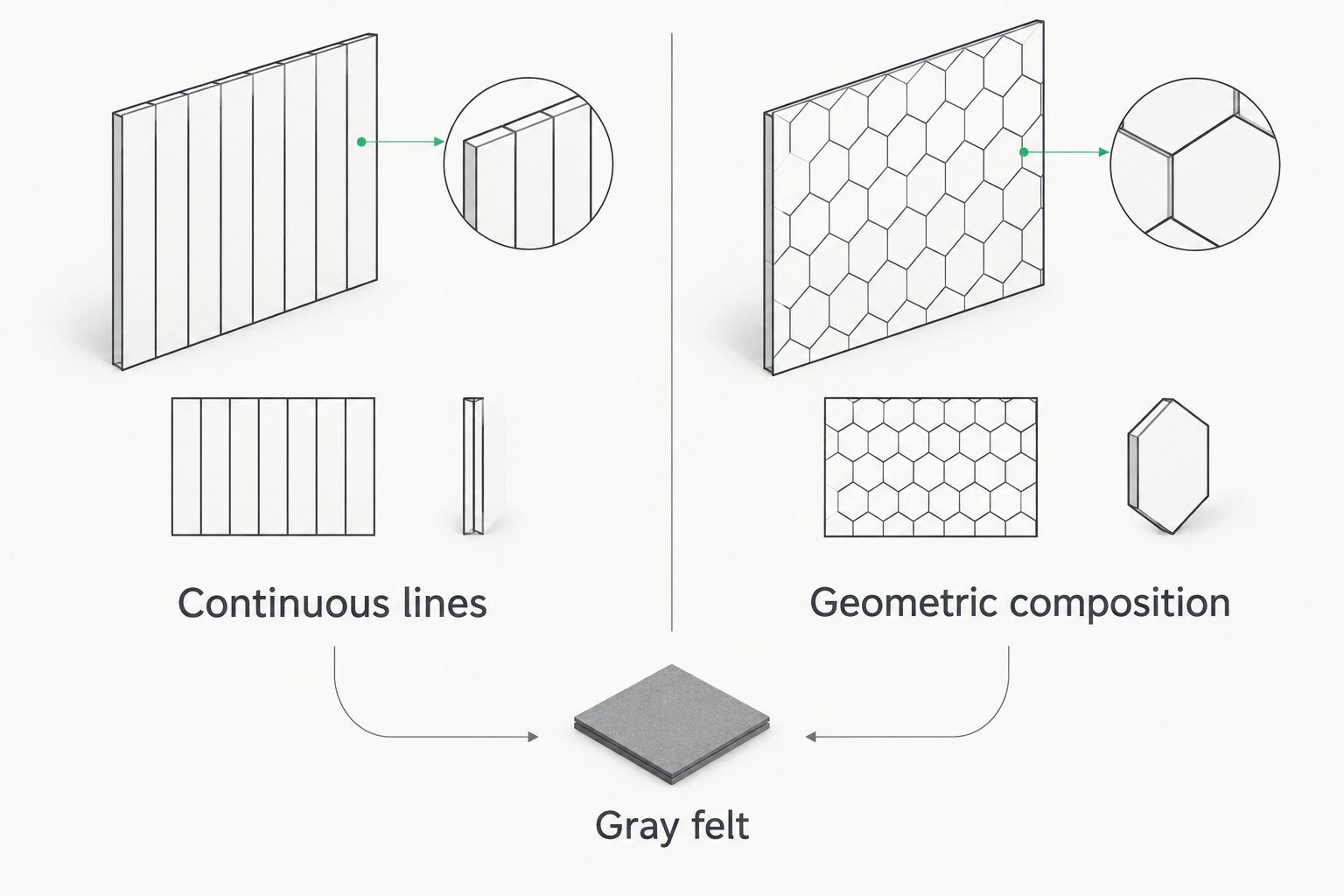
Neither layout automatically gives you better acoustics. The useful comparison is the tested assembly, the amount of treatment, and its placement—not whether the panel has straight or angled boundaries.
Compare the actual finishes
The following products are the light and dark linear options discussed above. Compare samples in the intended location before committing to the full wall.


How to assess acoustic claims in 2026
Ask what was tested and how it was mounted. A panel's absorption result belongs to a specific test arrangement, not every possible installation using the same finish.
For your 2026 shortlist, request the acoustic report and compare its assembly with the installation you intend to build. Check whether the tested arrangement includes an air space, additional absorptive material, or a mounting method different from yours.
Keep these distinctions clear:
- Absorption: Addresses sound energy reflected within a space.
- Sound isolation: Addresses sound transmission between spaces.
- Coverage: Describes how much treatment you install, not just how many boxes you buy.
- Placement: Describes where the treatment sits relative to the room and its sound sources.
Do not read NRC 0.75 as a guarantee that your room becomes 75% quieter. Room dimensions, existing surfaces, treatment area, and the noise source all affect the outcome.
If your main complaint is speech or music from next door, investigate the separating construction first. Decorative felt-backed panels are not a substitute for a sound-isolation design.
Plan the wall before ordering
A good panel choice still needs a workable layout. Complete these steps before you approve a 2026 installation, especially if the wall includes electrical fittings or mounted equipment.
Measure the wall
Record the intended treatment area's height and width, then mark windows, doors, outlets, switches, and fixed furniture. Use the actual panel dimensions to draw joints and cuts; do not estimate from a room photograph.
For hexagons, draw the outer boundary as well as the individual panels. Open spaces between pieces remain untreated wall, so the overall composition footprint is not the same as the panel area.
Check the backing
Confirm that the wall condition and chosen fasteners meet the installation instructions. Address loose finishes and substrate problems before covering them, rather than expecting paneling to correct the underlying surface.
If you rent, obtain permission for the proposed attachment method. Removable-looking panels do not make an adhesive or screw installation damage-free.
Resolve the edges
Decide where paneling stops and how each exposed edge will look. Include transitions beside cabinetry, baseboards, and door trim in the drawing, not as decisions left until the last panel is fitted.
For electrical outlets and switches, have a qualified electrician assess the finished wall depth and any required adjustments. Keep electrical fittings accessible and follow applicable requirements.
Confirm the assembly
Match the final layout and mounting method to the manufacturer's instructions and your acoustic requirements. For commercial work, request product-specific fire documentation and confirm acceptance with the project team before specification.
A wood finish or a felt layer does not establish code compliance. The exact product and intended use matter.
How the recommendations are ranked
This shortlist prioritizes construction, layout fit, finish coordination, acoustic evidence, and installation planning. It compares Akustiq USA felt-backed wood panels by intended use; it is not a market-wide ranking of exposed-felt products or a laboratory performance comparison.
Natural Oak with Gray Felt takes the default position for a light, linear feature wall. Smoked Oak with Gray Felt serves the darker-finish requirement, while Natural Oak with Gray Felt hexagons serve the geometric-layout requirement.
Which felt wall panels should you choose?
Choose Natural Oak with Gray Felt slats if you want the default light wood feature wall. Choose Smoked Oak with Gray Felt slats only when the darker finish fits your room better, and choose the hexagons when you want a shaped composition.
If you mean plain textile-faced felt wall panels, none of these wood-faced recommendations is a direct substitute. Keep that distinction in your search, and compare products with the surface construction you actually want.
For acoustic-led projects, settle the performance requirement before the finish. A wall that looks right still needs the right treatment area and installation assembly to address your room's reflections.
FAQ
What's the best felt wall panel for a living room?
Natural Oak with Gray Felt slat panels are the default pick in this shortlist for a light wood living room feature wall. Choose a dedicated textile-faced product instead if you want exposed felt rather than visible wood.
Are felt wall panels the same as felt-backed wood panels?
No. Exposed-felt panels have a textile-facing surface, while felt-backed wood panels combine a visible wood face with a felt layer.
Do felt wall panels soundproof a room?
Felt acoustic treatment is not a substitute for soundproofing the room's construction. Absorptive treatment addresses reflections inside the room; sound isolation depends on walls, doors, gaps, and other transmission paths.
Is Smoked Oak better acoustically than Natural Oak?
A different wood finish does not establish better acoustic performance. Compare product-specific test reports and mounting conditions rather than selecting an acoustic winner by color.
What does NRC 0.75 mean on the hexagon panels?
NRC 0.75 is a sound-absorption rating under test conditions, not a promise of 75% less room noise. Request the report and confirm that the tested mounting arrangement matches your proposed installation.
How many felt-backed wall panels do I need?
Calculate the quantity from the measured treatment area, actual panel dimensions, and planned layout. Include joints, openings, cuts, and the intended arrangement rather than using box count alone.
Can I use felt-backed wood panels in a commercial office?
Specify felt-backed wood panels only after checking the exact product against the office project's acoustic, installation, and fire requirements. Obtain product-specific documentation before approving the finish.
One last thing
Check the felt color as carefully as the wood finish. The backing remains visible between the slats and becomes part of the finished wall, not just a hidden construction layer.
Hold your sample vertically in the intended position, then view it straight on and from the doorway. That simple check helps you judge the complete wood-and-felt combination before committing to the layout.
Share:
Best oak wall panels in 2026
Best black wood wall panels in 2026