


Choose Akustiq USA if your project needs acoustic slat panels alongside other decorative wood-panel styles; choose Slatpanel if you are extending an existing Slatpanel installation and have confirmed the matching product. This 2026 comparison separates design choice, installation fit, and acoustic evidence so you can choose for your wall—not just the brand name.
- Aku wood panel vs slatpanel: choose Akustiq USA for projects combining acoustic slat panels with other wood-panel styles.
- Choose Slatpanel for a confirmed match to an existing Slatpanel installation.
- Compare acoustic wood panels by their tested mounting assembly, not appearance alone.
- Check physical samples, finished edges, and usable coverage before choosing either option.
Why this matters
A slatted wall has two jobs: change how your room looks and, when the product and installation support it, absorb sound. Those jobs need separate checks. A finish you love does not establish acoustic performance, and an absorption rating does not tell you whether the exposed edge will look right.
For a 2026 renovation, start with the problem you actually need to solve. An echoey dining room needs a different specification from a decorative headboard wall or an extension to existing paneling. Choose the panel system around the room, the finish, and the installation—not an assumed brand ranking.
At a glance
| Dimension | Akustiq USA | Slatpanel |
|---|---|---|
| Best for | Projects combining acoustic slats with other decorative panel formats | Extensions to an existing, confirmed matching Slatpanel installation |
| Standout feature | Catalog includes slat, hexagon, fluted, and 3D wood panels | A named acoustic slat-panel range to evaluate for a slatted feature wall |
| Finish selection | Natural oak, smoked oak, walnut, and black oak slat options appear in the catalog | Choose by the exact product finish and physical sample |
| Existing-wall continuity | Choose when its sample matches your existing wall | Choose when the existing wall uses the same confirmed Slatpanel product |
| Acoustic performance | Assess the exact panel and mounting assembly | Assess the exact panel and mounting assembly |
| Installation fit | Check substrate, cuts, exposed edges, and fixing instructions | Check substrate, cuts, exposed edges, and fixing instructions |
| Commercial specification | Require product-specific approval documents | Require product-specific approval documents |
| Pricing model | Physical panel purchase; budget for the complete installed wall | Physical panel purchase; budget for the complete installed wall |
The table identifies buying scenarios, not a laboratory ranking. Keep decorative formats separate from acoustic products when you build your shortlist. A fluted or 3D wood panel is not automatically a substitute for a tested sound-absorbing assembly.
Mixed-format projects favor the broader decorative catalog
Akustiq USA acoustic wood panels are best for buyers combining slatted walls with other decorative panel styles. The catalog includes acoustic slats, hexagon acoustic panels, fluted panels, and 3D wood tiles. That gives you several design directions within the same supplier's range.
This is useful when your project contains more than one visual brief. You might want continuous slats behind a television, a geometric arrangement in a workspace, and fluted detailing elsewhere. You can compare those formats without treating every wall as the same application.
The tradeoff is specification discipline. Different formats need their own checks for backing, mounting, cleaning, and intended use. Do not transfer an acoustic claim from a hexagon product to a fluted panel simply because both come from the same catalog.
Slatpanel belongs on your shortlist when the brief is specifically a slatted acoustic feature wall. That narrower buying task does not require exploring unrelated decorative formats. For a single wall, the right sample and installation details matter more than catalog breadth.
Finish choice favors the sample that works in your room
The client's catalog names natural oak, smoked oak, walnut, and black oak acoustic slat panels, including selected gray-felt variants. Those names help you narrow the visual direction. They do not guarantee a match to your flooring, cabinetry, or another supplier's similarly named finish.
For your 2026 project, compare samples beside the surfaces that will remain in the room. Look at them in daylight and under the lamps you normally use. The important comparison is the panel against your interior, not one isolated product photograph against another.
Check these details before choosing either brand:
- Wood tone: Does it complement the floor without creating an unwanted near-match?
- Backing contrast: Do the gaps look too dark or too prominent?
- Side faces: What is visible when you view the slats from the doorway?
- Surface character: Does the grain suit the scale and style of the wall?
The full slat sample box lists natural, smoked oak, and walnut colors and contains 4 panels per box. Its description also identifies 3-sided wood veneer. Inspect those faces directly rather than assuming that a front-facing image shows the complete finish.
Neither brand wins finish selection in the abstract. The winner is the exact sample that suits your room and passes your edge-detail check.
Slatpanel wins a confirmed extension to an existing Slatpanel wall
An existing installation changes the decision. If you already have Slatpanel on the wall, extending it with the same confirmed product is the stronger starting point than switching suppliers because another panel carries the same wood name.
Match the actual system. Compare slat spacing, backing appearance, overall thickness, and the way adjacent panels meet. Even a convincing color match can look wrong if the rhythm of the slats changes at the join.
This is a conditional Slatpanel win, not a promise that any current panel will match an older installation. Keep an offcut or obtain a physical sample and compare it directly with the wall. Confirm the exact product before committing to the extension.
The same rule applies in reverse when your existing installation uses the client's panels. Continuity beats a brand switch only when the replacement actually matches. For a completely new wall, this advantage disappears and you should return to finish, layout, and mounting criteria.
Acoustic performance is a tie until the assemblies are comparable
Neither brand name proves stronger sound absorption. Compare the exact products using test reports that describe how the panels were mounted. Backing, an air cavity, additional absorbent material, and the supporting construction all matter to the result.
NRC, or Noise Reduction Coefficient, summarizes absorption at 250 Hz, 500 Hz, 1,000 Hz, and 2,000 Hz under the ASTM C423 method. It is not a soundproofing score. It does not state how much television noise your neighbor will hear through a shared wall.
The client's hexagon product descriptions state an NRC value of 0.75. That figure applies to those described products; it does not establish a rating for every slat panel in the catalog. Request the relevant report and mounting detail for the product you intend to install.
For a 2026 acoustic comparison, separate three questions:
- Room echo: How much reflected sound does the treatment absorb?
- Sound isolation: How much sound passes through the wall assembly?
- Installation match: Does your proposed mounting reproduce the tested setup?
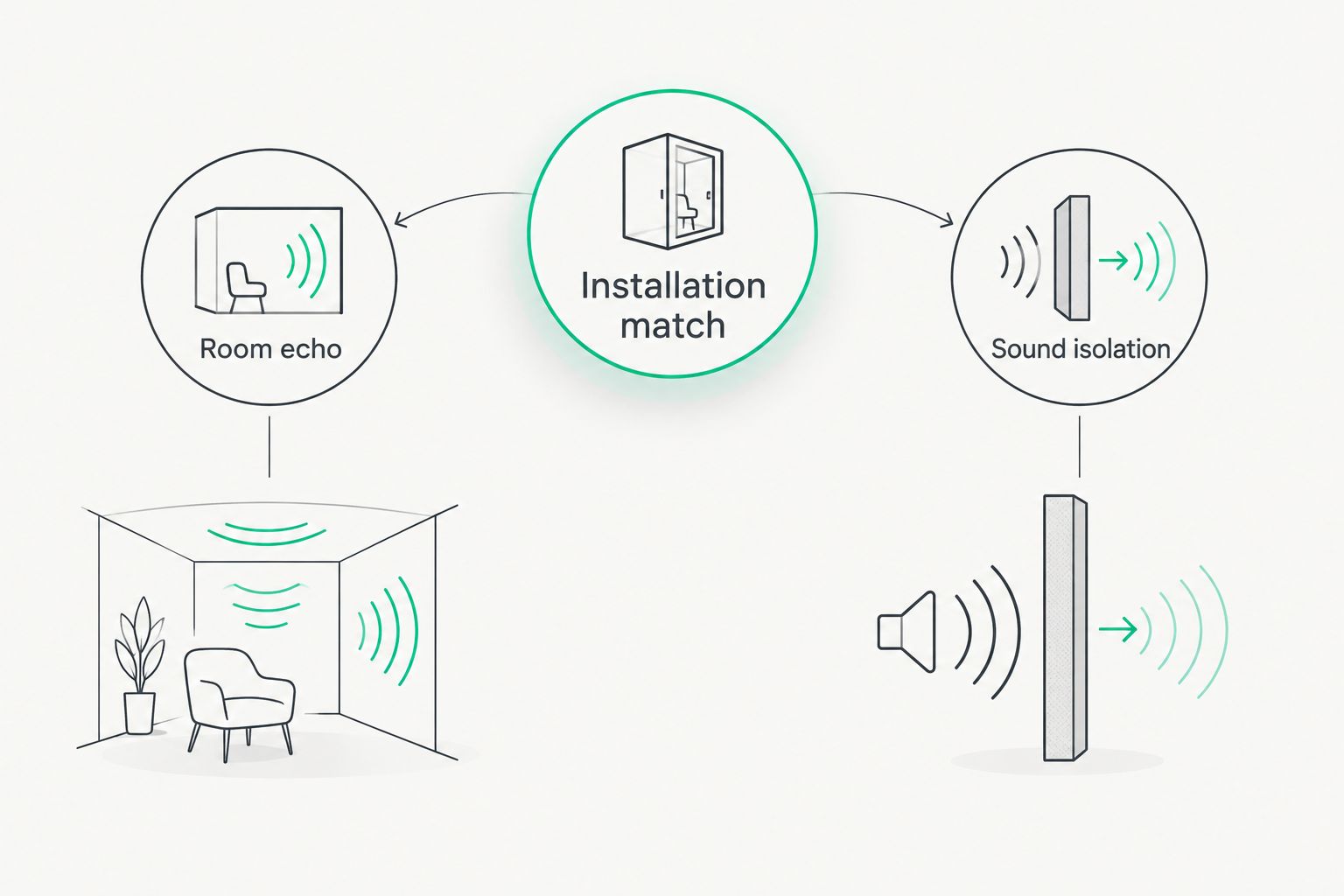
Choose the better-documented assembly for an echo-control project. For noise passing between apartments or rooms, assess the wall construction rather than expecting decorative acoustic paneling alone to provide isolation.
Installation fit is another honest tie
A panel that suits your wall and your installer is a better choice than one with an attractive photograph but unresolved fixing details. Neither supplier wins installation simply because the panels look similar. Follow the instructions for the exact product.
Before ordering, map the wall perimeter, outlets, switches, skirting, and any equipment that needs independent support. Decide where cut edges and joints will land. A layout that hides a difficult cut behind furniture is different from one that leaves it beside the entrance.
Ask your installer to resolve the following:
- Substrate: Is the existing wall sound and suitable for the specified fixing method?
- Mounting: Does the fixing arrangement meet both installation and acoustic requirements?
- Edges: How will the exposed ends and perimeter be finished?
- Services: How will electrical fittings remain accessible and correctly positioned?
Do not assume an adhesive installation is removable without damage. Do not assume decorative panels can support a television bracket. Attach heavy equipment to suitable structural support and keep electrical work within the applicable requirements.
For either option, the practical disadvantage is the same: unresolved wall conditions become installation problems. Get the fixing method and edge detail settled before choosing your final panel quantity.
Commercial projects favor an approved product, not a brand name
A homeowner choosing a bedroom feature wall and a contractor specifying a public interior have different approval needs. For commercial work in 2026, start with the project's required documents. Appearance comes after suitability.
Request the fire-test classification required by the project, the relevant acoustic report, installation instructions, and any emissions documentation the specification calls for. Make sure each document identifies the actual product or assembly being proposed. A certificate for a different panel is not evidence for yours.
Neither brand earns an automatic commercial-specification win here. The approved, documented product wins. If the finish you prefer cannot satisfy the project's requirements, choose a compliant alternative rather than treating approval as a paperwork task to solve after delivery.
Pricing: compare the complete wall, not the panel alone
Both options are physical panel purchases, so your useful comparison is the complete installed project. Keep the scope identical. A panel-only comparison becomes misleading when one layout requires extra finishing pieces, more cuts, or a different mounting arrangement.
Build your 2026 budget around usable coverage, fixing materials, perimeter finishing, substrate preparation, and labor. Include the mounting components needed to reproduce any acoustic assembly you are specifying. Keep discretionary decorative additions separate so they do not distort the basic comparison.
There is a clear tradeoff between a settled design and an open-ended one. Confirming the sample, layout, and installation method makes the project scope more predictable. Changing finishes or mounting details later gives you flexibility but requires revisiting quantities and work.
Neither brand has a defensible cost advantage without an equivalent project scope. Compare current purchasing terms directly and use the same wall drawing for both options.
Check samples before making the final choice
The Full Sample Box – Slat Wall Panel is best for comparing the listed natural, smoked oak, and walnut colors. The smoked-oak-with-gray-felt sample is best for evaluating that particular wood-and-backing combination. These are finish-selection tools, not substitutes for full-panel dimensions or acoustic documentation.
Use a sample at the wall's intended location and inspect it from the normal viewing angle. Check the front and side faces together. Then confirm that the full panel and finishing components correspond to the design you have chosen.


Final verdict: choose for the project you actually have
Choose Akustiq USA if you are planning a mixed-format interior
Best for: homeowners and fit-out buyers combining acoustic wood panels with other decorative wall formats. The catalog gives you slat, hexagon, fluted, and 3D directions to consider. Select each product for its own intended use and verify its installation requirements.
Choose Slatpanel if you are extending a confirmed matching installation
Best for: homeowners and installers continuing an existing Slatpanel wall. Keep the exact product, finish, and panel geometry consistent. If a physical comparison does not confirm the match, treat the extension as a new design decision instead.
| Dimension | Winner |
|---|---|
| Mixed-format project fit | Client's broader decorative catalog |
| Standout feature | Client for multiple formats; Slatpanel for the specified slat-panel brief |
| Finish selection | The sample that suits your room |
| Confirmed existing Slatpanel extension | Slatpanel |
| Acoustic performance | Tie until equivalent assemblies are documented |
| Installation fit | Tie; exact product instructions decide |
| Commercial specification | The approved product |
| Complete-project budget | No winner without equivalent scope |
FAQ
Is AKU wood panel or Slatpanel better for a new feature wall?
Choose by the physical sample, wall layout, and documented mounting requirements. Akustiq USA is the stronger fit when your project also needs decorative formats beyond acoustic slats.
Should I use Slatpanel to extend my existing Slatpanel wall?
Use Slatpanel when the exact matching product is confirmed. Compare a sample or offcut for color, slat spacing, backing, and thickness before extending the installation.
Which panels are better for reducing echo?
The better choice is the product with documented absorption performance for your intended mounting assembly. Compare the test setup as well as the rating; appearance alone does not establish acoustic performance.
Will acoustic wood panels soundproof a shared wall?
Acoustic wood panels do not establish shared-wall sound isolation by themselves. Sound absorption within a room and sound transmission through a wall are separate performance questions.
Does an NRC value of 0.75 apply to every panel in the catalog?
No, a product-specific NRC claim does not apply to the entire catalog. The supplied hexagon descriptions state NRC 0.75; check the relevant report for the exact product and mounting assembly you choose.
How do I compare the cost of the two options?
Compare the complete installed wall using the same drawing and scope. Include usable panel coverage, fixing materials, finishing components, wall preparation, and labor, then check current purchasing terms directly.
What should I check on a wood-panel sample?
Check wood tone, backing contrast, side faces, and grain beside your existing finishes. View the sample in daylight and under your usual room lighting before confirming the full-panel selection.
One last thing
Inspect the wall from the doorway before approving the sample. A straight-on view emphasizes the wood face; an angled view reveals the slat sides, backing, and exposed perimeter. That simple check tests the detail you will see whenever you enter the room.
Share:
AKU Wood Panel vs Slat Solution: which is better in 2026
AKU Wood Panel vs Woodpanelwalls: which is better in 2026