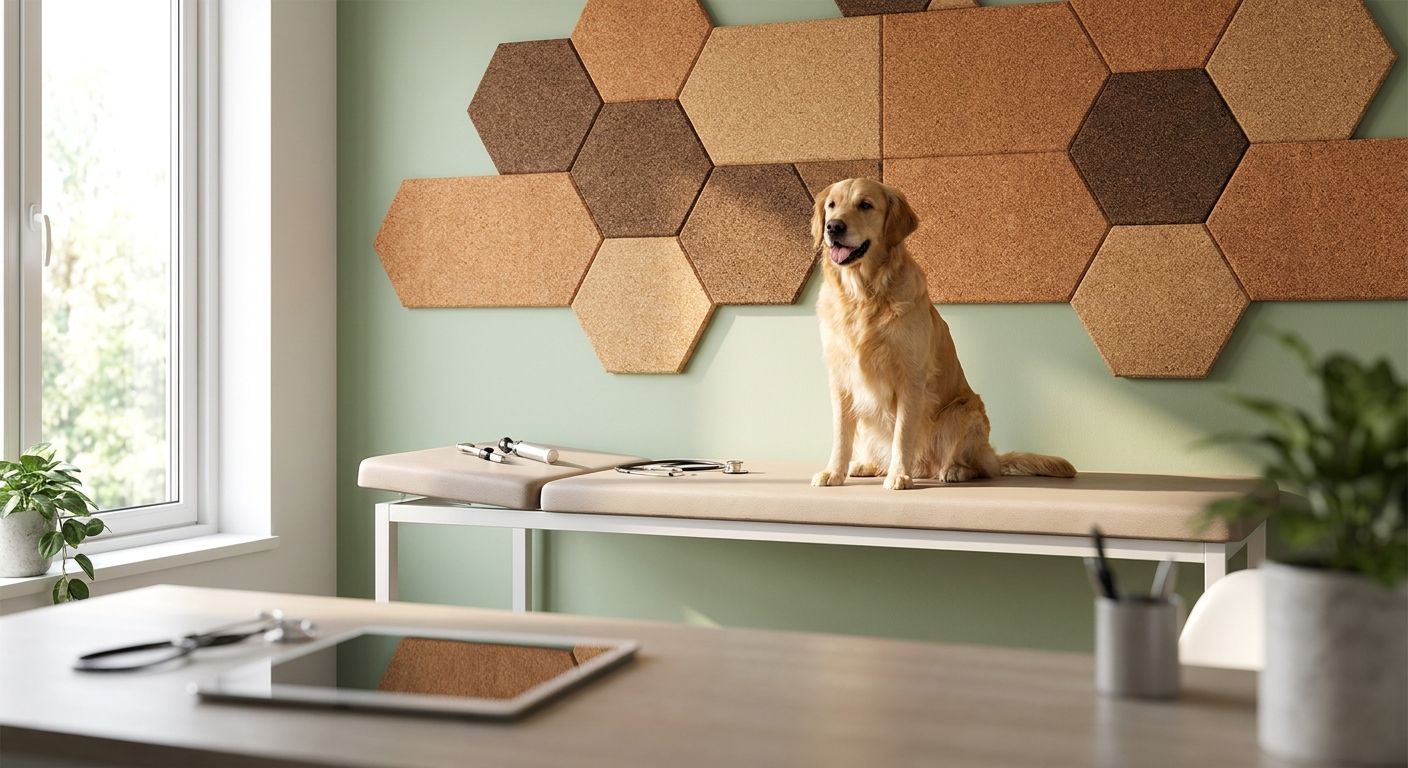
Cork acoustic panels for veterinary clinic exam rooms promise quieter rooms and calmer patients, but cork alone struggles against the disinfectant routines and cage-side traffic of a working clinic. Felt-backed wood slat and hexagon panels solve the same reverberation problem and hold up better to daily bleach-based cleaning in 2026.
- Cork absorbs sound but stains and scratches under daily veterinary disinfecting; wipeable veneer surfaces last longer.
- AKU Woodpanel's hexagon acoustic panel in Natural Oak with Gray Felt rates NRC 0.75 at $165.95 per box of 4.
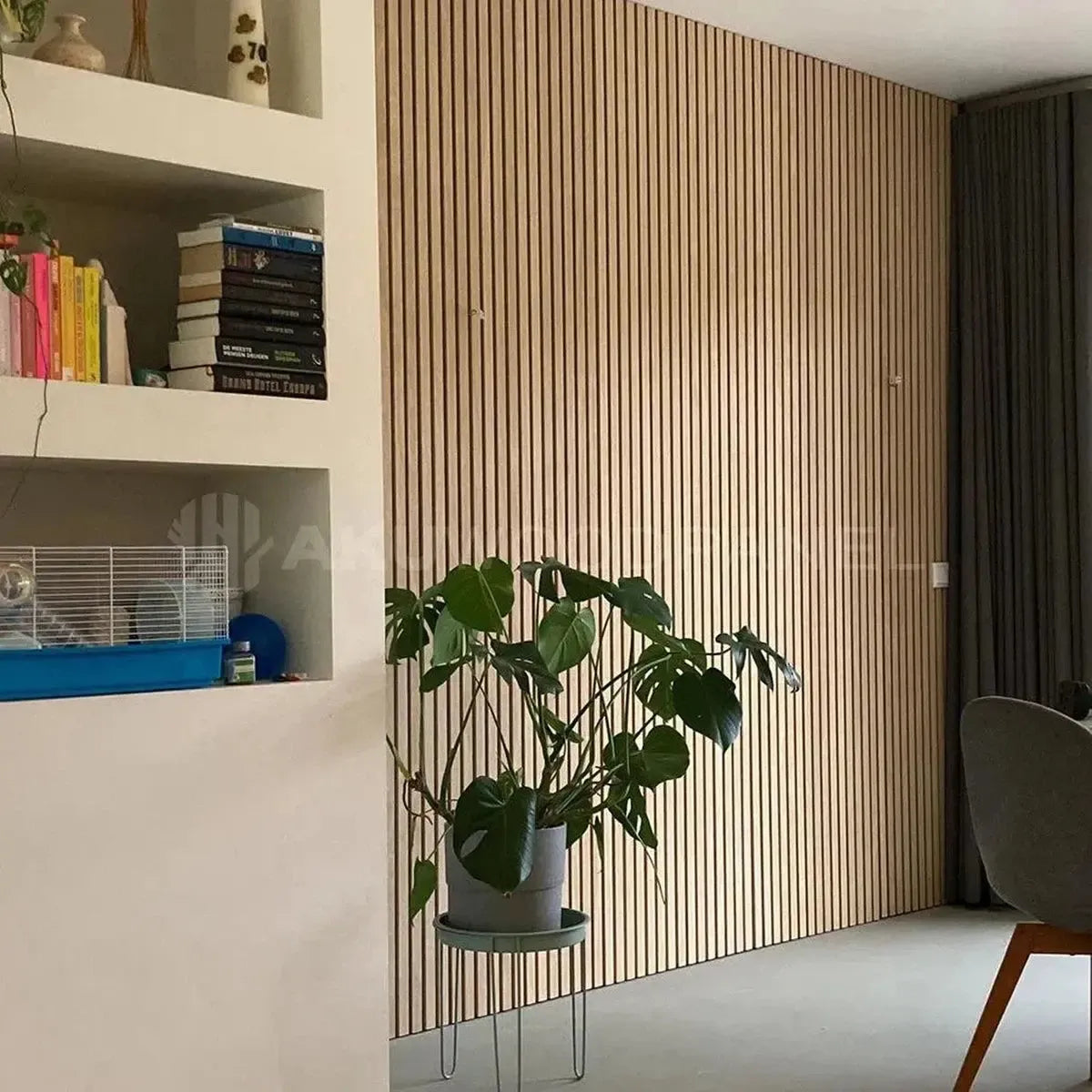
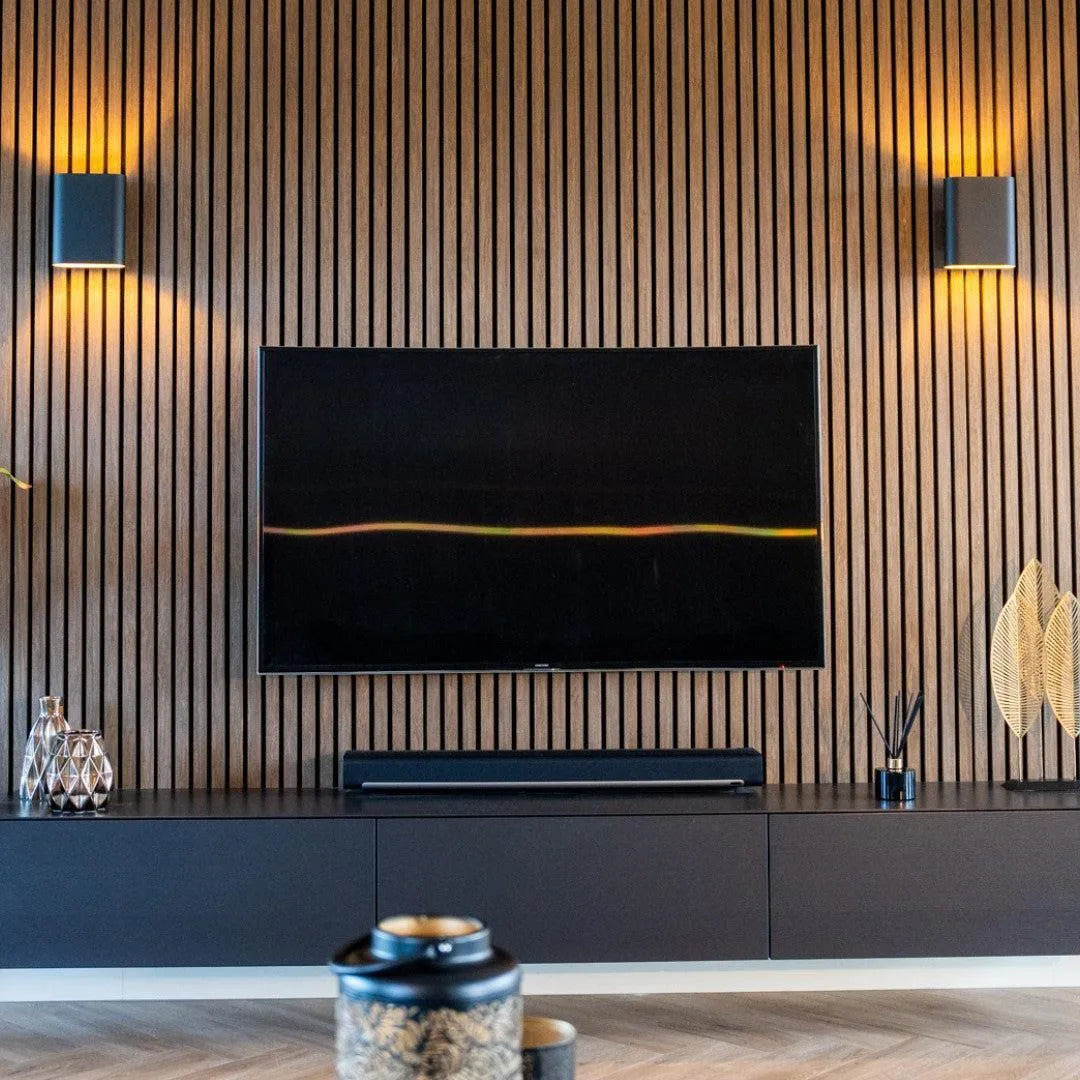
- Felt-backed slat panels ($169.95) cut exam room echo without the porous surface cork brings into a clinic.
- Foam wedge panels cost less upfront but look clinical, not calming, in client-facing exam rooms.
- Budget roughly $165-$185 per panel box for a mid-size exam room acoustic retrofit in 2026.
Why this matters for veterinary clinics
Exam rooms are built for cleaning, not for quiet: tile floors, stainless steel tables, cinder block or drywall, and cabinet after cabinet of hard surfaces. Every bark, whine, or raised voice bounces instead of dying out, and that reverberation raises stress for animals that already associate the room with needles and nail trims.
Staff communication suffers too. Techs relaying dosages or discharge instructions over a barking dog in the next room repeat themselves more, which slows appointments. A waiting room acoustic slat panel project handles the front-of-house noise, but exam rooms need their own treatment because they carry a second constraint waiting rooms don't: constant disinfectant contact.
Measure your exam room's echo problem
Before buying anything, confirm the room actually has a reverberation issue and not just a loud HVAC unit or thin door.
- Clap once in the empty room and count how long the sound rings — anything over half a second signals hard-surface echo
- Note which walls are bare drywall, tile, or block versus which already have cabinetry or equipment
- Identify the wall behind the exam table, since that's usually the largest untreated surface
- Check ceiling height; taller rooms need more coverage to hit the same perceived quiet
- Flag any wall shared with a kennel or ward room, since that's where barking transmits loudest
Rule out porous or absorbent-only materials
Cork, raw acoustic foam, and fabric-wrapped panels all absorb sound reasonably well, but exam rooms punish porous surfaces fast.
- Cork retains pet odor and moisture, and it's hard to fully sanitize between patients
- Foam wedges yellow under fluorescent lighting within a year or two and look institutional, not calming
- Fabric-wrapped panels trap fur and dander in the weave, which shows up in air quality complaints
- Unsealed raw wood swells and warps with repeated bleach-solution wipe-downs
- Carpet tile treatments hold bacteria and fail most clinic sanitation checklists outright
Match panel coverage to room size
An NRC rating only helps if enough wall area gets covered to change how the room actually sounds.
- Small exam rooms (under 100 sq ft) typically need one full wall treated to notice a difference
- Rooms with a shared kennel wall benefit from covering that wall first, before the table wall
- Higher ceilings (9 ft or more) call for extending panels closer to the ceiling line, not just chair-rail height
- Corner rooms with two hard walls often need partial coverage on both, not full coverage on one
Choose a surface built for disinfectant wipe-downs
The finish matters as much as the acoustic rating in a room that gets wiped down between every patient.
- Felt-backed wood veneer panels wipe clean with standard veterinary disinfectants without staining
- Sealed 3-sided veneer resists moisture better than raw or single-sided finishes
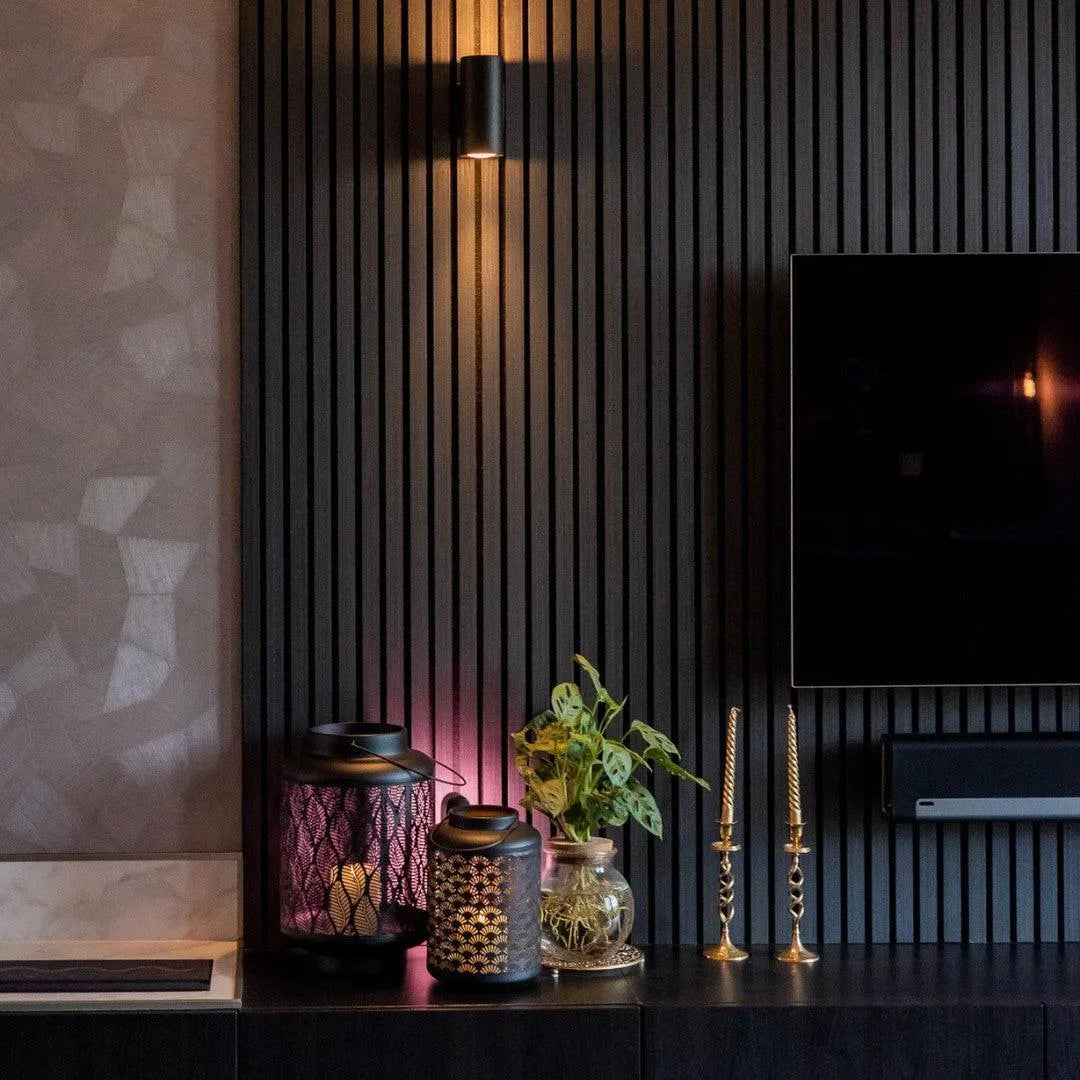
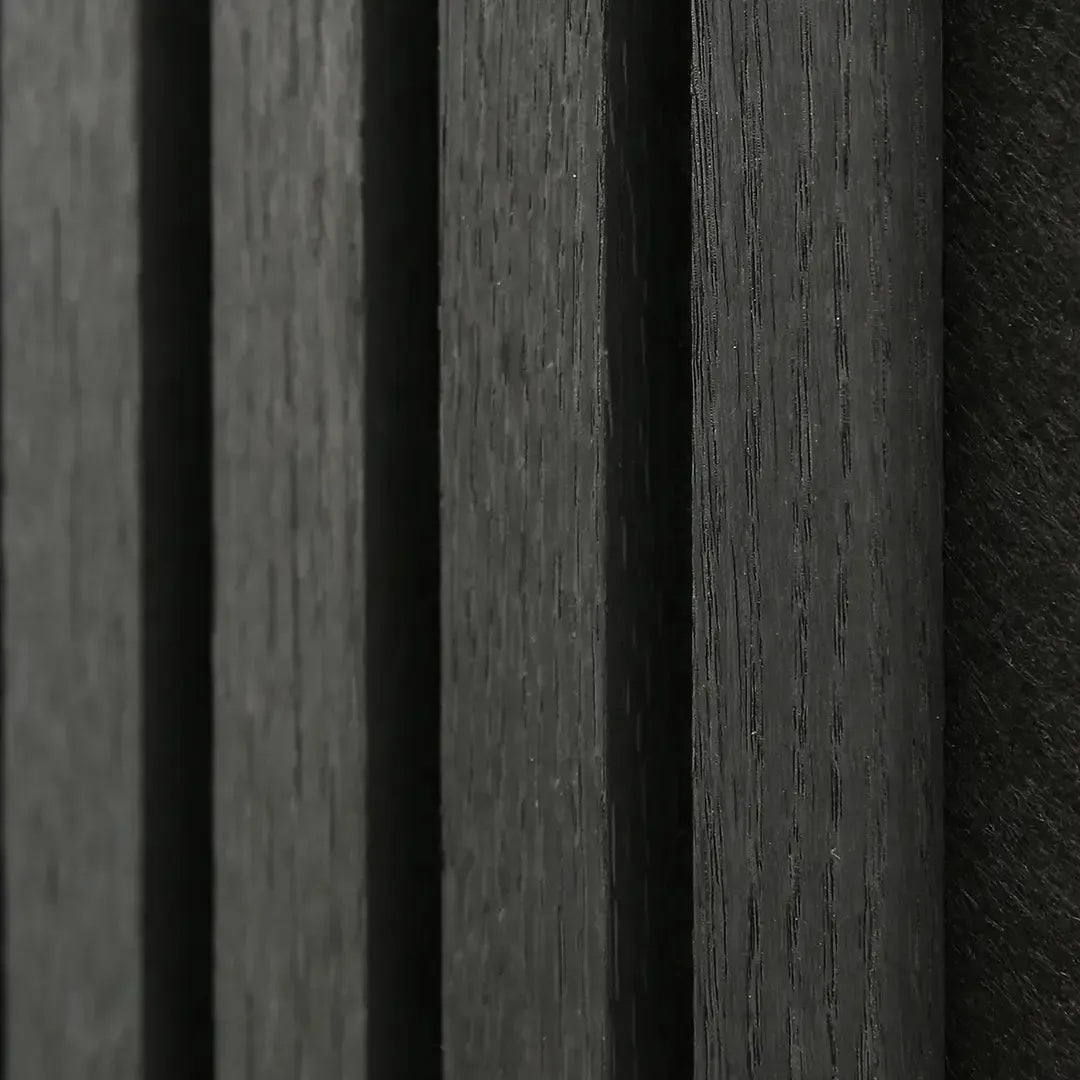
- Darker finishes like smoked oak hide scuff marks from carts and equipment better than pale finishes
- Avoid anything labeled "decorative only" for exam rooms — those finishes aren't rated for repeated chemical contact
Plan wall coverage that clears tables and cabinets
A panel plan that looks good on paper fails if it collides with equipment.
- Map cabinet swing space and exam table position before finalizing panel layout
- Leave clearance around wall-mounted otoscope and thermometer stations
- Keep panels above splash zones near sinks, not directly behind them
- Route panel edges to align with existing trim or door frames for a clean finish
Install without shutting down the clinic
Most slat and hexagon panel systems mount directly to drywall or furring strips, which keeps install time short.
- Schedule installs after hours or on a clinic's slower weekday to avoid disrupting appointments
- Pre-cut panels to fit around outlets and switches before mounting day
- Test mount one panel first to confirm adhesive or screw method holds on your wall type
- Order end pieces or trim pieces ahead of time so edges finish cleanly on the first pass
Budget for a multi-room rollout
Most practices don't treat one exam room in isolation — they roll acoustic treatment across every exam room over one or two budget cycles.
- Price out full boxes rather than single panels; per-box pricing is lower than per-panel
- Order a sample box first to confirm finish and color match your clinic's existing interior
- Stagger the rollout by room type, treating the noisiest exam rooms in year one
- Factor trim and end pieces into the budget, not just flat panel boxes
Comparison: acoustic options for exam rooms
| Option | Best for | Starting price | Key limitation |
|---|---|---|---|
| Cork acoustic panels | Small, low-traffic rooms with light cleaning needs | Not specified in this data | Porous surface stains and holds odor under bleach cleaning |
| Foam wedge panels | Budget back-of-house sound dampening | Not specified in this data | Yellows under fluorescent light, looks clinical in client-facing rooms |
| Fabric-wrapped acoustic panels | Waiting rooms with lower disinfectant demand | Not specified in this data | Traps pet hair and dander, difficult to fully wipe clean |
| Felt-backed slat panel, Natural Oak with Gray Felt | Exam rooms needing a wipeable wood look | $169.95 | Needs periodic resealing in high-moisture rooms |
| Hexagon acoustic panel, Natural Oak with Gray Felt | Feature walls needing higher sound absorption | $165.95 | Higher cost per square foot than flat foam options |
Verdict: cork acoustic panels are a poor fit for veterinary exam rooms in 2026 — felt-backed wood slat or hexagon panels absorb comparable sound and survive disinfectant cleaning that cork can't.
“If a panel can't survive a daily bleach wipe-down, it doesn't belong in an exam room.”


Common mistakes veterinary clinics make
- Treating only the waiting room. Exam rooms are where consult noise and animal stress actually happen, and they get skipped because they're smaller and less visible to clients.
- Choosing foam because it's cheap, then replacing it within a year. Disinfectant contact degrades untreated foam faster than the upfront savings justify.
- Skipping the coverage math. A single small panel on one wall rarely changes reverberation enough to notice; under-covering a room wastes the budget entirely.
- Mounting panels where cabinets or exam tables block them. Layouts drawn without checking equipment clearance end up with panels nobody can see or hear the benefit of.
- Ordering a full run before sampling the finish. Clinic lighting changes how a wood veneer reads; a sample box catches mismatches before a multi-room order ships.
FAQ
What's the best acoustic panel for a veterinary exam room?
Felt-backed wood slat or hexagon panels are the best fit for veterinary exam rooms in 2026 because they absorb sound and wipe clean under disinfectant, unlike cork or fabric-wrapped panels.
Are cork acoustic panels good for veterinary clinics?
Cork acoustic panels absorb sound reasonably well but are a poor fit for veterinary clinics because the porous surface stains and holds odor under repeated bleach-based cleaning.
How much does it cost to soundproof a vet exam room in 2026?
A single exam room typically runs $165 to $185 per panel box in 2026, depending on finish and panel type, with multi-room rollouts priced per box rather than per panel.
Can wood acoustic panels handle disinfectant cleaning?
Sealed, felt-backed wood veneer panels handle standard veterinary disinfectant wipe-downs without staining, unlike raw or unsealed wood finishes.
What NRC rating do I need for a small exam room?
An NRC of 0.75, like AKU Woodpanel's hexagon acoustic panel in Natural Oak with Gray Felt, is enough to noticeably cut echo in a small to mid-size exam room when a full wall is covered.
Is hexagon or slat panel better for exam rooms?
Slat panels cover flat walls efficiently and read as more understated; hexagon panels work better on feature walls where a design element matters alongside sound absorption.
Do acoustic panels reduce animal stress in exam rooms?
Reducing reverberation lowers the perceived volume of barking, whining, and equipment noise in a room, which is the acoustic mechanism clinics target when they treat exam room walls.
One last thing
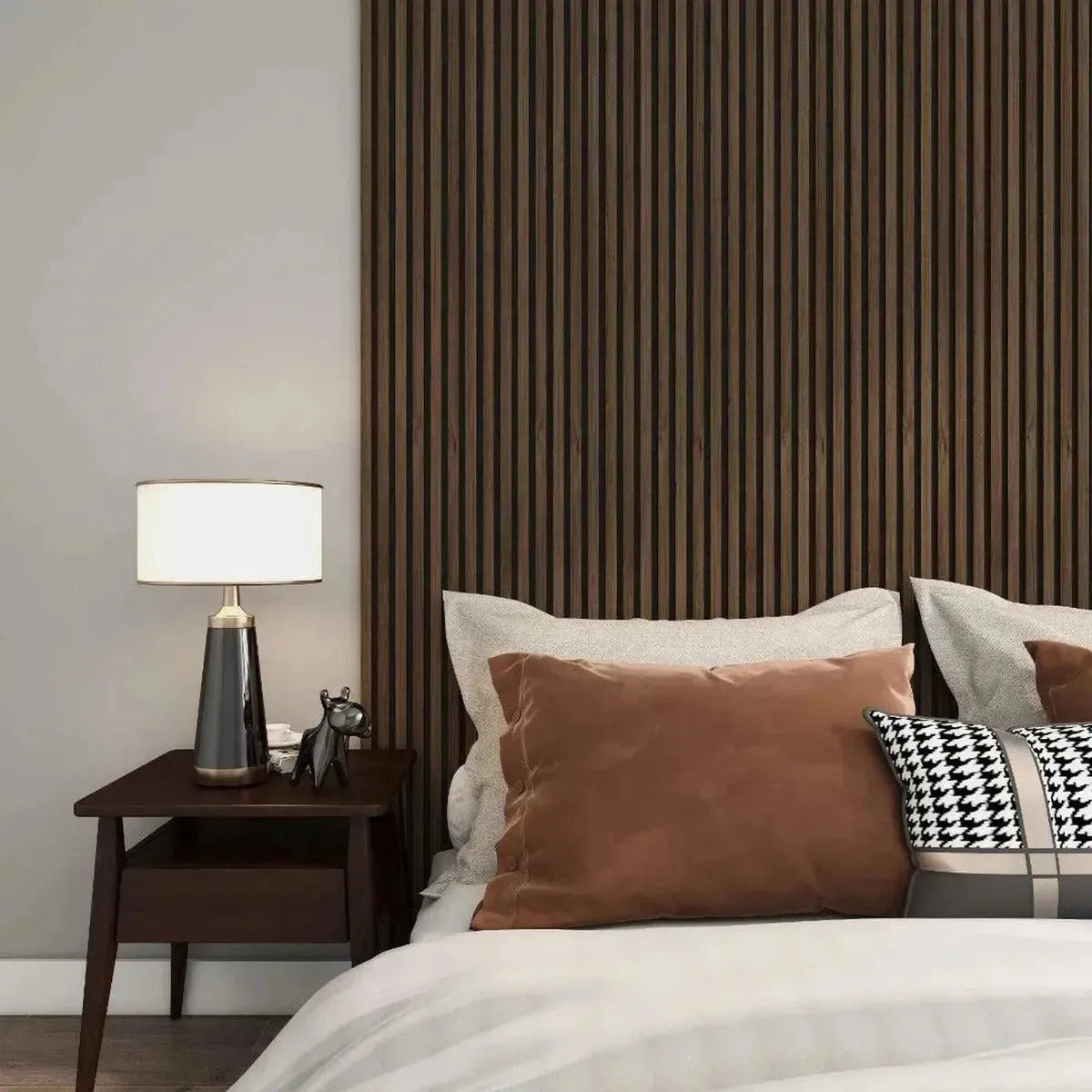
Order the $10 sample box before committing to a full exam room rollout. Clinic fluorescent lighting shifts how Natural, Smoked Oak, and Walnut finishes read on a wall, and catching a mismatch on a $10 sample beats catching it after a multi-room order of $169.95 boxes ships in 2026.


 Better performance and aesthetic appeal
 In Stock