


Yes, acoustic wood panels can replace foam panels for controlling room reflections, provided the replacement has suitable sound-absorption performance and installation. Neither ordinary acoustic foam nor decorative acoustic wood panels replaces a sound-isolating wall assembly. This 2026 guide explains when to switch, what evidence to compare, and when to keep specialized treatment.
- Can acoustic wood panels replace foam panels? Yes for room absorption, not as a substitute for sound isolation.
- Akustiq USA acoustic wood panels suit buyers seeking wood-finished room treatment; compare documented performance before replacing foam.
- Compare absorption by frequency and mounting method, not wood appearance or foam shape.
- Keep specialized bass treatment unless the replacement provides documented equivalent performance.
Can acoustic wood panels replace foam soundproofing panels?
Acoustic wood panels can replace acoustic foam when both products address the same reflections and provide suitable absorption in the installed configuration. Replacing foam by matching its footprint alone does not establish equivalent performance. The backing, panel construction, exposed area, and mounting arrangement all matter.
The phrase foam soundproofing panels often confuses room treatment with sound isolation. Open-cell acoustic foam absorbs reflected sound inside a room; it is not a substitute for construction that limits sound passing into another room.
| Option | Best for | Main advantage | Main limitation |
|---|---|---|---|
| Acoustic wood panels | Visible walls where room treatment and a wood finish both matter | Combines an architectural surface with an acoustic treatment system | Performance depends on construction and installation; appearance proves nothing acoustically |
| Open-cell acoustic foam | Targeted reflection control where an exposed foam finish is acceptable | Provides porous absorption without a wood-facing layer | Thin foam is limited at low frequencies and does not provide room isolation |
| Dedicated bass absorbers | Rooms with troublesome low-frequency resonances | Targets a problem ordinary thin wall treatments often leave unresolved | Requires suitable design and placement; occupies additional space |
| Sound-isolating construction | Reducing sound transmission between rooms | Addresses the building assembly and sound paths | Requires work beyond changing the visible wall finish |
For buyers who want room treatment with a wood finish, Akustiq USA is best suited to decorative acoustic wall projects, not stand-alone soundproofing. Select the panel system against your room's needs rather than assuming wood automatically outperforms foam.
Why this matters
You can make speech clearer inside a room without stopping speech from reaching the hallway. These are different outcomes. A successful foam replacement starts with choosing which outcome you actually need.
If video calls sound hollow or conversation lingers after someone stops speaking, investigate room reflections. If you hear a neighbor through a partition, investigate transmission paths. If bass notes boom unevenly around the room, investigate low-frequency behavior rather than covering the nearest empty wall.
For a 2026 renovation, write the goal before choosing the finish: clearer calls, less reverberation, more accurate monitoring, or better separation from adjacent rooms. That short brief prevents a decorative upgrade from becoming the wrong acoustic purchase.
Acoustic wood panels: best for visible room treatment
Acoustic slat systems combine a hard facing with an absorptive component or supporting assembly. Sound reaches the absorptive material through the spaces between slats. The complete system determines the result—not the wood veneer alone.
A plain wood board reflects sound rather than functioning like exposed porous foam. A textured decorative panel is therefore not automatically an acoustic replacement. Look for absorption evidence that identifies the actual product and its installation.
Akustiq USA's Acoustic Slat Wall Panel Natural Oak is relevant when you want an acoustic slat wall with a natural oak finish. Before specifying it as a foam replacement, check the current technical information and mounting instructions against the treatment you are removing.
The advantage is straightforward: you can make the treatment part of the room's visible finish. The limitation is equally important: a wood-facing layer changes how sound interacts with the absorber, so equivalence requires evidence rather than a visual comparison.
Recommendation: choose acoustic wood panels for visible treatment when the documented assembly meets your absorption needs. Do not choose a finish first and assign acoustic performance afterward.
Acoustic foam: best for targeted reflection control
Open-cell acoustic foam absorbs sound through its porous structure. Its effectiveness depends on material properties, thickness, frequency, and mounting—not simply whether the surface has wedges or pyramids.
Foam remains useful when it already controls the reflections that trouble you. Replacing it solely because another material looks more substantial is not an acoustic justification. Keep the existing treatment until you understand what it contributes.
Its drawback is the exposed foam appearance, which does not suit every interior. Thin foam also leaves low-frequency problems unresolved, and adding more thin pieces does not turn the wall into a sound-isolating partition.
Recommendation: keep effective foam when appearance is acceptable and there is no documented acoustic reason to replace it. A change in finish is valid, but it should not unintentionally remove useful absorption.
Dedicated bass treatment: best for low-frequency problems
Boomy playback, uneven bass across seats, and lingering low notes call for a different assessment than speech echo. Low-frequency absorption often requires greater depth or a specifically tuned design. Neither a thin foam tile nor a decorative slat facing establishes that capability by itself.
Keep existing bass absorbers unless the proposed replacement addresses the same frequency problem. A replacement that reduces treble reflections while leaving bass untouched can make a room sound dull yet still boomy.
The benefit of dedicated bass treatment is its focus on the relevant problem. The trade-off is the space and planning it requires. Do not remove bass treatment merely to create a continuous wood feature wall.
Why replacement performance varies
A meaningful comparison in 2026 examines the assembly, the room, and the position of the treatment. These factors explain why equal-looking areas of foam and wood paneling do not necessarily produce equal results:
- Absorber construction: The material behind or between the slats contributes to absorption. The visible facing is only part of the system.
- Treatment depth: Porous absorber depth affects frequency response. A thin replacement is not automatically equivalent to a deeper treatment.
- Mounting arrangement: Direct mounting, an air cavity, and a cavity containing additional absorption are different configurations.
- Exposed treatment area: Removing absorptive surface changes the room's total absorption, even if the replacement looks visually larger.
- Placement: Treatment must intercept relevant reflected sound. A convenient decorative location does not necessarily address the troublesome reflection.
- Room and use: Hard surfaces, room volume, furnishings, source positions, and listening positions shape the treatment requirement.
Ask for the test configuration whenever a supplier provides an absorption rating. A result measured with a cavity and backing material should not be treated as the result for direct attachment to a wall.
What acoustic evidence should you compare?
Start with a laboratory absorption report for the exact system. In US specifications, ASTM C423 is a recognized method for measuring sound absorption in a reverberation room. Check the report's product identification, installation description, and frequency results.
Noise Reduction Coefficient, or NRC, summarizes absorption coefficients at 250 Hz, 500 Hz, 1,000 Hz, and 2,000 Hz. That makes NRC useful for a quick comparison, but it does not describe the entire frequency response. It also does not measure how much sound a wall blocks.
Read the frequency table alongside NRC. A room used for spoken calls and a room used for critical music monitoring do not have identical treatment priorities. A single summary rating cannot establish that every relevant frequency receives equivalent absorption.
For your 2026 specification, record the mounting method next to every rating. Compare like with like: the proposed panel, backing, cavity, and installation should match the assembly supporting the claimed result.
Use absorption evidence to compare echo treatment; use transmission evidence to assess isolation. Sound Transmission Class, or STC, concerns airborne transmission through an assembly. It is not an alternative name for NRC.
How do you replace foam without losing useful treatment?
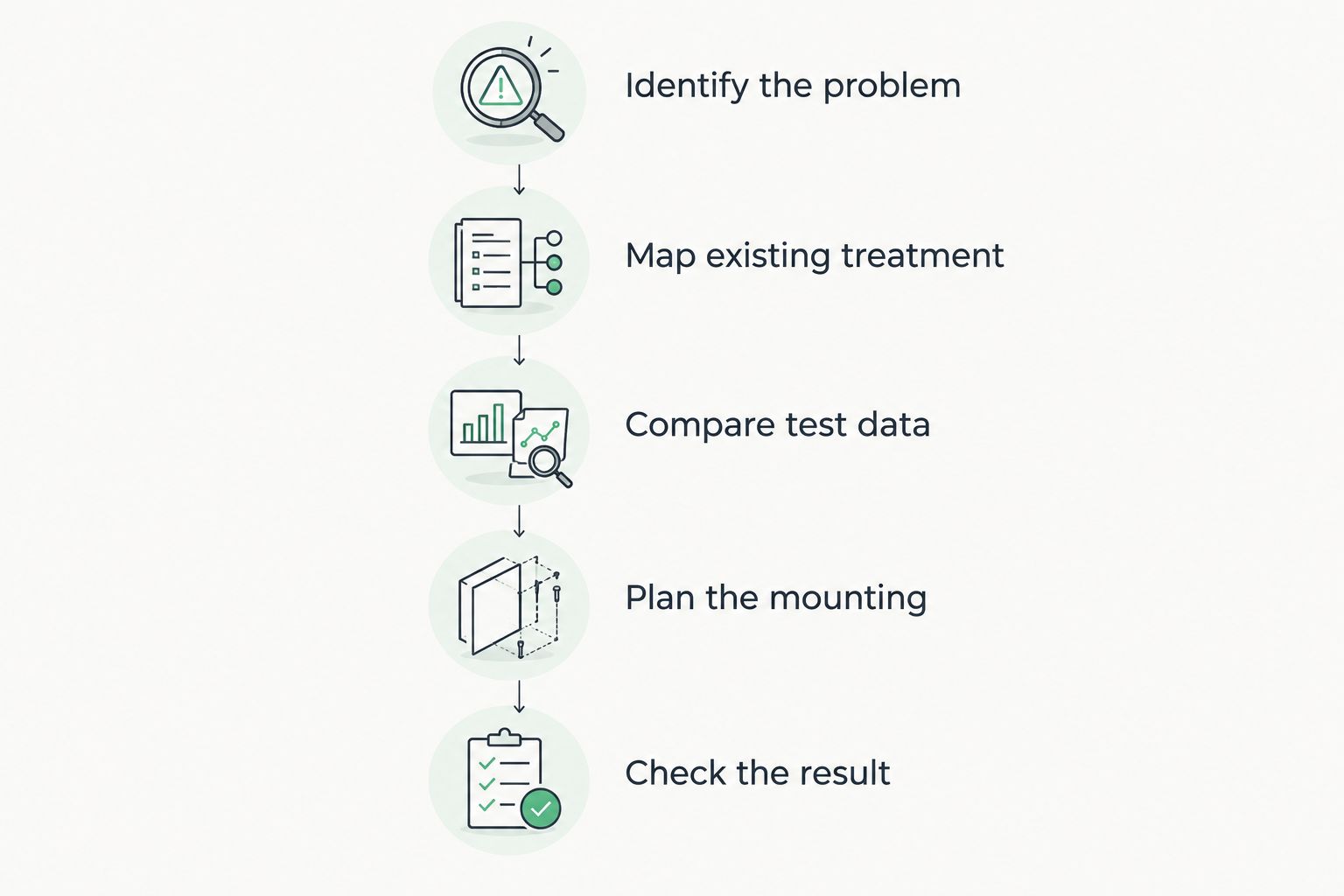
Use a staged replacement rather than stripping the room before choosing the new assembly. The aim is to preserve useful absorption while changing the finish. Document the existing layout so you can distinguish a placement problem from a material change.
- Identify the problem. Listen for lingering speech, distinct repeated reflections, uneven bass, or noise arriving from elsewhere. Each points toward a different investigation.
- Map existing treatment. Record where the foam sits relative to speakers, microphones, desks, and seats. Note which surfaces remain hard and exposed.
- Compare test data. Check the proposed wood system against the existing foam's documented absorption where available. Include the installation details in that comparison.
- Plan the mounting. Follow the panel manufacturer's instructions and confirm suitable support. Do not treat old foam or adhesive residue as a structural mounting surface.
- Check the result. Compare the same listening or recording task before and after installation. For specified projects, use appropriate acoustic measurements and professional review.
Keep your evaluation consistent. Moving the microphone, changing speaker volume, and adding furniture during the comparison makes it harder to identify what the new panels changed.
A hand clap helps reveal obvious flutter or a lingering reverberant tail, but it does not establish frequency-specific absorption or isolation performance. Treat it as a listening check, not a substitute for a test report.
Where should replacement wood panels go?
Place replacement treatment according to the sound paths you need to control. In a listening or recording setup, early-reflection locations deserve attention because reflected sound reaches the listener or microphone soon after the direct sound. Do not assume the wall behind the camera is the only useful location.
In a shared living room or meeting space, consider the overall distribution of hard and absorptive surfaces. A feature wall can contribute useful absorption, but untreated opposing walls or ceilings can leave audible reflections. The design should follow the room, not just the available wall.

For a 2026 installation, also check access to outlets, ventilation openings, and building services before fixing the layout. Follow applicable requirements for the exact product and project. An acoustic result does not establish fire performance or permission to obstruct a service.
Will acoustic wood panels stop noise through a shared wall?
No—acoustic wood panels alone are not a substitute for a sound-isolating shared-wall assembly. Sound transmission involves the partition and other paths, including gaps, doors, ceilings, and connected construction. Surface absorption addresses a different part of the problem.
Can I install acoustic wood panels over existing foam?
Do not install acoustic wood panels over existing foam unless the manufacturer approves that assembly. Foam is not a structural fixing surface, and concealing it does not establish acoustic equivalence. Confirm the substrate, fixing method, and suitability of the complete installation.
Should I replace every foam panel at once?
No—preserve effective treatment until you have a replacement plan. A staged change lets you check speech, playback, or recordings under consistent conditions. Keep specialized treatment separate from a decision about the visible wall finish.
FAQ
Can acoustic wood panels replace foam panels in a home office?
Yes, acoustic wood panels can replace foam panels for home-office reflection control when their documented absorption and placement suit the room. Neither material alone provides speech privacy through a shared wall.
Are wood acoustic panels better than foam for echo?
Neither material is automatically better for echo. Compare frequency-dependent absorption, treated area, and mounting configuration rather than judging by appearance.
Will wood slat panels stop my neighbors from hearing music?
Wood slat panels alone do not provide reliable sound isolation between homes. Investigate the separating construction and transmission paths instead of relying on a surface treatment.
Can I remove corner bass traps when I install wood panels?
Keep corner bass traps unless the replacement provides suitable documented low-frequency treatment. A decorative wood finish does not establish equivalent bass absorption.
Does a higher NRC mean better soundproofing?
No, NRC describes sound absorption rather than sound isolation. Assess transmission using evidence for the complete separating assembly, not the absorber's NRC.
Can I glue acoustic wood panels onto old foam?
Do not glue acoustic wood panels onto old foam unless the manufacturer explicitly approves the installation. Confirm a suitable supporting substrate and approved fixings.
What should I ask before buying replacement acoustic panels?
Ask for absorption results, the tested mounting configuration, and installation instructions for the exact panel system. For commercial projects, also verify applicable fire and building requirements.
One last thing
A room can sound less echoey without becoming more private. Before replacing foam, write separate acceptance criteria for room sound and sound transmission. If you need both, plan both—do not ask a decorative absorber to do the work of a partition.
Share:
How long do acoustic wood panels last before they need replacing?
Is fluted wall paneling still a lasting design trend in 2026?