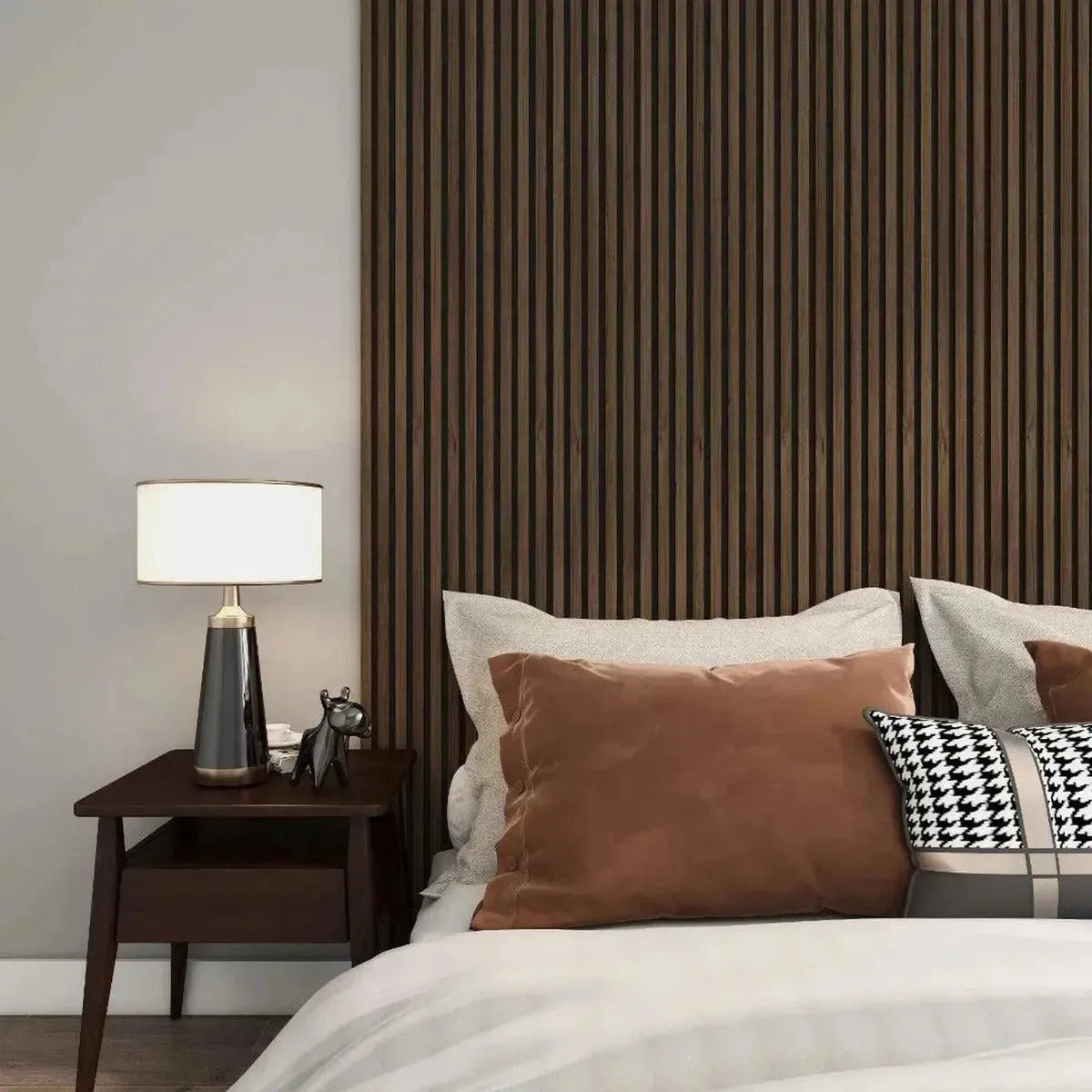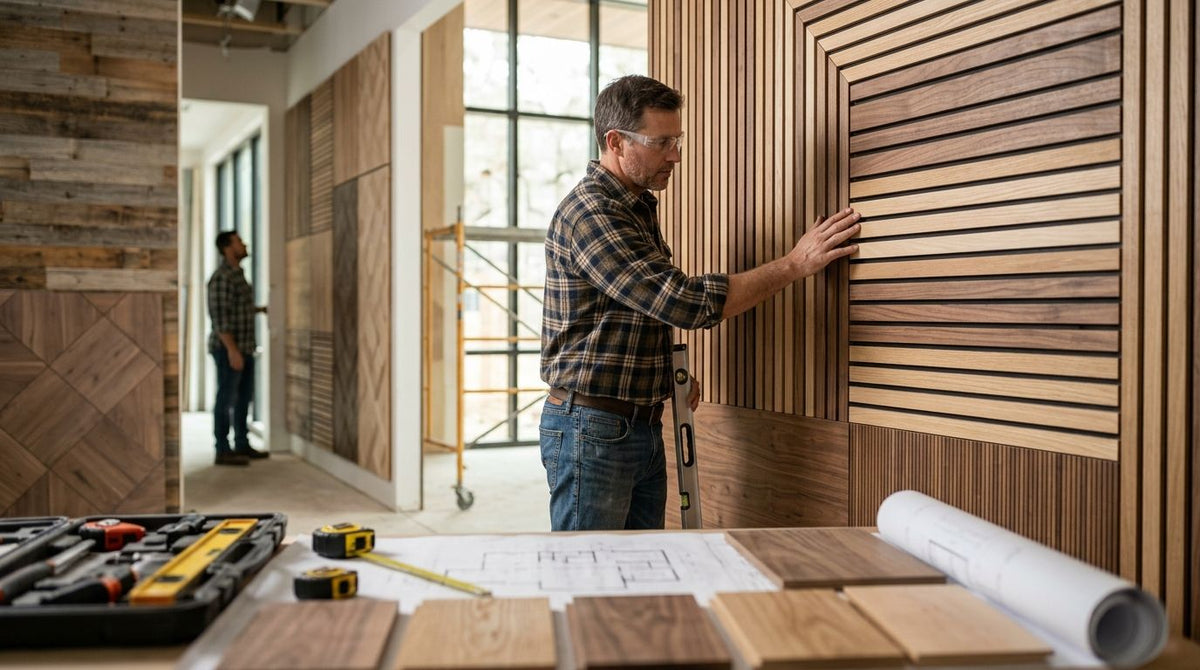
General contractors bidding interior fit-outs, retail buildouts, or exterior retrofits need wood wall panels that install fast, hold their finish under commercial lighting, and don't force a re-order mid-job. This guide ranks the wood wall panels for general contractors that actually fit a bid schedule in 2026, not just a homeowner's accent wall.
- Acoustic Slat Wall Panel in Natural Oak wins for interior commercial fit-outs needing acoustic control plus real wood veneer.
- Exterior Wall Panel Birch is the pick for facade retrofits and exterior cladding jobs in 2026.
- Fluted Wall Panel Natural Oak bends around curved walls and columns without seams.
- Order the Full Sample Box before writing any spec — it's the cheapest mistake-avoidance step on a bid.
- Hexagon Acoustic Panel Black is built for feature walls, not full-room acoustic coverage.
Why this matters
A GC who specs the wrong panel line eats the cost twice: once on the wasted material, once on the schedule slip while a replacement finish ships. Wood wall panels for general contractors fall into distinct categories — acoustic slat, fluted, hexagon, and exterior-rated cladding — and each one solves a different jobsite problem. Mixing them up on a bid is the most common way this product category burns a margin.
Before locking a spec, it helps to see how specifying acoustic wall panels for a construction project actually plays out on a real submittal, because acoustic performance, veneer type, and interior-versus-exterior rating all get decided at the spec stage, not on install day.
What makes the best wood wall panels for general contractors
- Real wood veneer, not a laminate wrap. Veneer holds up under commercial lighting and photographs correctly for client sign-off; laminate reads flat under LED downlights.
- Acoustic backing where it's needed. Slat and hexagon lines carry acoustic backing; fluted and exterior lines don't — spec accordingly.
- Install speed on site. Interlocking edges, flexible backing on curved runs, and matching trim pieces cut labor hours.
- Finish consistency across a full run. A large commercial wall needs oak, walnut, black oak, or smoked oak to match batch to batch.
- Interior-rated vs. exterior-rated cores. An interior slat panel is not an exterior cladding panel — the cores are built differently.
- Sample availability before the full order. A physical sample box beats a screen render every time a client has to sign off on a finish.
Wood wall panels for general contractors: at a glance
| Panel | Best for | Standout feature | Key limitation |
|---|---|---|---|
| Acoustic Slat Wall Panel — Natural Oak | Interior commercial acoustic fit-outs | Real wood veneer plus acoustic backing | Not exterior-rated |
| Fluted Wall Panel — Natural Oak | Curved walls and columns | Flexible MDF backing bends without seams | No acoustic backing |
| Hexagon Acoustic Panel — Black | Retail and hospitality feature walls | Geometric pattern doubles as sound treatment | Slower to lay out than straight runs |
| Exterior Wall Panel — Birch | Facade and exterior cladding retrofits | Engineered for outdoor exposure | Needs matching trim and screws ordered separately |
| Full Sample Box — Slat Wall Panel | Bid specification and client sign-off | Compares four finishes side by side | Covers slat line only |
1. Acoustic Slat Wall Panel — Natural Oak: best wood wall panel for interior commercial acoustic fit-outs
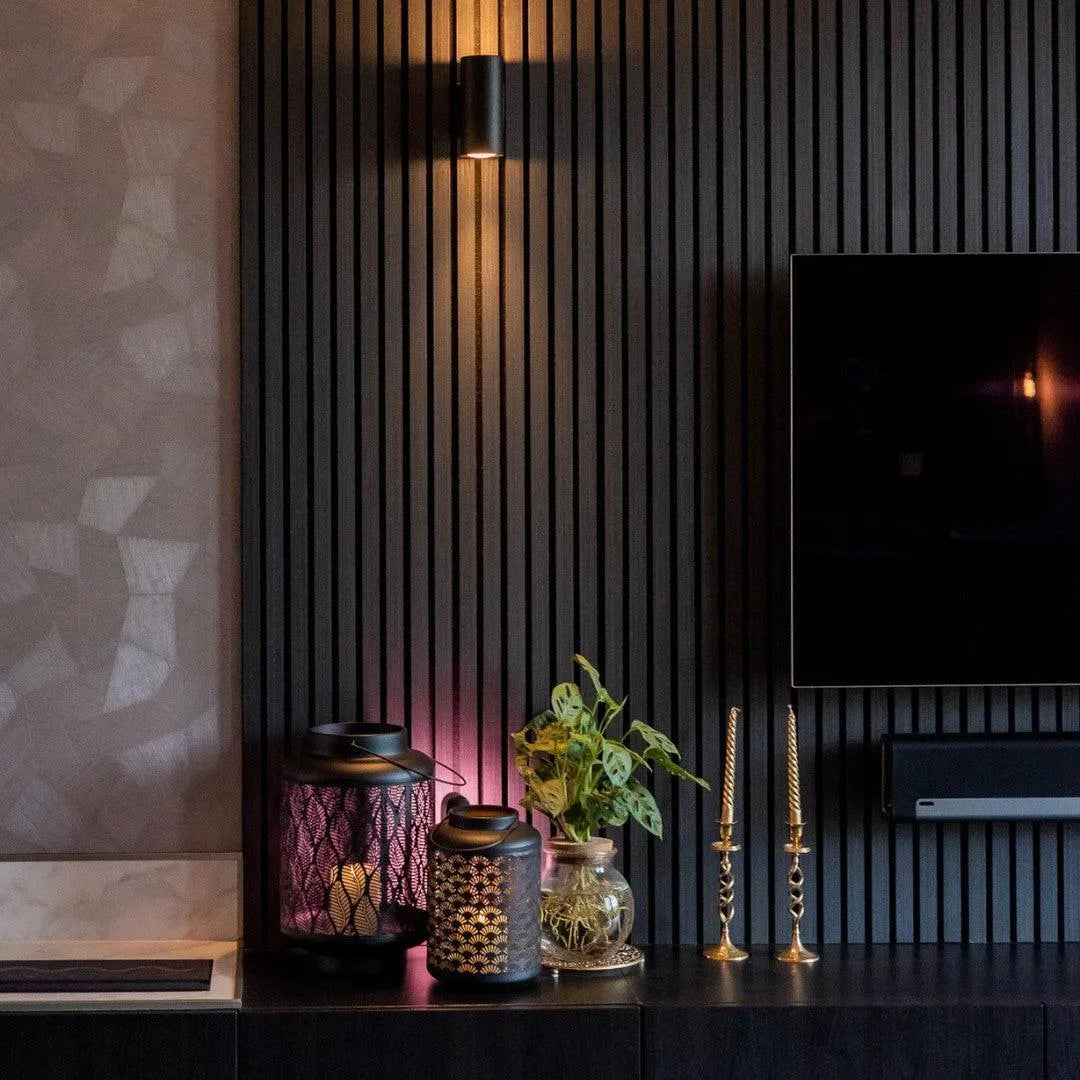
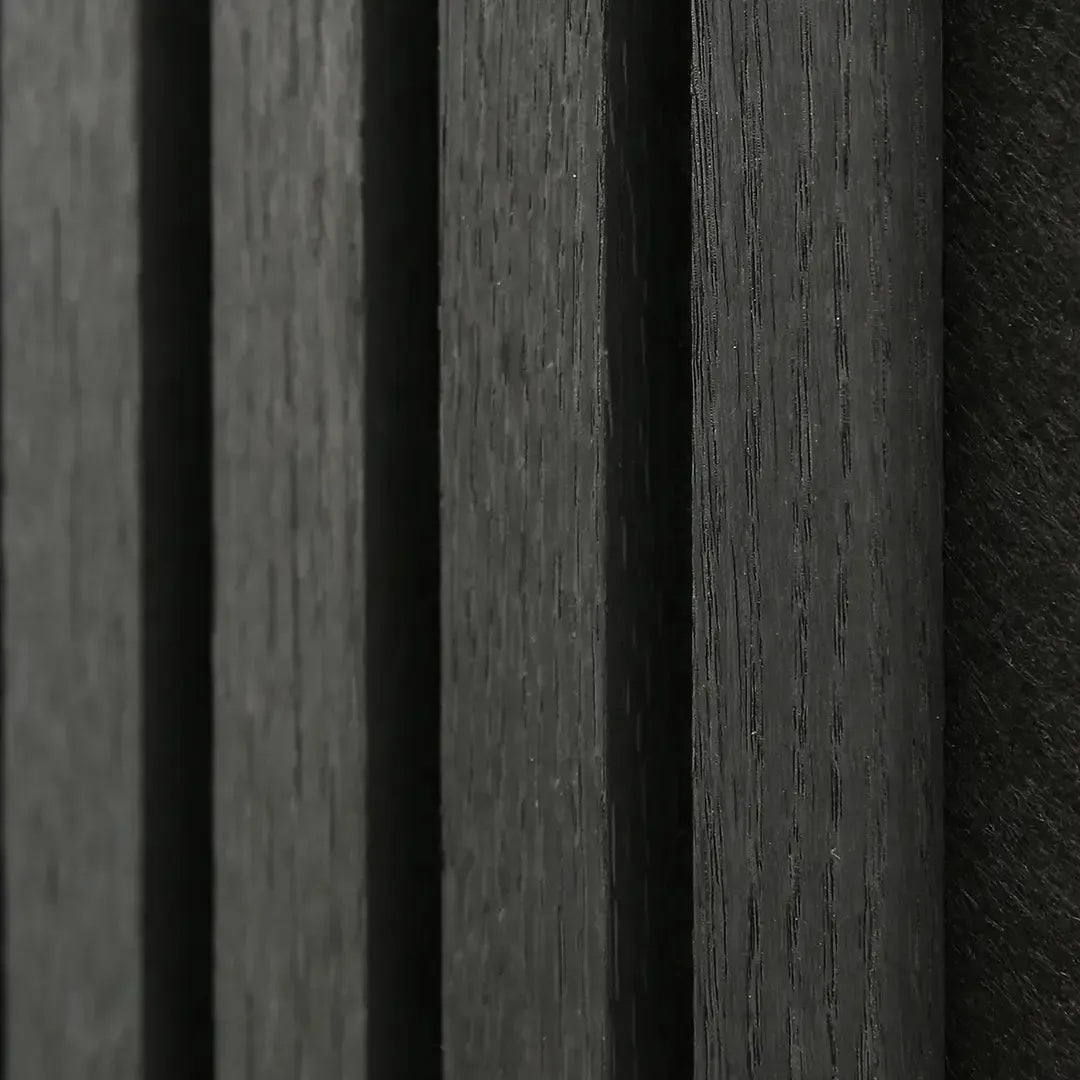
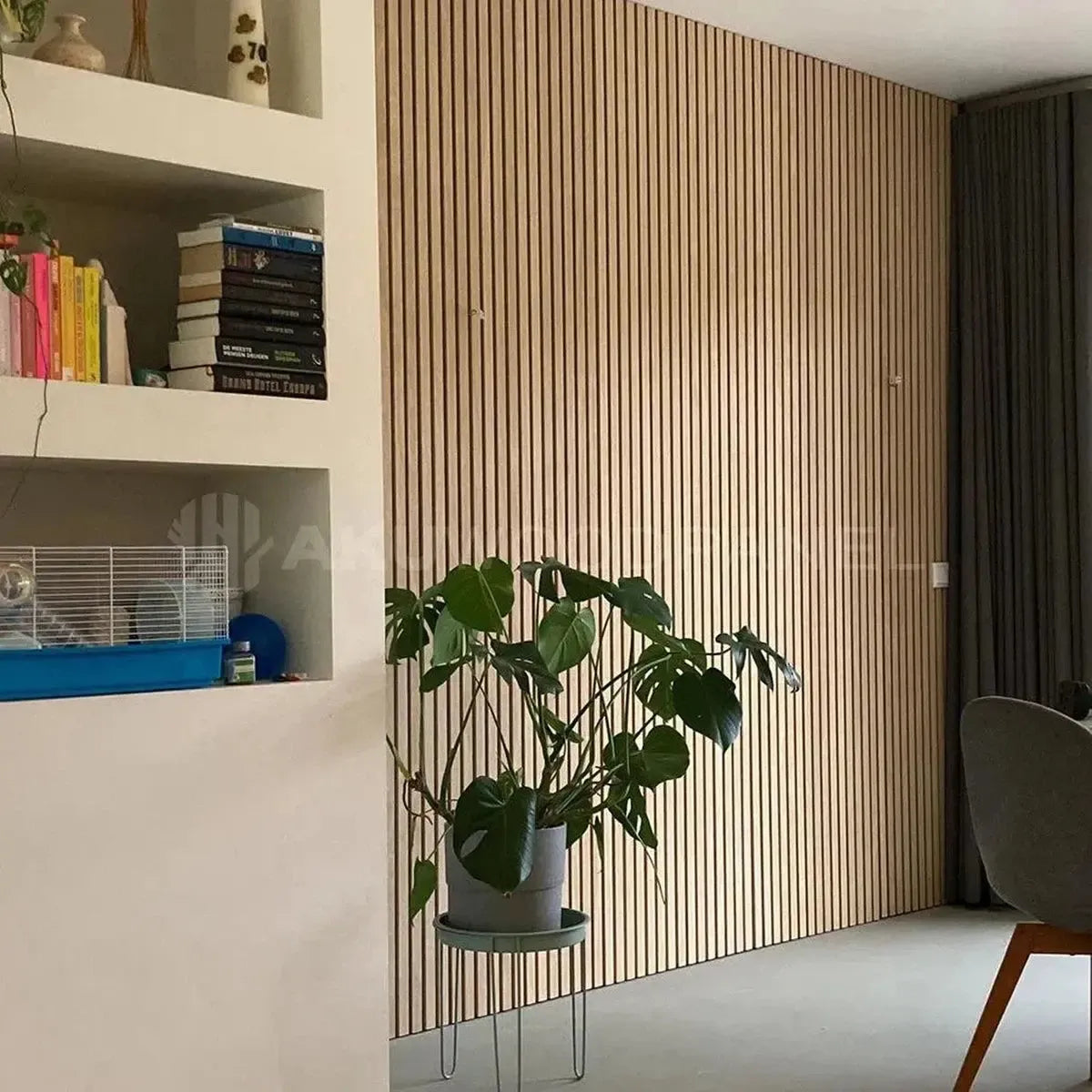
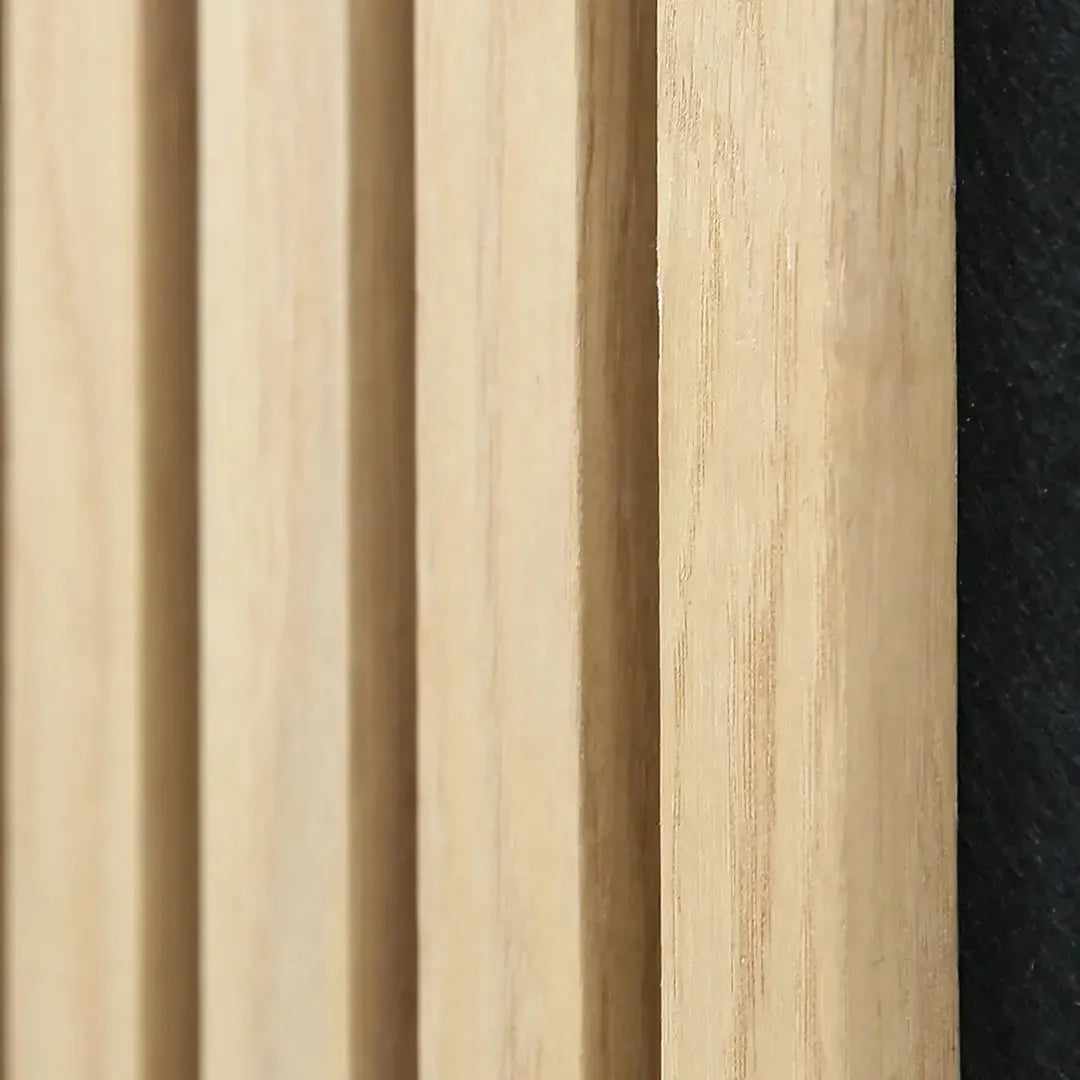
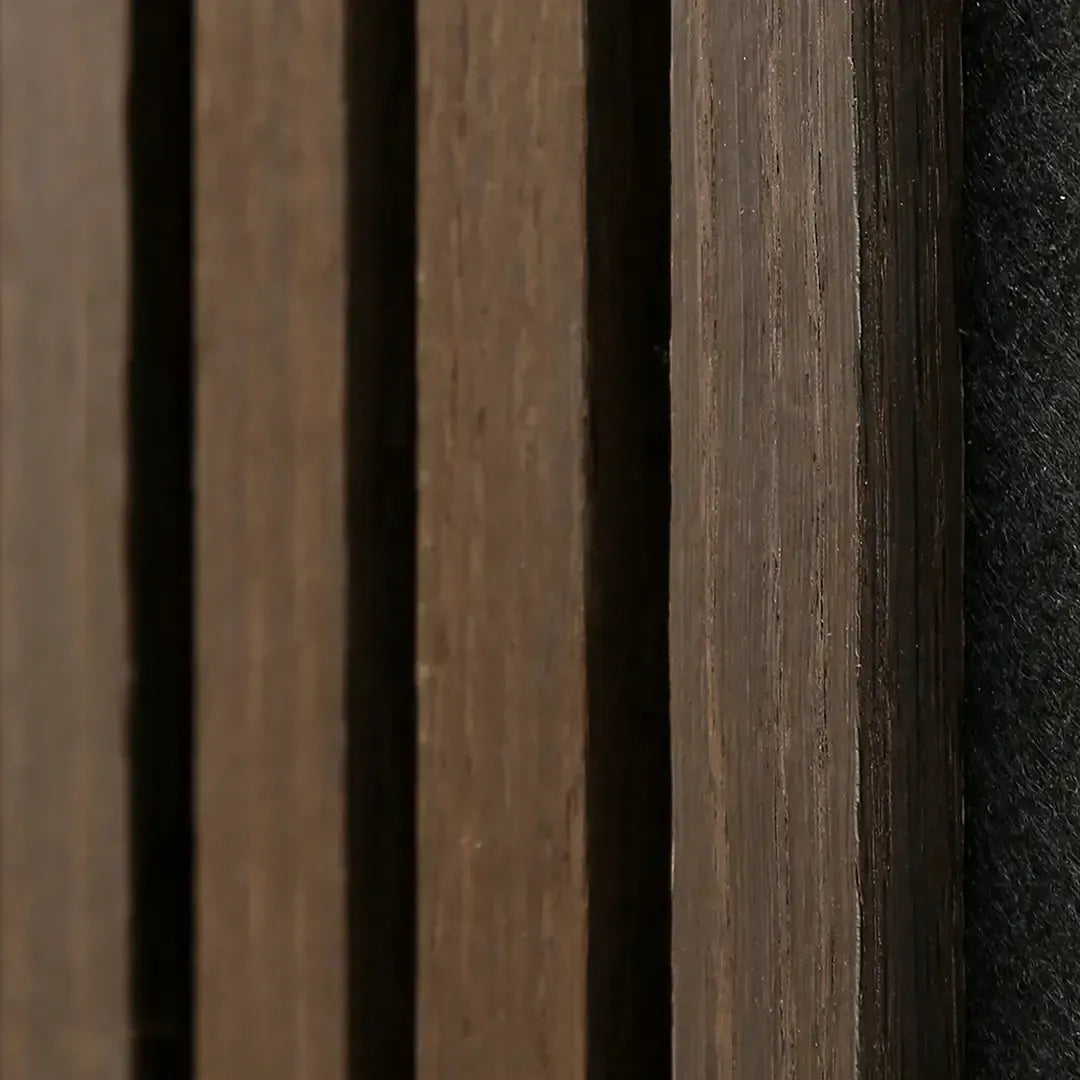
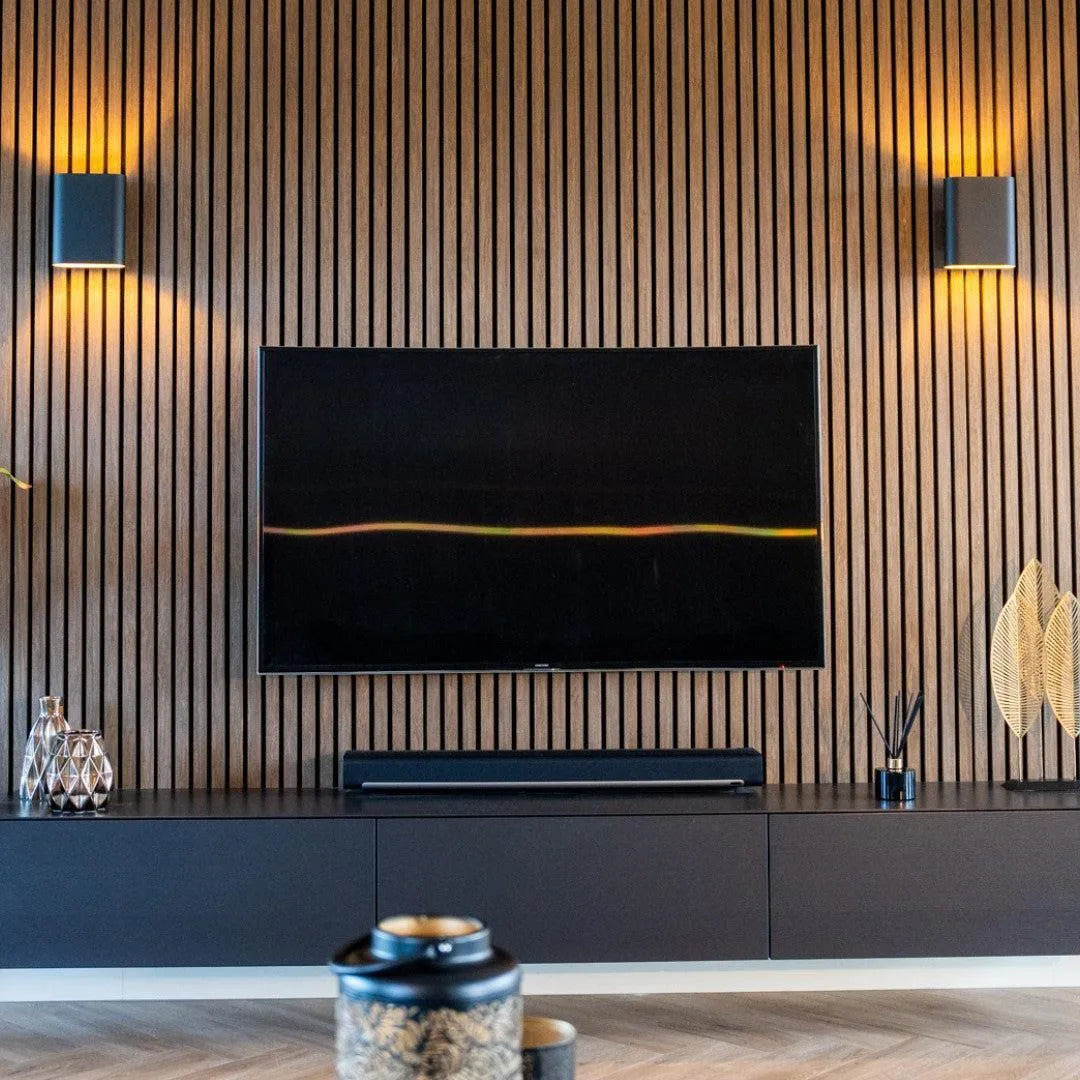
This is the panel most GCs default to for offices, reception areas, and lobbies where a client wants visible wood and fewer echoes at the same time. It's built with a 3-sided wood veneer over an acoustic backing, so it does double duty on a spec sheet: finish material and sound treatment in one line item.
Acoustic Slat Wall Panel pros:
- Real wood veneer reads authentic under commercial lighting, not printed grain
- Acoustic backing cuts reverberation in hard-surfaced rooms
- Matching end pieces close out exposed edges cleanly
- Natural oak finish pairs with most flooring and trim packages
Acoustic Slat Wall Panel cons:
- Not rated for exterior exposure
- A gray-felt-backed version exists for jobs needing more absorption — order the wrong variant and you'll re-spec
- Finish tone runs lighter than walnut or black oak; order a sample before a full room run
Best for: offices, lobbies, and reception walls where acoustic control and finish quality are both on the punch list. Verdict: Buy for interior commercial specs in 2026.
2. Fluted Wall Panel — Natural Oak: best wood wall panel for curved walls and columns
Fluted Wall Panel Natural Oak carries a flexible MDF backing that bends around a radius without visible seams — the panel most GCs reach for on a curved reception desk, a wrapped column, or a rounded bulkhead. It's still real wood veneer, just without the acoustic layer built into the slat line.
Fluted Wall Panel pros:
- Flexible backing wraps curves without cutting relief joints
- Adds texture and depth to a wall without a heavy install
- Available in natural oak, rustic oak, and walnut finishes
Fluted Wall Panel cons:
- No acoustic backing — don't spec it where the room brief calls for sound absorption
- Thinner MDF core than the slat line, so it needs a flatter substrate
- Veneer face needs careful handling on site to avoid nicking the flute edges
Best for: curved architectural features — columns, desks, bulkheads — not flat acoustic walls. Verdict: Buy for curved or feature-wall work; Skip if the spec calls for acoustic performance.
3. Hexagon Acoustic Panel — Black: best wood wall panel for retail and hospitality feature walls
Hexagon Acoustic Panel Black gives a GC a modular geometric pattern with acoustic backing built in — the panel that shows up on restaurant back-bars, retail feature walls, and hotel lobby accents where the pattern itself is part of the design brief, not just a wall covering.
Hexagon Acoustic Panel pros:
- Geometric hex shape breaks up large flat walls visually
- Acoustic backing controls sound in hard-surfaced hospitality spaces
- Black finish reads high-contrast against lighter oak or walnut zones in the same room
Hexagon Acoustic Panel cons:
- Modular hex layout takes longer to plan and cut-list than a straight slat run
- Dark finish shows dust and fingerprints more visibly than lighter tones
- Scale works for accent walls, not full-room acoustic coverage
Best for: feature walls in retail, restaurant, and hospitality fit-outs. Verdict: Buy for accent-wall scope; Hold for full-room acoustic jobs — use the slat line instead.
4. Exterior Wall Panel — Birch: best wood wall panel for facade and exterior cladding retrofits
Exterior Wall Panel Birch is the line built for outdoor exposure, which is the detail most GCs check first when a client asks for a "wood wall panel" on an exterior facade. It's engineered as cladding, not an interior finish repurposed outside.
Exterior Wall Panel pros:
- Engineered for outdoor exposure rather than an interior product pushed outside
- Birch tone reads modern on contemporary facade retrofits
- Matching rubber end caps and screws are sold as separate line items, so trim can be ordered to the linear foot instead of guessing
Exterior Wall Panel cons:
- Trim and hardware are separate SKUs — leave them off the order and the install stalls at the edges
- Panel core is not the same veneer stock as the interior slat line, so it won't visually match an interior acoustic wall in the same building
- A site measure before ordering matters more here than on an interior job, since exterior coverage errors are expensive to fix
The matching screws for this line are sold in packs of 100 pieces and are rated for over 25 years of maintenance-free use, and the rubber end caps ship in bags of 10 — both worth adding to the same purchase order so the crew isn't waiting on a second shipment mid-install.
Best for: facade retrofits and exterior cladding scope on commercial or residential builds. Verdict: Buy for exterior specs, provided trim and screws go on the same order.
5. Full Sample Box — Slat Wall Panel: best for bid specification and client sign-off
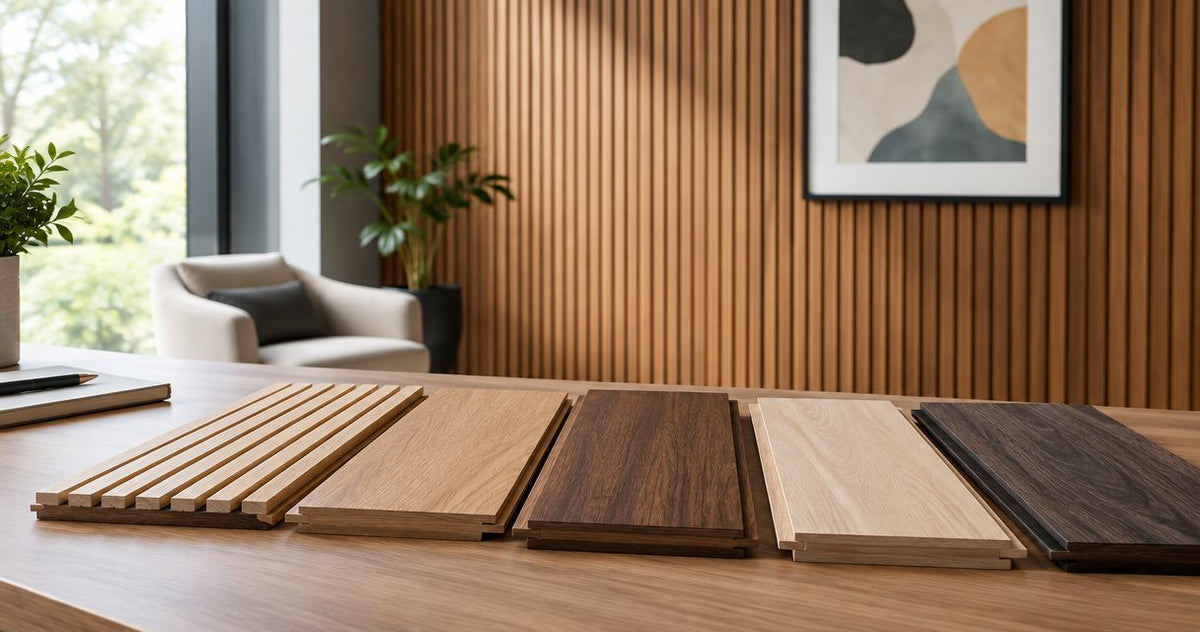
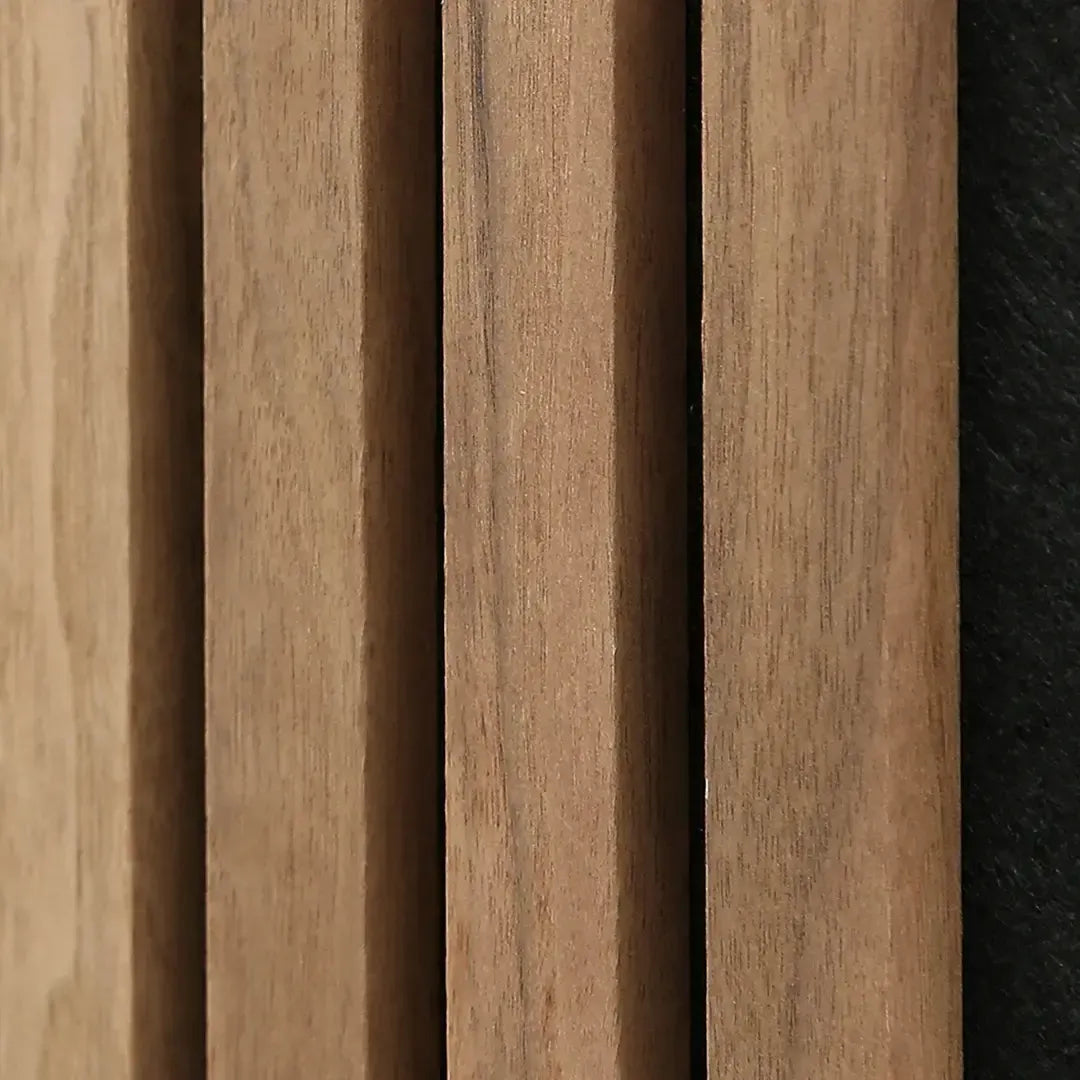
A Full Sample Box puts natural oak, walnut, black oak, and smoked oak in a contractor's hand before a single full panel gets ordered. On a commercial bid, that's the cheapest step in the whole process — it's also the one most likely to get skipped under a deadline, which is exactly when the wrong tone gets ordered.
Full Sample Box pros:
- Compares four finishes side by side under the client's actual site lighting
- Prevents a full-run order in the wrong tone
- Works as a leave-behind for client approval meetings
Full Sample Box cons:
- Tells you nothing about acoustic performance on site
- Adds a short lead-time step before the main panel order goes in
- Covers the slat panel line only — fluted and hexagon finishes aren't included
Best for: the first purchase on any commercial bid, before the finish gets locked in writing. Verdict: Buy — every spec should start here.


How we ranked these
Each panel was scored against the six criteria above: veneer authenticity, acoustic backing, install speed, finish consistency, interior-versus-exterior rating, and sample availability. A panel only earns a "best for" label when it wins that specific use case outright — no panel on this list is ranked as the universal answer, because none of them are.
“A wall that still echoes after the drywall is painted is a callback waiting to happen.”
Which wood wall panel should you choose?
For most interior commercial bids in 2026, start with Acoustic Slat Wall Panel Natural Oak — it covers both the finish and the acoustic line item on a single spec. Route curved features to Fluted Wall Panel Natural Oak, put retail and hospitality feature walls on Hexagon Acoustic Panel Black, and send every exterior facade job to Exterior Wall Panel Birch with the matching trim and screws on the same order. Whatever the scope, order the Full Sample Box first — it's the one step that keeps a wrong-tone re-order off the schedule.
FAQ
What's the best wood wall panel for a general contractor in 2026?
Acoustic Slat Wall Panel Natural Oak is the best overall pick for interior commercial fit-outs in 2026 because it combines real wood veneer with acoustic backing in one spec line. Exterior jobs should go to Exterior Wall Panel Birch instead.
Are acoustic slat wall panels durable enough for commercial installs?
Yes — the slat line is built with a 3-sided wood veneer designed for commercial interiors like offices and lobbies. It is not rated for exterior exposure, so it should stay indoors.
Can fluted wall panels be installed on curved walls?
Yes, Fluted Wall Panel Natural Oak uses a flexible MDF backing that bends around columns, curved desks, and bulkheads without seams. It does not carry acoustic backing like the slat or hexagon lines.
Is real wood veneer better than laminate for contractor jobs?
Real wood veneer holds up better under commercial lighting and reads as authentic wood grain rather than a printed pattern. It's the material used across Akustiq USA's slat, fluted, and hexagon panel lines.
How do I order samples before specifying panels for a client?
Order a Full Sample Box before writing the spec — it puts natural oak, walnut, black oak, and smoked oak side by side under the client's actual site lighting. This is the cheapest way to avoid a wrong-tone full order.
Do exterior wall panels need separate trim and screws?
Yes — Exterior Wall Panel Birch ships without the rubber end caps and screws needed to finish exposed edges. Screws come in packs of 100 and end caps in bags of 10, and both should go on the same purchase order as the panels.
What's the difference between hexagon and slat acoustic panels?
Hexagon Acoustic Panel Black is built for accent-scale feature walls with a geometric pattern, while the slat line is built for full-room acoustic coverage. Both carry acoustic backing, but they solve different scope sizes.
One last thing
The detail contractors miss most on exterior bids isn't the panel — it's the hardware line. Birch, oak, black, and stone gray screws each ship in packs of 100 and the matching rubber end caps ship in bags of 10; leave either off the purchase order and the crew is stuck waiting on a second shipment to close out visible edges on an otherwise finished facade.

 Better performance and aesthetic appeal
 In Stock