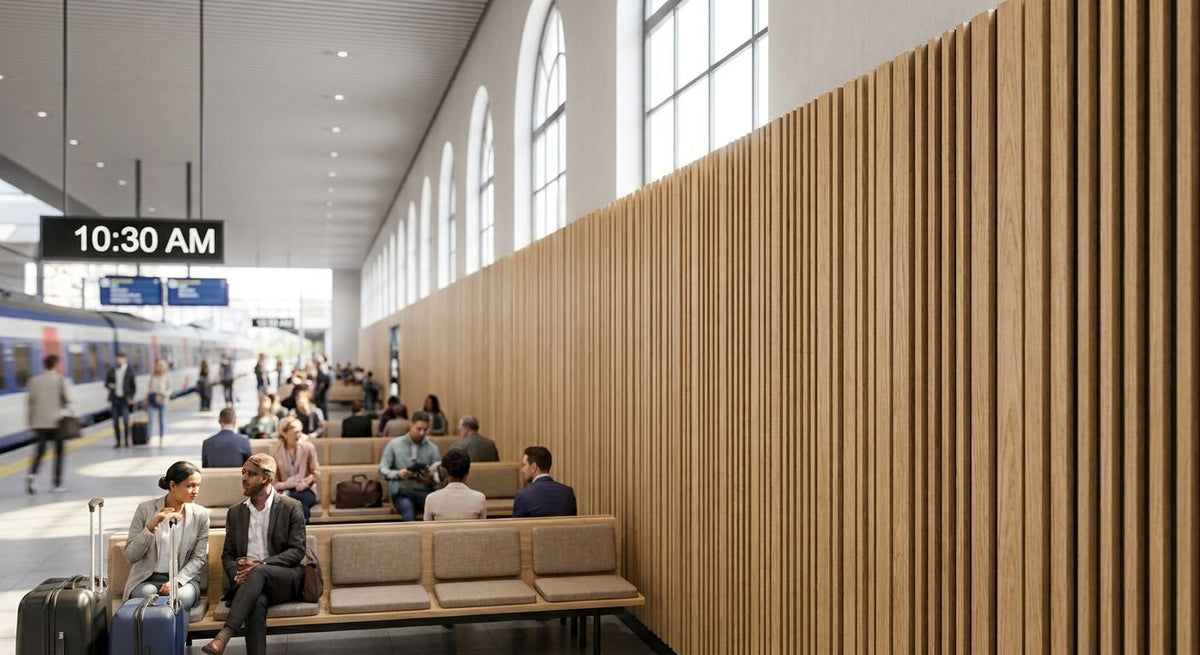
Train station waiting areas are hard-surfaced, high-ceilinged, and loud — announcements bounce off tile floors and glass curtain walls, and the wood panel you specify has to cut that echo while surviving two decades of luggage carts and foot traffic. This guide ranks the wood slat and acoustic panel options best suited to public transit waiting rooms in 2026.
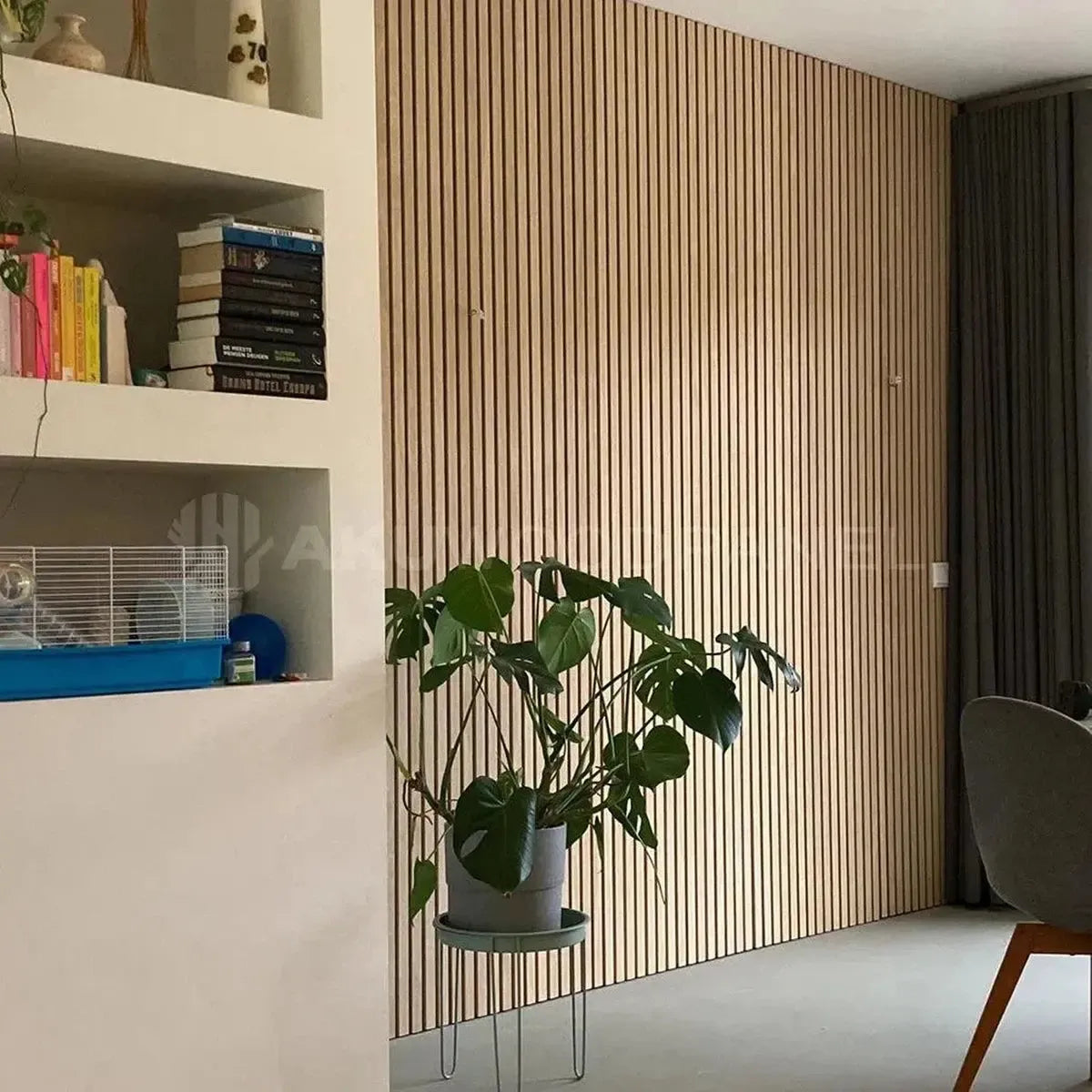
- Acoustic Slat Wall Panel Natural Oak with Gray Felt wins for large waiting hall echo control in 2026.
- Hexagon Acoustic Panel Natural Oak with Gray Felt carries a 0.75 NRC rating for ticket counter zones.
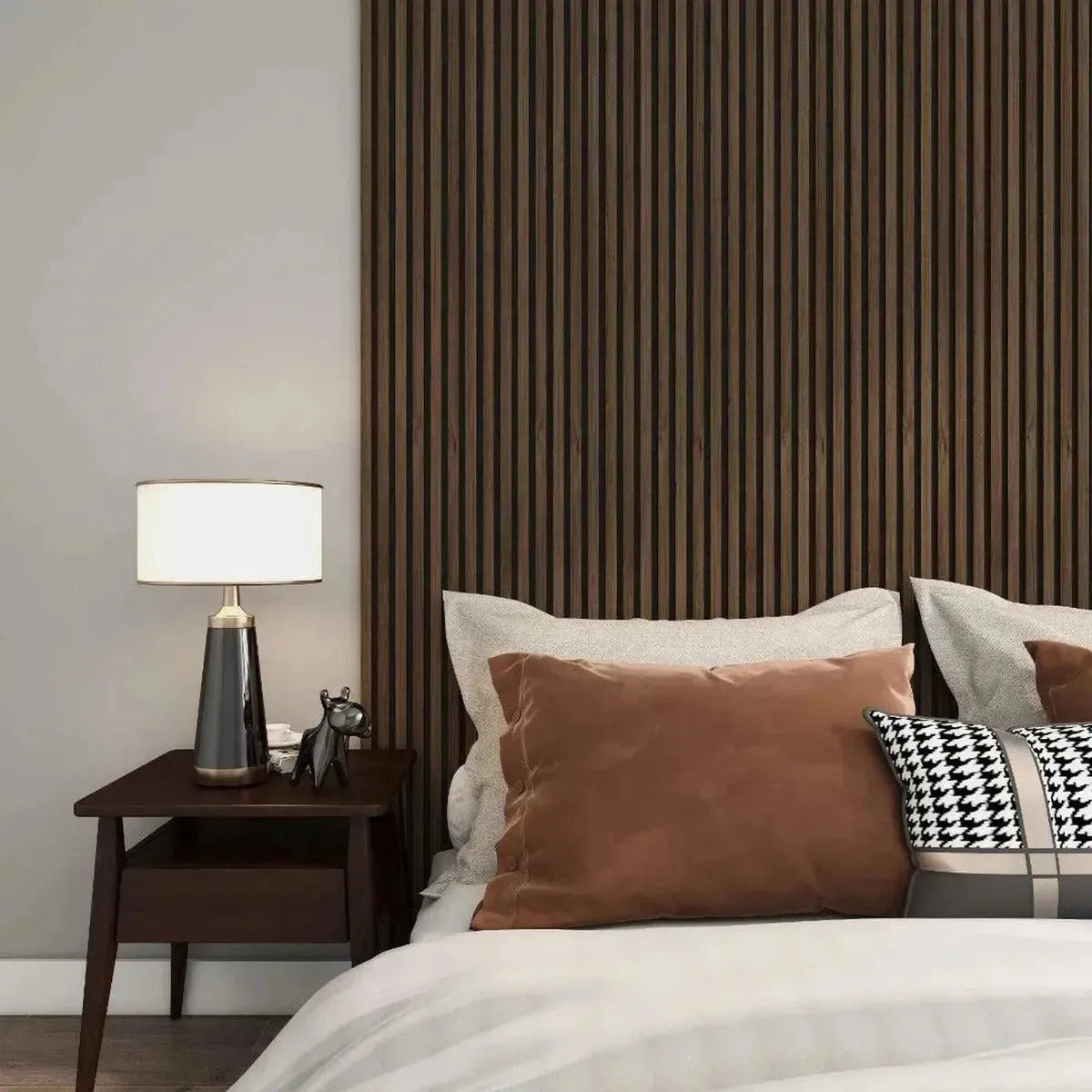
- Fluted Wall Panel Walnut bends around columns and curved kiosk walls without cutting.
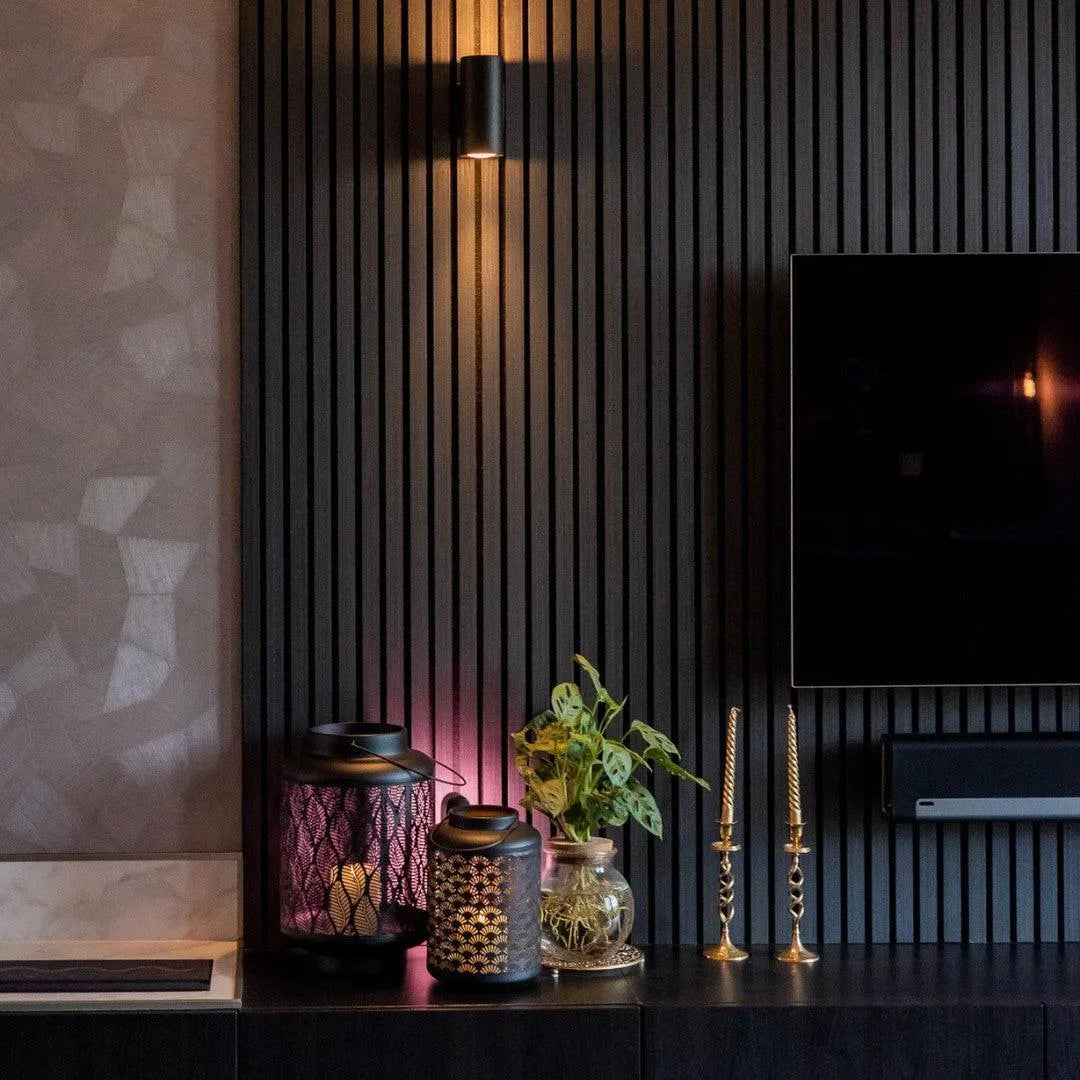
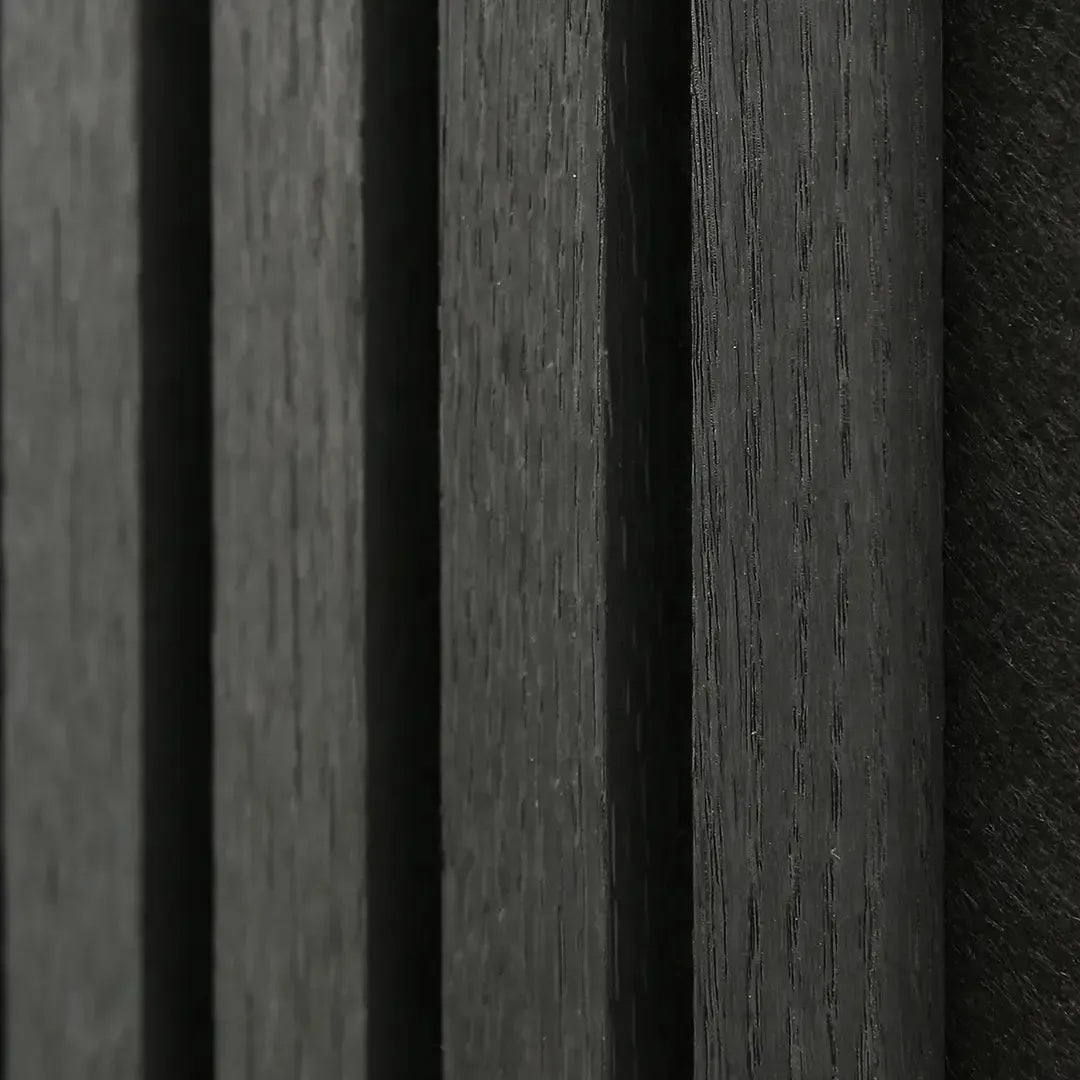
- Acoustic Slat Wall Panel Black Oak hides scuffs and grime in heavy foot-traffic corridors.
- 3D Wood Wall Panel White Oak works as a budget accent for smaller station offices and back-of-house rooms.
Best overall for large waiting hall echo control: Acoustic Slat Wall Panel Natural Oak with Gray Felt. Best for ticket counter acoustic accents: Hexagon Acoustic Panel Natural Oak with Gray Felt. Best budget option: 3D Wood Wall Panel White Oak. Everything else on this list slots between those three depending on the shape of your waiting room.
Why this matters
A train station waiting area is not a living room. Ceilings run 15 to 30 feet, floors are tile or polished concrete, and hundreds of people move through daily — every one of those surfaces reflects sound instead of absorbing it. Announcements over a PA system get unintelligible fast in a space like that, and the fix isn't more speakers, it's more absorption on the walls.
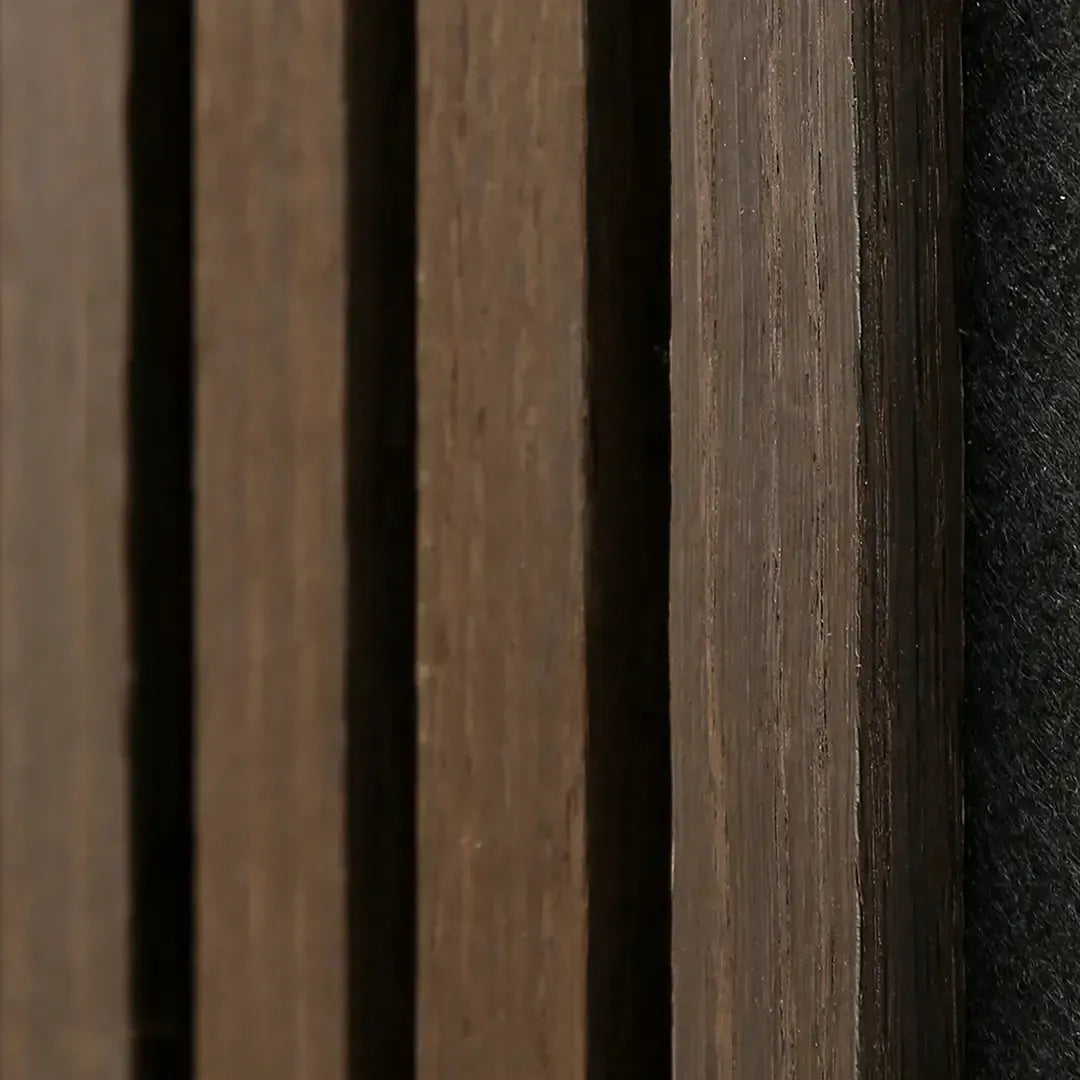
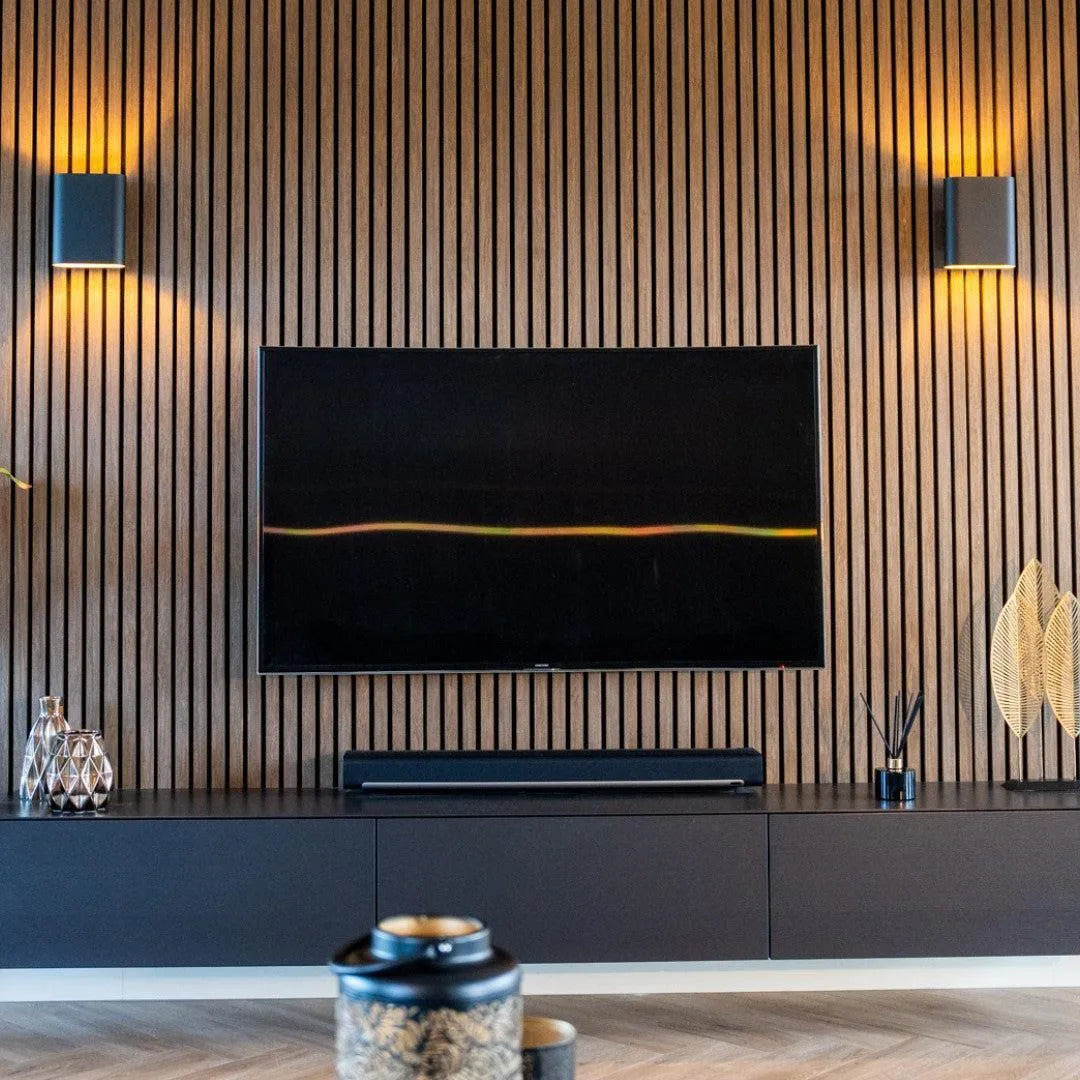
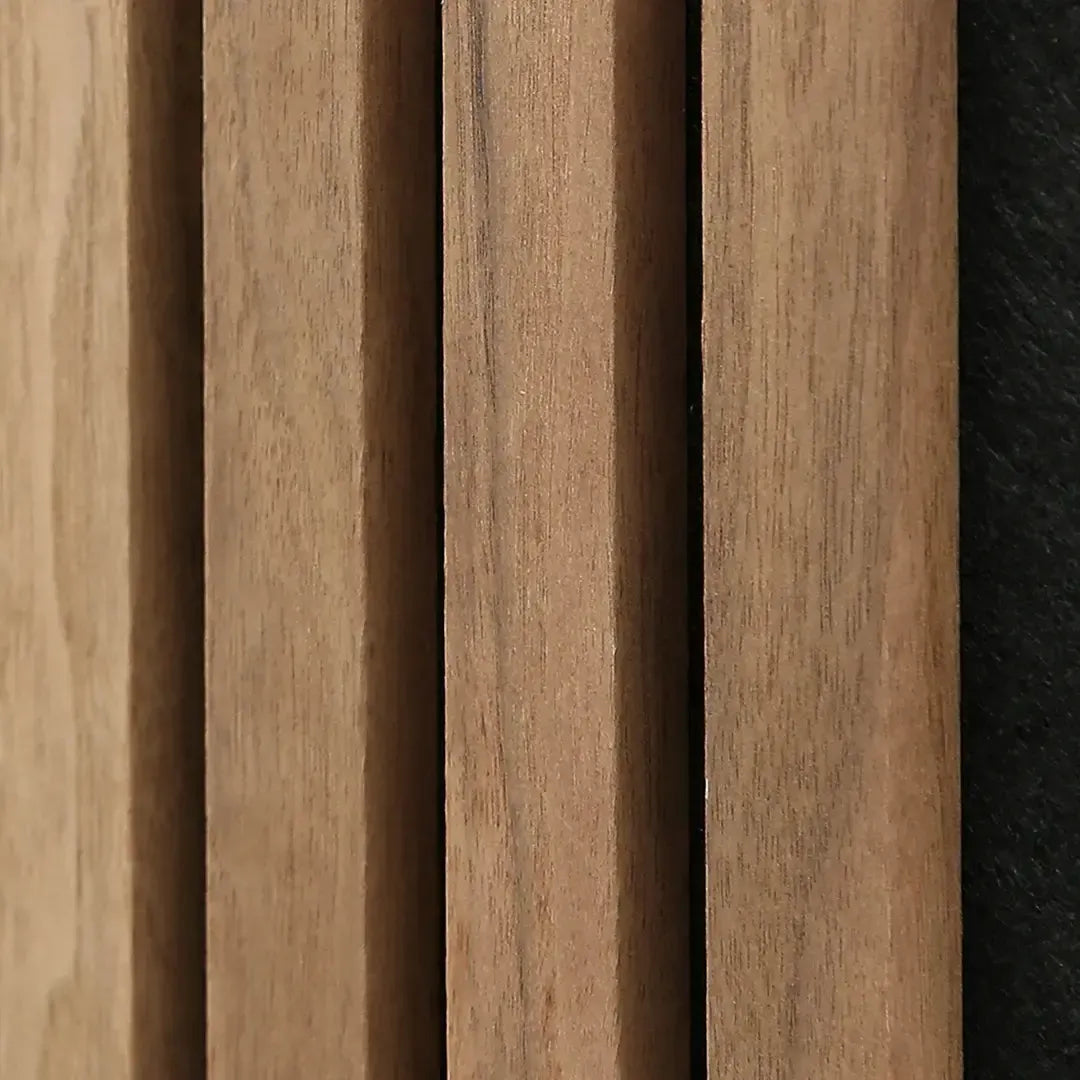
Wood slat panels solve two problems at once in a transit hub: they break up sound reflection and they give a hard, institutional space a warmer, more human finish. The Acoustic Slat Wall Panel Natural Oak with Gray Felt pairs a felt backing with real oak veneer slats, which is the combination that matters most for a waiting hall — the felt absorbs, the wood veneer holds up to daily handling better than painted MDF.
Not every panel on the market is built for this kind of traffic. Some are decorative-only with no acoustic backing, some use faux wood finishes that scuff and show wear within a year. The rankings below separate panels that genuinely belong in a station waiting room from ones better suited to a quiet residential accent wall.
What makes the best wood slat panels for train station waiting areas
- Acoustic performance — a felt or fiber backing that actually absorbs sound, not just a decorative slat surface
- Wear and impact resistance — real wood veneer over engineered board holds up to luggage carts and bench contact better than laminate
- Fire safety suitability — public transit buildings typically carry stricter fire code requirements than residential interiors
- Low-maintenance finish — a surface that wipes clean without special products, since station maintenance crews move fast
- Veneer and finish variety — enough color range to match existing terminal finishes (steel, glass, stone)
- Flexibility for curved surfaces — station architecture often includes columns, rounded kiosks, and curved seating bays that flat panels can't wrap
If you're specifying panels for a public building, review fire-retardant options before finalizing a plan — see fire-retardant slat wall panels for commercial projects for what to check with your local code before ordering.


Best wood slat panels for train station waiting areas at a glance
| Panel | Best for | Standout feature | Key limitation |
|---|---|---|---|
| Acoustic Slat Wall Panel – Natural Oak with Gray Felt | Large waiting hall echo control | Felt-backed slats over real oak veneer | Full coverage needs more panels than a small accent wall |
| Hexagon Acoustic Panel – Natural Oak with Gray Felt | Ticket counter and bench-area acoustic accents | 0.75 NRC rating on felt-backed hex tiles | Hex geometry needs more layout planning around outlets and doors |
| Fluted Wall Panel – Walnut, Modern Flexible Design | Curved walls and columns | Flexible backing bends around round surfaces without cutting | Groove profile shows dust more than flat slats |
| Acoustic Slat Wall Panel – Black Oak | High-traffic corridors prone to scuffs | Dark oak veneer hides marks between cleanings | Dark finish shows dust and lint more under bright terminal lighting |
| 3D Wood Wall Panel – White Oak | Budget accent in smaller waiting rooms or offices | Individual tiles let you cover partial walls affordably | Not built as a full acoustic solution on its own |
1. Acoustic Slat Wall Panel – Natural Oak with Gray Felt: best for large waiting hall echo control
This panel puts real oak veneer slats over a gray felt backing, which is the combination a waiting hall actually needs — the felt does the absorbing, the veneer takes the daily contact. Across a full-height wall behind seating rows, the felt backing cuts down the slap-back echo that makes PA announcements hard to understand in tile-and-glass halls.
Natural Oak with Gray Felt pros:
- Real wood veneer face reads as upgraded finish, not budget laminate
- Felt backing adds absorption a purely decorative slat panel doesn't have
- Oak grain works with steel, glass, and stone finishes common in transit architecture
Natural Oak with Gray Felt cons:
- Covering a full waiting hall wall takes more panels than an accent-wall job, which adds install time
- Lighter oak shows scuff marks faster than a darker finish in a heavy-traffic zone
Best for: waiting halls where echo control is the primary problem. Verdict: Buy.
2. Hexagon Acoustic Panel – Natural Oak with Gray Felt: best for ticket counter and bench-area acoustic accents
The hexagon shape works well behind ticket windows and seating bays where you want a defined acoustic zone rather than wall-to-wall coverage. This panel carries a 0.75 NRC rating, which is a meaningful absorption figure for a decorative wood-veneer product and makes it a reasonable pick for smaller acoustic problem areas rather than an entire hall.
Hexagon Natural Oak with Gray Felt pros:
- 0.75 NRC rating gives you a real absorption number to spec against
- Hex geometry reads as a design feature, not just an acoustic patch
- Sold in 4-panel boxes, which suits smaller zones like counter surrounds
Hexagon Natural Oak with Gray Felt cons:
- Hex layout takes more planning around outlets, signage, and doorframes than a straight slat run
- Felt color is limited to gray, which may not match every terminal color scheme
Best for: ticket counters, bench nooks, and other defined acoustic zones. Verdict: Buy.
3. Fluted Wall Panel – Walnut, Modern Flexible Design: best for curved walls and columns
Station architecture rarely stays flat — rounded kiosks, structural columns, and curved seating bays are common. The fluted wall panel uses a flexible backing designed to wrap those curved surfaces without the cutting and scoring a rigid slat panel would need.
Fluted Walnut pros:
- Flexible design wraps columns and curved kiosk fronts without custom cuts
- Walnut tone adds contrast against lighter terminal finishes
- Grooved profile still breaks up sound reflection, even without a felt backing
Fluted Walnut cons:
- Groove channels collect dust faster than a flat slat surface, which means more frequent cleaning
- No felt backing means less absorption than the felt-backed slat or hexagon options
Best for: columns, rounded kiosks, and curved seating bays. Verdict: Buy.
4. Acoustic Slat Wall Panel – Black Oak: best for high-traffic corridors prone to scuffs
Corridors leading into a waiting hall take the heaviest contact — luggage, strollers, and shoulder bags brush against walls constantly. The black oak finish on this slat panel hides scuffs and grime between cleaning cycles far better than a light oak tone does.
Black Oak pros:
- Dark veneer masks scuffs and handling marks between maintenance passes
- Same slat-and-felt construction as the natural oak version, so absorption performance carries over
- Reads as a deliberate design choice in modern terminal interiors, not just a durability compromise
Black Oak cons:
- Dust and lint show up more visibly on dark surfaces under bright fluorescent or LED terminal lighting
- Limited to darker terminal palettes; doesn't suit every station's existing color scheme
Best for: high-contact corridors and transition zones. Verdict: Buy.
5. 3D Wood Wall Panel – White Oak: best budget accent for smaller waiting rooms
Not every station space needs full acoustic coverage — smaller waiting rooms, back-of-house offices, and staff break areas often just need a warmer finish on one wall. The 3D Wood Wall Panel in white oak is sold as individual 12x12 inch tiles, so you can cover a partial wall without committing to a full acoustic install.
White Oak pros:
- Individual tile format lets you scale coverage to budget and wall size
- Solid wood construction holds up better than printed laminate over time
- Works as a standalone accent without needing acoustic backing to justify the cost
White Oak cons:
- No felt or acoustic backing, so it doesn't address echo the way the slat or hexagon options do
- Not the right pick for a wall that needs to carry real absorption load
Best for: smaller rooms and budget-constrained accent walls. Verdict: Hold — buy only where absorption isn't the primary requirement.
How we ranked
Each panel above was placed against the six criteria listed earlier: acoustic performance, wear resistance, fire safety suitability, maintenance ease, finish variety, and flexibility for curved surfaces. Panels with a felt or fiber backing ranked above decorative-only options for any zone where echo is the main complaint; panels without acoustic backing were kept in the list only where they suit a genuinely lower-stakes use case, like a small accent wall.
Which wood slat panel should you choose for your train station waiting area?
For a full waiting hall wall behind seating rows, the Acoustic Slat Wall Panel Natural Oak with Gray Felt is the default pick in 2026 — it's the combination of real veneer and felt backing built for exactly this kind of space. If you're treating a smaller zone like a ticket counter or bench nook, the Hexagon Acoustic Panel with its 0.75 NRC rating gives you a documented absorption number to spec against. Curved columns and kiosks call for the fluted walnut panel regardless of which of the other two you choose for the flat walls, and a budget-limited back office is the only place the white oak tile belongs on its own.
FAQ
What's the best wood slat panel for a train station waiting area?
The Acoustic Slat Wall Panel Natural Oak with Gray Felt is the best overall pick for 2026 because it pairs a felt acoustic backing with real oak veneer, which handles both the echo problem and daily foot-traffic wear in a waiting hall.
Do wood slat panels actually reduce echo in large transit halls?
Panels with a felt or fiber backing do absorb sound, unlike purely decorative slat panels with no backing material. The Hexagon Acoustic Panel with Gray Felt carries a documented 0.75 NRC rating, which is a real absorption figure you can spec a project against.
Are wood acoustic panels fire-safe enough for public transit buildings?
Public transit buildings typically carry stricter fire code requirements than residential interiors, so fire-rated specification should be confirmed with local code before ordering any wood panel for a station project.
Is hexagon or slat design better for a ticket counter wall?
Hexagon panels work well for defined smaller zones like ticket counters because they read as a design feature and come in smaller box quantities, while slat panels are better suited to covering a full-height wall.
Can wood slat panels bend around columns and curved walls?
Flexible fluted panels, like the Fluted Wall Panel in walnut, use a bendable backing designed to wrap columns and rounded kiosk fronts without cutting, which rigid flat slat panels can't do.
How do you clean wood slat panels in a high-traffic public space?
Real wood veneer panels generally wipe clean without special products, but darker finishes like black oak hide scuffs and grime between cleaning cycles better than lighter oak tones in heavy foot-traffic areas.
Is real wood veneer better than faux wood panels for transit interiors?
Real wood veneer over engineered board holds up to daily handling and contact better than painted or printed faux wood finishes, which scuff and show wear faster under constant public foot traffic.
One last thing
Order physical samples before locking in a station-wide spec. Fluorescent and LED terminal lighting shifts how oak, walnut, and black finishes read compared to a showroom or a product photo, and a color that looks right under daylight can read differently under a station's fixed lighting rig once the wall goes up in 2026.

 Better performance and aesthetic appeal
 In Stock