

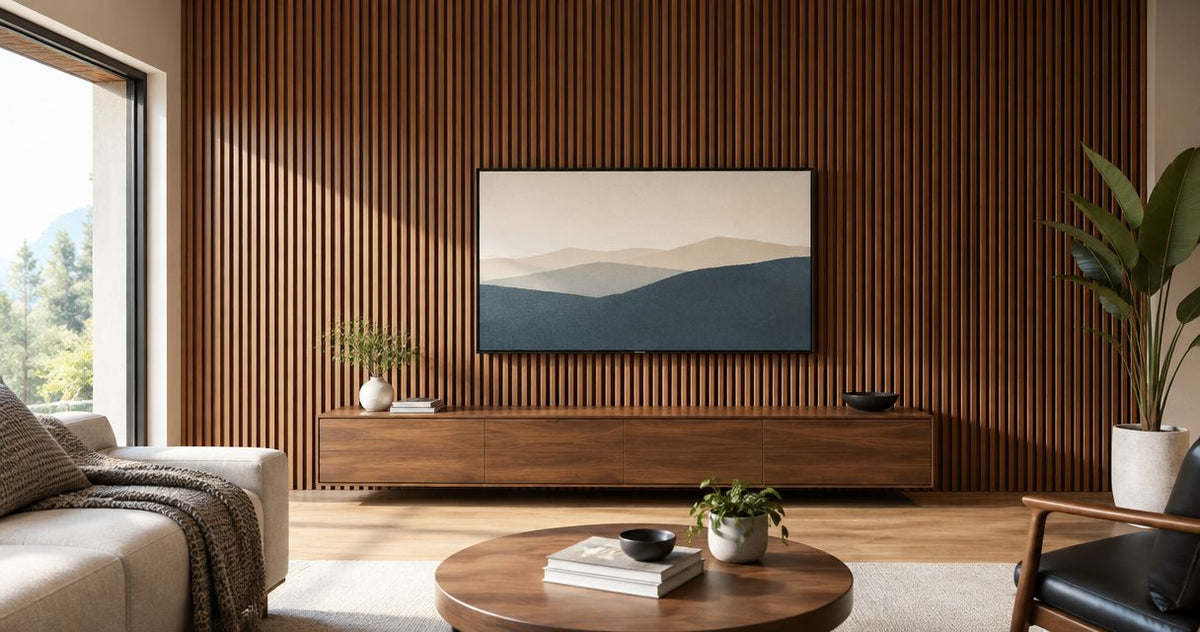
Best overall for walnut slat wall panels in 2026: Akustiq USA’s Acoustic Slat Wall Panel in Walnut. Choose the Walnut Fluted Wall Panel for flexible decorative cladding, or the Walnut Hexagon Acoustic Panel for a geometric accent instead of continuous slats.
- Akustiq USA walnut slat wall panels are the default choice for straight, linear feature walls.
- Choose walnut fluted panels for flexible decorative cladding, not as an assumed acoustic equivalent.
- Choose walnut hexagon acoustic panels for geometric layouts; the product description lists NRC 0.75.
- Check samples, mounting requirements, exposed edges, and acoustic documentation before ordering your wood wall panels.
Why this matters
Walnut names a finish; it does not tell you how a panel performs. For your 2026 project, choose the panel format first, then confirm the surface, installation details, and acoustic requirements.
This shortlist compares options within the Akustiq USA range. The fluted and hexagon products are alternatives to slat panels, not interchangeable versions of the same construction.
What makes the best walnut slat wall panels?
- Surface construction: Check where real wood veneer covers the slat.
- Profile: Match straight slats, flexible fluting, or geometric pieces to your layout.
- Acoustic evidence: Compare documented mounting assemblies, not appearance.
- Edge treatment: Plan visible ends before cutting.
- Finish matching: Review a physical sample beside your flooring and furniture.
Walnut wall panels at a glance
| Item | Best for | Standout feature | Key limitation |
|---|---|---|---|
| Acoustic Slat Wall Panel — Walnut | Straight, continuous feature walls | 3-sided wood veneer | Veneer construction is not solid walnut throughout |
| Fluted Wall Panel — Walnut | Flexible decorative cladding | Real wood veneer and flexible MDF backing | Do not assume the fluted construction matches an acoustic slat assembly |
| Hexagon Acoustic Panel — Walnut | Geometric accent layouts | 32-inch format; listed NRC 0.75 | Separate hexagons do not create uninterrupted slat lines |
Akustiq USA walnut slat wall panels are best for homeowners who want a straight, wood-veneered feature wall with a continuous slat pattern. Pick an alternative only when its shape or backing solves a different design requirement.
1. Acoustic Slat Wall Panel — Walnut: best for linear feature walls
The Acoustic Slat Wall Panel in Walnut is the closest match to the search itself: walnut slat wall panels with a repeated linear profile. Its listed construction includes 3-sided wood veneer, which makes the surface treatment a useful comparison point when you inspect competing panel specifications.
Choose this format when you want the slat pattern to continue across a living-room wall, headboard backdrop, or office feature wall. Start with the full wall composition rather than choosing a panel from a close-up photograph alone.
Walnut acoustic slat panel pros
- A direct match for a continuous walnut slat feature wall.
- Specified 3-sided wood veneer gives you a clear surface-construction detail to compare.
- The range includes a Walnut sample for checking the finish in your room.
- A separately named Walnut end piece gives you an edge-finishing option to investigate.
Walnut acoustic slat panel cons
- Wood veneer does not mean the panel is solid walnut throughout.
- Slat lines require careful alignment across adjoining panels and cut sections.
- Acoustic performance must be checked against the intended mounting assembly; the product name alone does not establish the result.
Best for: Homeowners planning a straight feature wall where the walnut finish and repeated slat pattern are the main design priorities.
For a 2026 TV-wall project, locate the bracket, outlets, and cable access before setting the panel layout. Secure equipment to suitable structural support rather than treating decorative slats as the load-bearing surface.
Verdict: Buy for a continuous walnut slat wall, after confirming dimensions, mounting instructions, and exposed-edge details.
A full-wall view helps you judge the pattern more effectively than a small material close-up. Look at where the slats meet the ceiling, furniture, and adjacent painted wall.
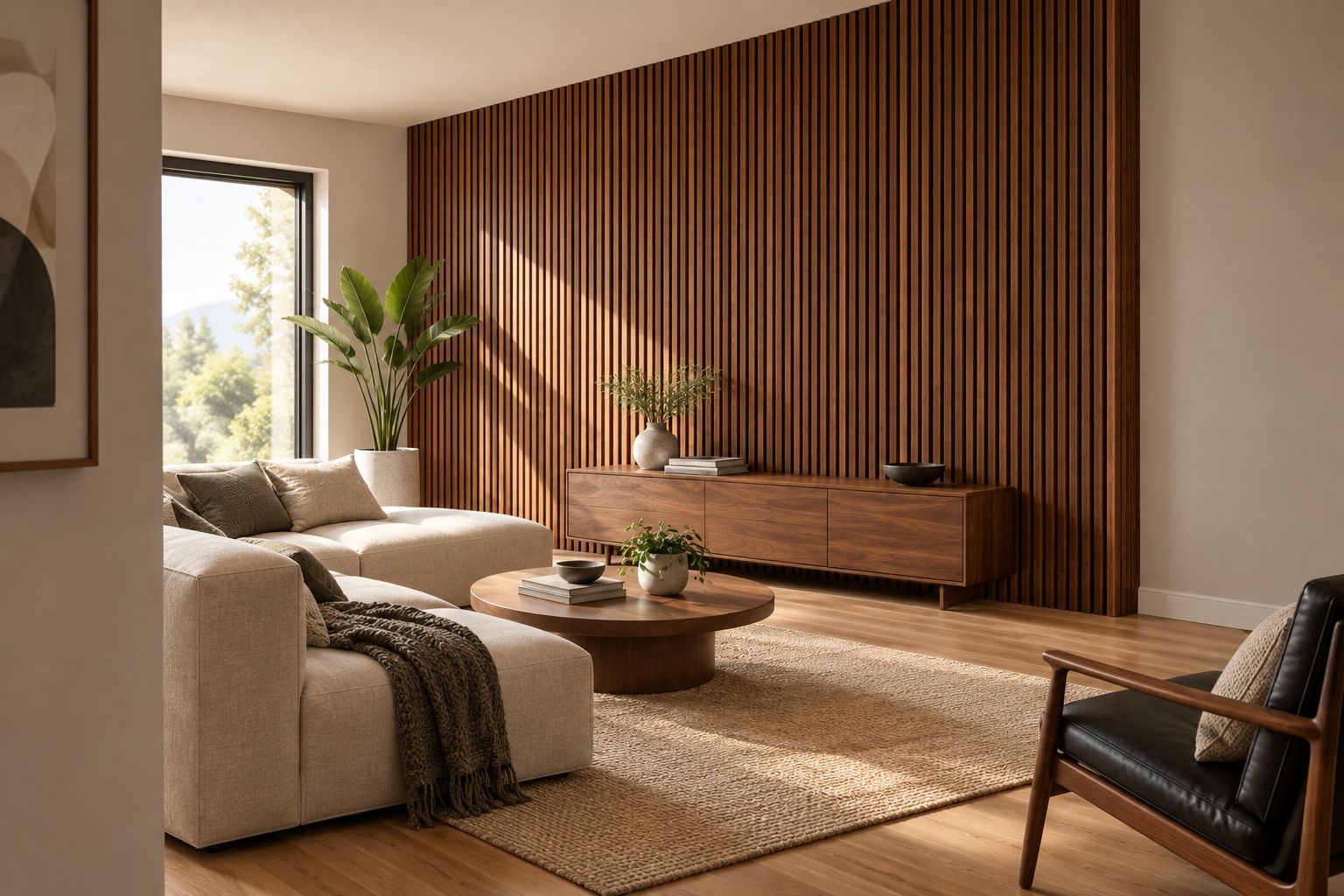
2. Fluted Wall Panel — Walnut: best for flexible decorative cladding
The Fluted Wall Panel in Walnut uses real wood veneer and flexible MDF backing. It belongs on this shortlist when your priority is a flexible decorative surface rather than the specific construction of an acoustic slat panel.
The distinction matters. A fluted profile gives you a different surface rhythm, so choose it because you want that profile—not because every wood-textured panel performs the same acoustic job.
Walnut fluted panel pros
- Real wood veneer provides a wood surface rather than a printed wood-look claim.
- Flexible MDF backing distinguishes it from a conventional straight-panel choice.
- The fluted design creates a different decorative profile from separated slats.
- A Walnut fluted sample lets you assess this particular construction before committing.
Walnut fluted panel cons
- Flexible backing does not establish suitability for every curve or corner.
- Acoustic absorption cannot be inferred from the fluted appearance.
- A Walnut slat sample is not a substitute for checking the fluted product’s profile and finish.
Best for: Decorative projects that specifically require flexible backing and a fluted wood-veneer surface.
For a curved installation, confirm the permitted bending direction, minimum radius, substrate requirements, and fastening method with the supplier. Do not force the material around a tight return simply because its title says flexible.
If your 2026 brief includes both curvature and echo control, specify those as separate requirements. Approve the geometry and acoustic evidence independently before selecting the final assembly.
Verdict: Buy when flexible fluted cladding is the requirement. Skip as an automatic substitute for a documented acoustic slat assembly.
3. Hexagon Acoustic Panel — Walnut: best for geometric accents
The Hexagon Acoustic Panel in Walnut changes the layout from continuous slat lines to separate geometric pieces. The product title specifies a 32-inch format and 4 panels per box, while its description lists an NRC value of 0.75.
Choose this option when you want the panel arrangement itself to form the feature. It is a walnut acoustic-panel alternative, not a way to reproduce an uninterrupted slat wall.
Walnut hexagon panel pros
- The geometric format supports a visibly different composition from linear paneling.
- The listed 32-inch format gives you a concrete dimension to check against the wall drawing.
- The stated pack contains 4 panels, which helps organize the layout and purchasing schedule.
- The listed NRC 0.75 gives you a specific acoustic claim to verify against supporting documentation.
Walnut hexagon panel cons
- Separate hexagons interrupt the continuous lines expected from slat wall panels.
- A box count does not establish installed coverage; confirm the panel geometry and dimensions.
- NRC does not establish how much sound passes through a wall into another room.
Best for: A geometric walnut accent where individual panel placement matters more than continuous slat lines.
Draw the arrangement before ordering. Check its outer boundary against nearby doors, shelving, and furniture so the pattern looks deliberate rather than squeezed into the remaining space.
For an acoustically specified project in 2026, request the report supporting NRC 0.75 and check its mounting conditions. Do not transfer the hexagon product’s rating to the walnut slat or fluted panels.
Verdict: Buy for a geometric acoustic accent. Skip when your brief specifically calls for uninterrupted walnut slats.
Check the finish before choosing the format
A finish sample and a full panel answer different questions. Use the sample to assess the material beside your existing finishes; use a wall drawing to assess the scale and repetition of the finished installation.
Akustiq USA offers both a Walnut slat sample and a Walnut fluted sample. Choose the sample that matches the construction you are considering, rather than assuming the shared Walnut name makes them visually identical.


Plan the wall before ordering
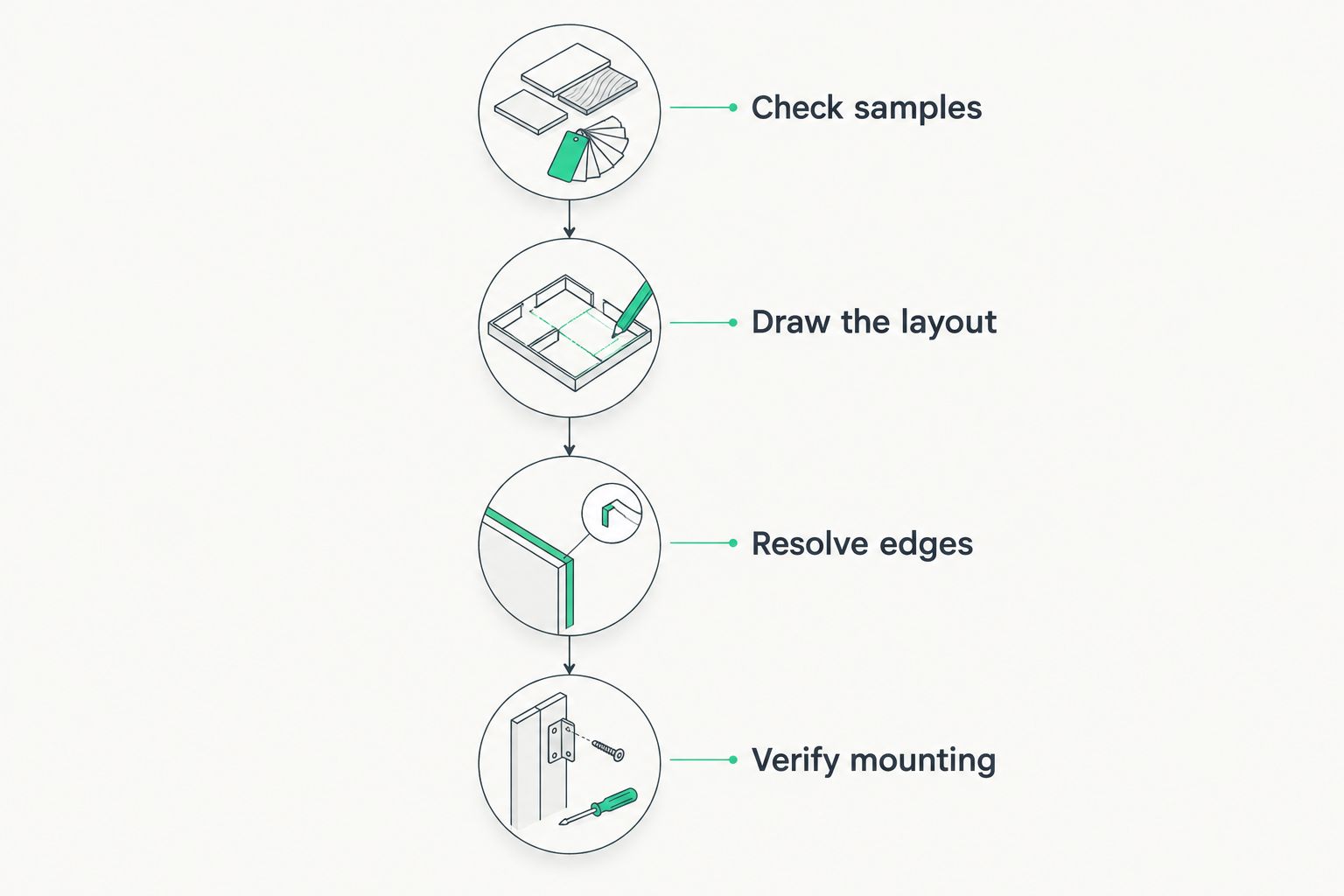
Check samples
Hold the relevant sample vertically against the intended wall. Examine it in daylight and under the lights you normally use, alongside the floor, sofa fabric, cabinetry, or desk finish that will remain.
Judge the combination, not whether the woods look identical. Keep the sample in its intended orientation so you assess the grain and profile as they will appear after installation.
Draw the layout
Record the wall width and height, then mark doors, outlets, switches, furniture, and equipment. Use confirmed product dimensions to place panel joints and cuts on the drawing.
Do not calculate an order from wall area alone. Panel orientation, joint positions, openings, and usable offcuts determine how the pieces fit together, while the total area only describes the surface you want to cover.
Resolve edges
Identify every place where paneling stops against painted wall, cabinetry, a doorway, or an outside corner. Decide which edges need a finishing piece and which meet another surface.
The Walnut end piece is a separate product in the range. Confirm its fit with the selected panel and proposed detail before including it in your order; a shared finish name is not an installation instruction.
Verify mounting
Match the fastening method to the wall substrate and the manufacturer’s instructions. Include any required backing, framing, or acoustic cavity in the drawing before finalizing outlet and trim details.
For commercial projects, request the fire-performance and acoustic documentation required by the specification. Do not treat decorative appearance, a product category, or an article heading as evidence of compliance.
The sequence is simple: approve the finish, solve the layout, finish the boundaries, then verify the complete mounting assembly. Each decision affects the next.
Acoustic panels are not a soundproof wall
Sound absorption addresses reflections within a room; sound isolation addresses transmission between spaces. That distinction should guide your walnut-panel purchase, especially when the complaint is a neighbor’s television rather than your own room’s echo.
NRC describes sound absorption, not the sound-isolation performance of a partition. The Walnut Hexagon Acoustic Panel’s listed NRC 0.75 therefore does not establish a wall’s STC rating or promise a particular reduction in neighboring-room noise.
For a 2026 renovation, describe the problem clearly before selecting treatment:
- Echo during conversation: Assess room reflections and the proposed absorptive assembly.
- Noise through a shared wall: Assess the partition, openings, and sound-transmission paths.
- Poor recorded speech: Plan treatment around the recording position and room behavior.
Wood paneling also does not replace structural supports for shelving, televisions, or cabinets. Plan decorative treatment, acoustic treatment, and equipment support as separate parts of the same wall design.
How the options are ranked
This ranking prioritizes fit to the query, stated surface construction, panel format, acoustic evidence, and finishing requirements. It compares the named products’ descriptions and intended design roles, not laboratory testing or measured room outcomes.
The walnut acoustic slat panel ranks first because it directly matches the requested linear format. Fluted walnut ranks next for flexible decorative work; walnut hexagons serve a separate geometric layout. These are use-case choices, not a claim that one construction outperforms every other construction.
Which walnut wall panel should you choose?
Choose the Walnut Acoustic Slat Wall Panel if you are undecided. It is the direct match for a straight walnut slat feature wall, with specified 3-sided wood veneer and separate sample and end-piece options to assess.
Choose the Walnut Fluted Wall Panel only when its fluted surface and flexible backing answer your design brief. Choose the Walnut Hexagon Acoustic Panel when you want individual geometric pieces rather than continuous slat lines.
Your final purchase should follow the approved sample, dimensioned layout, edge detail, and mounting requirements. A clear wall plan is more useful than adding another finish to an unresolved shortlist.
FAQ
What are the best walnut slat wall panels in 2026?
Akustiq USA’s Acoustic Slat Wall Panel in Walnut is the default choice in this shortlist for a straight, continuous slat feature wall. Its stated construction includes 3-sided wood veneer; confirm dimensions and mounting requirements before ordering.
Are walnut slat wall panels made from solid walnut?
The listed Walnut Acoustic Slat Wall Panel specifies wood veneer, not solid walnut throughout. Check the complete construction specification when comparing it with solid-wood products.
Are walnut fluted panels better than walnut slat panels?
Walnut fluted panels are the better fit when you specifically need their fluted profile and flexible MDF backing. Walnut slat panels are the direct choice for a continuous slat pattern; do not assume their acoustic performance is interchangeable.
Will walnut slat wall panels stop noise from next door?
Do not buy walnut slat wall panels as a stand-alone solution to neighboring-room noise. Sound absorption inside a room and sound isolation through a partition are different requirements.
What does NRC 0.75 mean on the walnut hexagon panel?
NRC 0.75 is the absorption rating listed in the Walnut Hexagon Acoustic Panel’s description. Request the supporting test report and check the mounting assembly; NRC is not a wall sound-isolation rating.
Should I order a walnut panel sample first?
Yes—check the sample for the exact panel construction you intend to use. Examine it vertically beside your existing finishes in daylight and under your usual room lighting.
Can I install walnut slat panels behind a television?
Plan the television’s structural support independently of the decorative slat panels. Locate the bracket, outlets, and cable access before finalizing the panel cuts and joints.
One last thing
Inspect your planned wall from the side. A finish that looks right head-on still needs a resolved stopping edge, aligned joints, and sensible cuts around nearby fittings. Check the view from the doorway before approving the order.
Share:
Best renter-friendly acoustic panels in 2026
Best decorative wood wall panels in 2026