

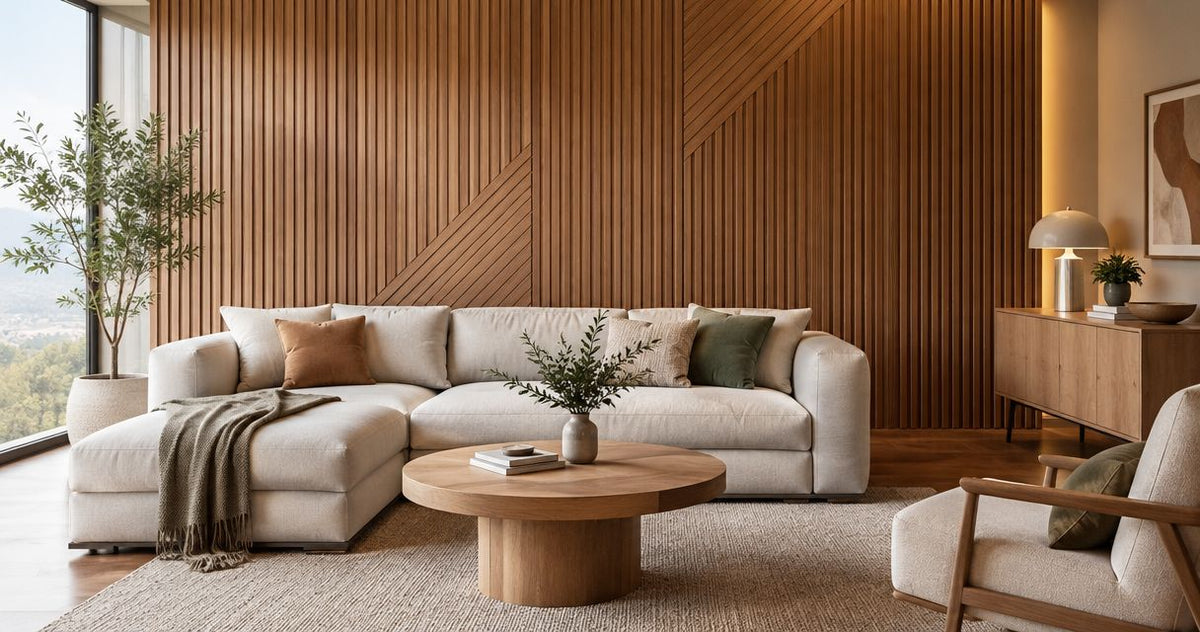
Best overall: Natural Oak Acoustic Slat Wall Panel. Best for curved details: Walnut Fluted Wall Panel. Best for geometric accents: Black Hexagon Acoustic Panel. Best for solid-wood texture: Velvet Walnut 3D Wood Wall Panel. This 2026 guide compares decorative wooden wall panels from Akustiq USA by construction, appearance, and intended use.
- Akustiq USA decorative wooden wall panels: choose Natural Oak acoustic slats as the default for a linear feature wall.
- Choose Walnut fluted panels for flexible MDF backing and real wood veneer.
- Black hexagon acoustic panels suit geometric layouts; their listed NRC is 0.75.
- Choose Velvet Walnut 3D wood panels for solid-wood texture, not an assumed acoustic rating.
Why this matters
The best decorative wooden wall panels solve your actual design problem. A flexible backing, a geometric outline, and a solid-wood face serve different purposes; none makes every panel suitable for every room.
For your 2026 project, choose the panel format before the finish. Then check dimensions, installation instructions, exposed edges, and any performance documentation your room requires.
What makes the best decorative wooden wall panels?
- Construction: Distinguish real wood veneer from solid wood.
- Wall geometry: Match straight walls or curved details to the backing.
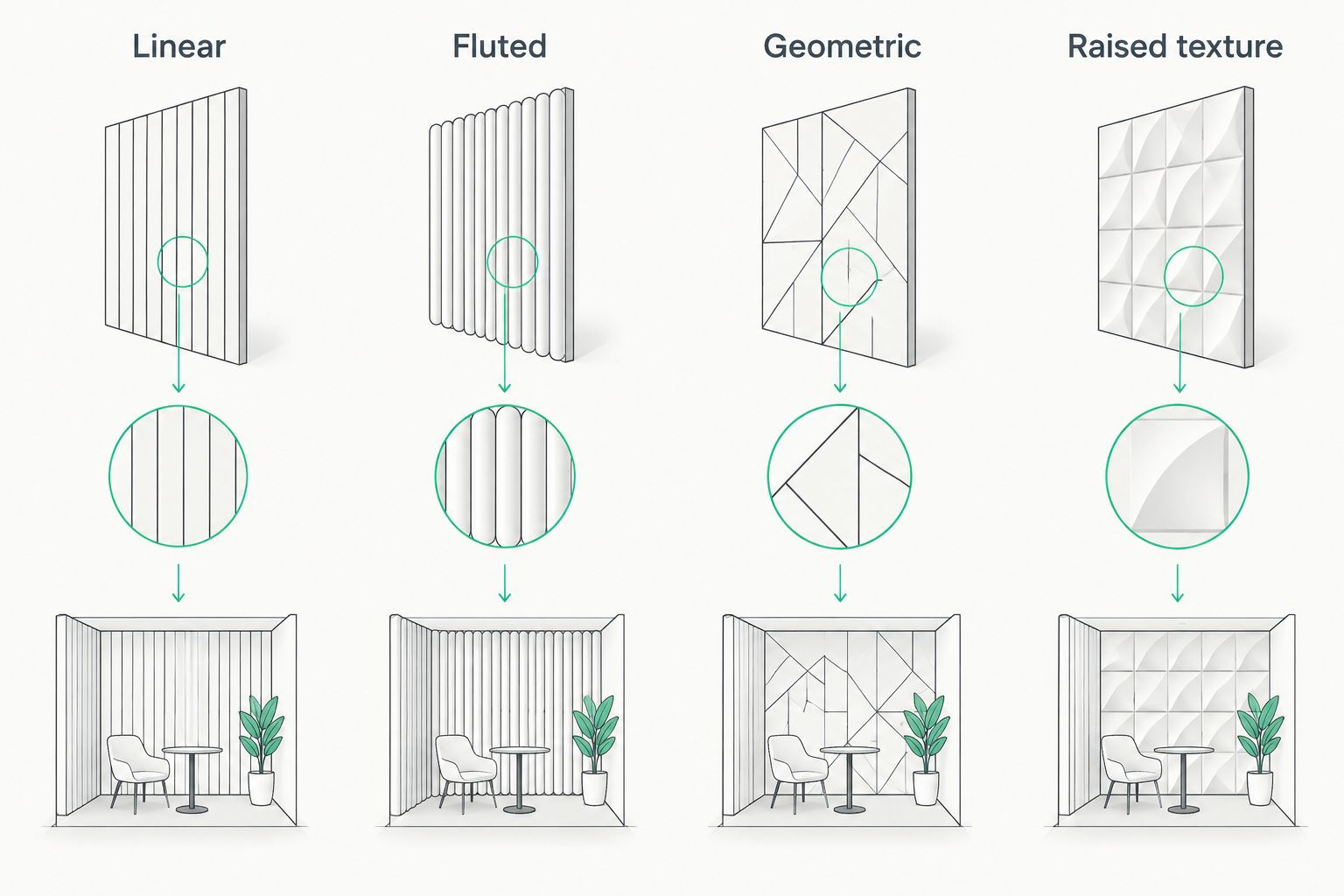
- Visual pattern: Choose linear, fluted, geometric, or raised texture.
- Acoustic evidence: Separate documented absorption from decorative claims.
- Installation details: Plan joints, cuts, outlets, and exposed edges.
Decorative wood wall panels at a glance
| Panel | Best for | Standout feature | Key limitation |
|---|---|---|---|
| Natural Oak Acoustic Slat Wall Panel | A default linear feature wall | 3-sided wood veneer | Veneer construction is not solid wood throughout |
| Walnut Fluted Wall Panel | Curved decorative details | Real wood veneer with flexible MDF backing | Flexibility does not establish an allowable bend radius |
| Black Hexagon Acoustic Panel | Geometric acoustic accents | Listed NRC of 0.75 | NRC does not measure sound isolation between rooms |
| Velvet Walnut 3D Wood Wall Panel | Solid-wood statement texture | Solid wood in a raised decorative format | Small modules require deliberate joint planning |
These are different design tools, not interchangeable finishes. Start with the effect you need: continuous lines, a flexible fluted surface, a geometric arrangement, or raised wood texture.
1. Natural Oak Slat Panel: best for a linear feature wall
The Natural Oak Acoustic Slat Wall Panel uses 3-sided wood veneer and a repeated slat pattern. It is the default recommendation when you want visible wood grain and a clearly ordered wall treatment rather than a patchwork or sculptural surface.
Akustiq USA decorative wooden wall panels in Natural Oak are best for homeowners who want a linear feature wall with real wood veneer. Choose this format around a seating area, behind a bed, or on an otherwise plain interior wall when the lines are part of your design.
Natural Oak Slat Panel pros
- Real wood veneer provides a wood surface rather than an assumed printed imitation.
- The specified veneer covers three sides of the slats.
- The repeated linear pattern gives your layout a consistent direction.
- The acoustic product category makes it relevant when you are investigating room echo as well as appearance.
Natural Oak Slat Panel cons
- Wood veneer does not mean the entire panel is solid wood.
- The slat pattern needs alignment at adjoining panel edges.
- Do not select it against a required absorption target without checking the applicable test documentation.
Best for: A straight interior feature wall where the wood grain and linear pattern should share attention.
Before committing, decide whether the slats should run vertically or horizontally. Mark the direction on your wall drawing, then check where the pattern meets corners, door frames, and switches. Keep the installation method consistent with the manufacturer's instructions rather than adapting a method intended for another panel type.
Verdict: Buy for a linear wood feature wall; hold if your project requires an acoustic result that you have not verified.
2. Walnut Fluted Panel: best for curved decorative details
The Walnut Fluted Wall Panel combines real wood veneer with flexible MDF backing. That construction makes it the relevant choice when your design includes a curve rather than only a flat wall.
For a 2026 renovation, treat flexibility as a feature to verify against your drawing, not permission to force the panel around any shape. Confirm the permitted bending direction, curve, substrate, and fastening method before you commit to the layout.
Walnut Fluted Panel pros
- Real wood veneer supplies the visible wood finish.
- Flexible MDF backing distinguishes it from a rigid decorative panel.
- The fluted format adds a repeated surface profile.
- It gives curved details a panel option to assess before commissioning individual wood pieces.
Walnut Fluted Panel cons
- Flexible MDF backing is not solid-wood construction.
- The product description does not establish a minimum bend radius.
- A decorative fluted profile is not evidence of a tested acoustic rating.
Best for: A curved interior feature or decorative detail where flexible backing is part of the specification.
Make a template of the intended curve before ordering the full installation. Compare that shape with the product's installation requirements, and decide how the flutes will meet the flat surfaces beside it. A curve that looks convincing in a drawing still needs a workable start, finish, and fastening arrangement.
Do not use flexibility as a shortcut around wall preparation. Check the supporting surface and resolve irregularities before attaching the finish; the panel should follow an intentional shape, not disguise an undefined one.
Verdict: Buy for a verified curved application; skip when documented sound absorption is your main requirement.
3. Black Hexagon Panel: best for geometric acoustic accents
The Black Hexagon Acoustic Panel gives you a geometric format instead of continuous slat lines. Its product title specifies 32 inches and 4 panels per box, while its description lists a wood veneer finish and an NRC of 0.75.
NRC describes sound absorption under test conditions. An NRC of 0.75 is not a promise that your room becomes 75% quieter, and it does not establish soundproofing between rooms. Ask for the relevant test setup when performance drives the purchase.
Black Hexagon Panel pros
- The hexagon outline supports a deliberately geometric wall arrangement.
- The listed wood veneer finish adds a wood surface to the shape.
- A stated NRC gives you an acoustic specification to investigate.
- The box quantity is explicit, helping you distinguish individual panels from packs.
Black Hexagon Panel cons
- A geometric layout needs planning at the outer boundary.
- A scattered decorative arrangement does not establish sufficient acoustic coverage.
- The stated 32-inch size alone is not enough to calculate coverage without the full dimension drawing.
Best for: A geometric accent wall where you also want to assess documented sound absorption.
Start with the outline of the complete arrangement. Decide whether the perimeter should remain visibly hexagonal or end against a straight boundary, then mark the layout before fixing anything. Include furniture and wall-mounted equipment in that drawing so the pattern does not disappear behind them unintentionally.
For your 2026 acoustic plan, work from the room and the test documentation rather than a preferred box count. Panel quantity follows the layout and treatment requirement, not the other way around.
Verdict: Buy for a planned geometric acoustic feature; skip if your goal is blocking sound through a shared wall.
4. Velvet Walnut 3D Panel: best for solid-wood texture
The Velvet Walnut 3D Wood Wall Panel uses solid-wood construction in a raised decorative format. Its listed module dimensions are 12.4 inches by 11.8 inches, making the individual panel and the overall wall pattern separate layout decisions.
Choose this option when you want the surface relief itself to be the feature. Unlike an acoustic recommendation, this recommendation rests on construction and appearance; do not assign it a sound-absorption result without supporting documentation.
Velvet Walnut 3D Panel pros
- Solid-wood construction answers a different material preference from veneer.
- Raised texture creates a more sculptural surface than a flat finish.
- Explicit module dimensions support a measured layout.
- The format suits a defined accent area where you want the wood surface to stand out.
Velvet Walnut 3D Panel cons
- Repeated modules make joint placement part of the finished design.
- Relief and projecting edges need consideration beside furniture and circulation routes.
- Solid wood and a textured face do not establish an acoustic rating.
Best for: A statement wall where solid wood and visible depth matter more than a continuous slat pattern.
Draw the module grid before choosing the final wall boundary. Check how the last row and column meet the surrounding surfaces, and avoid leaving the edge treatment as an installation-day decision. Confirm the product's actual coverage and joint arrangement rather than assuming the listed dimensions describe a seamless repeating grid.
Also consider your lighting. View a sample in the intended location, with the room's existing light sources on, so you judge the relief as part of the space rather than only as a close-up photograph.
Verdict: Buy for solid-wood decorative texture; hold if the wall needs a verified acoustic specification.
How to choose before you order
Your first decision is functional: is this wall primarily decorative, part of an acoustic treatment, or a curved detail? Write that answer on your project plan. It prevents a good-looking finish from replacing a requirement it cannot document.
Then follow this sequence:
- Measure the wall: Record the finished boundaries, openings, and obstacles.
- Map the pattern: Show slat direction, flute direction, hexagon arrangement, or module joints.
- Check the edges: Identify every exposed end and transition to another material.
- Confirm installation: Match the product instructions to your substrate and application.
- Assess a sample: Compare the surface with your flooring, furniture, and actual lighting.
For commercial work, request the fire, material, and acoustic documentation the project requires before approving the finish. A product name, a wood species, or a decorative photograph does not demonstrate compliance with your specification.
Akustiq USA supplies both veneer-based and solid-wood decorative wooden wall panels. Keep those constructions distinct in your order notes, especially when a designer, purchaser, and installer are working from the same schedule.
Compare the two default directions
Choose the Natural Oak acoustic slat format when your priority is a straight, repeated wood pattern. Choose the Walnut fluted format when flexible backing is relevant to the detail you have designed; confirm that application before ordering.


How the panels are ranked
This 2026 ranking compares the supplied product descriptions by construction, wall geometry, visual pattern, acoustic evidence, and installation considerations. It is a buying guide to the named collection, not a claim of hands-on testing or a market-wide performance ranking.
Natural Oak slats take the default position for a linear interior feature. Walnut fluted panels, Black hexagons, and Velvet Walnut 3D panels each answer a different brief; their lower positions do not mean they are worse at their intended use.
Which decorative wooden wall panels should you choose?
Choose Natural Oak Acoustic Slat Wall Panel if you are undecided and want a straight, linear wood feature wall. Move to Walnut fluted panels for a confirmed curved detail, Black hexagons for a geometric acoustic arrangement, or Velvet Walnut 3D panels for solid-wood relief.
For a 2026 project, approve the sample, layout, and installation requirements together. Do not approve the finish first and leave the technical details for the installer to resolve.
FAQ
What's the best decorative wooden wall panel for a living room?
Natural Oak Acoustic Slat Wall Panel is the default recommendation for a linear living-room feature wall in this collection. Choose another format when you specifically want curved details, geometric shapes, or solid-wood relief.
Are Akustiq USA decorative wooden wall panels solid wood?
Construction depends on the panel. The listed slat and fluted options use wood veneer, while the Velvet Walnut 3D Wood Wall Panel description specifies solid-wood construction.
Are fluted wall panels better than slat wall panels?
Fluted panels are the better fit when their flexible backing serves a verified curved detail; slat panels suit a linear feature-wall brief. A decorative profile alone does not establish acoustic performance.
Do decorative wood panels soundproof a room?
Do not treat decorative wood panels as a soundproofing system. Sound absorption within a room and sound isolation between rooms are different requirements, and each needs appropriate evidence.
What does NRC 0.75 mean for the Black Hexagon Acoustic Panel?
NRC 0.75 is the sound-absorption rating listed in the Black Hexagon Acoustic Panel description. It does not mean your room becomes 75% quieter or establish performance against sound passing through walls.
Can I bend the Walnut Fluted Wall Panel around any curve?
No; flexible MDF backing does not establish suitability for every curve. Confirm the permitted bending direction, radius, supporting surface, and installation method for your detail.
How do I work out how many decorative wall panels I need?
Calculate quantities from a measured layout and the product's actual coverage information. Include openings, pattern direction, joints, edge details, and the cuts required by your design.
One last thing
Approve the exposed edge before approving the whole wall. A front-facing sample does not show how the installation ends beside a doorway, turns a corner, or meets an outlet. Ask your installer to resolve those details on the drawing while changes are still simple.
Share:
Best walnut slat wall panels in 2026
Best weatherproof wall panels in 2026