


Best overall: freestanding fabric acoustic panels. Best wood-finish option: Akustiq USA acoustic slat panels on an approved, securely supported independent frame. For renter friendly acoustic panels in 2026, choose the support and removal method before the finish; no wall panel becomes damage-free simply because an adhesive is removable.
- The best renter friendly acoustic panels use freestanding supports when drilling and adhesives are prohibited.
- Akustiq USA acoustic wood panels suit renters who can arrange a safely supported, removable installation.
- Acoustic treatment reduces room reflections; it does not replace soundproofing between apartments.
- Choose documented absorption performance, safe mounting, and a clear removal plan before buying.
Why this matters
A rental creates two separate problems: you need less echo, and you need to leave the property in acceptable condition. A panel that solves the first problem but damages paint during removal fails the second.
Renter-friendly describes the installation, not the panel material. Start with the lease, written landlord permission, and the panel manufacturer's mounting instructions. The guide to installing acoustic panels in a rental covers that planning question before you choose a finish.
Also identify the sound you want to change. Reflections from your own voice, television, or speakers call for absorption inside the room. Footsteps overhead, traffic, and neighbors' conversations involve sound transmission through the building; decorative acoustic treatment is not a substitute for addressing those paths.
What makes the best renter friendly acoustic panels?
Use these criteria for your 2026 shortlist. Appearance matters, but mounting safety and removal come first.
- Property protection: Favor supports that avoid attaching anything to the rental's walls when your lease prohibits alterations.
- Mounting safety: Check the complete panel-and-support weight, attachment instructions, and resistance to tipping or falling.
- Absorption evidence: Request acoustic test information for the exact panel and mounting arrangement you intend to use.
- Useful placement: Choose a format that fits near the activity causing troublesome reflections without blocking doors or circulation.
- Removal and reuse: Plan how you will dismantle, carry, store, and reinstall the treatment.
- Room fit: Check finish samples, furniture clearances, outlet access, and the visible edges of the completed installation.
A small tile is not automatically safe for adhesive mounting. A large panel is not automatically unsuitable for a rental either. The support, surface, permissions, and removal process determine the answer.
Renter-friendly acoustic panels at a glance
These are installation-led recommendations, not interchangeable products. The order prioritizes rental suitability, then specific design and recording needs.
| Option | Best for | Standout feature | Key limitation |
|---|---|---|---|
| Freestanding fabric acoustic panels | Strict no-alteration leases | Independent support avoids wall attachment | Bases occupy floor space |
| Felt acoustic panels on a removable board | Compact desk treatment | Grouped treatment moves as a unit | The board still needs safe support |
| Natural Oak acoustic slat wall panel on an independent frame | Wood-finish living areas | Real wood veneer covering 3 sides of the slats | Requires a separately planned support system |
| Natural Oak hexagon acoustic panel on a removable board | Geometric feature layouts | Listed as 32-inch panels, with 4 panels per box | Shape complicates edge and layout planning |
| Acoustic foam on a portable board | Voice-practice corners | Portable treatment around a recording position | Not a solution for transmitted neighbor noise |
1. Freestanding fabric panels: best for no-alteration leases
Freestanding fabric acoustic panels combine an absorptive panel with a purpose-built base or stand. You place them in the room rather than fixing them to the building. This is the default recommendation when your landlord prohibits holes, glue, and adhesive strips.
Choose an acoustic product with documented absorption, not an ordinary fabric-covered privacy screen. Fabric appearance alone does not establish acoustic performance.
Freestanding fabric panel pros:
- Avoids wall attachments when used as intended.
- Moves with your desk, seating, or recording setup.
- Leaves the wall accessible for inspection and cleaning.
Freestanding fabric panel cons:
- Bases compete with furniture and walking space.
- Stability needs particular attention around children and pets.
Best for: Renters who need movable room treatment without altering painted surfaces.
Before choosing, map the base footprint as carefully as the panel face. Check that the stand remains stable in its intended location and that you can open nearby doors fully. Never replace a specified base with an improvised leaning arrangement.
Verdict: Buy a purpose-built freestanding acoustic panel when wall attachment is off limits and the base fits safely.
2. Felt panels on a removable board: best for compact desk treatment
Felt acoustic panels attached to a separate board let you group treatment around a desk without bonding each piece to the rental wall. The board becomes the movable installation surface. It still needs a manufacturer-approved stand or another properly designed support.
For your 2026 home-office plan, distinguish tested acoustic felt from decorative craft felt. Material thickness, construction, and mounting all affect absorption; color and texture do not prove performance.
Felt panel pros:
- Allows a grouped arrangement rather than separate wall attachments.
- Offers a visually simple alternative to exposed foam.
- Lets you relocate the treatment with the workstation.
Felt panel cons:
- A backing board adds weight to the complete assembly.
- A solid backing changes the mounting arrangement and must match the performance information you rely on.
Best for: Renters treating a compact work or video-call area with a safely supported movable assembly.
Keep absorptive surfaces exposed to the room. Hiding the treatment behind a cabinet defeats the placement goal, even if it makes the installation easier to conceal.
Verdict: Buy when the panel, backing, and support form a documented, safely supported assembly.
3. Natural Oak slat panels: best for a wood-finish living area
The Acoustic Slat Wall Panel | Natural Oak | Premium 3-sided Wood Veneer is a wood-faced acoustic option for interior walls. Its listed construction includes veneer on 3 sides of the slats. For a rental, consider it only after settling how the installation will stand or attach safely and come apart later.
Akustiq USA acoustic wood panels are best for renters who want a wood finish and can arrange an approved removable installation. That recommendation does not make the panel a ready-made freestanding product or establish compatibility with adhesive strips.
Natural Oak slat panel pros:
- Provides real wood veneer for a visible interior feature.
- Covers the slat faces and sides with veneer.
- Supports a coordinated wood-finish design rather than a studio-style appearance.
Natural Oak slat panel cons:
- Needs a separately planned frame or landlord-approved wall installation.
- Cutting panels to fit one apartment reduces flexibility in the next home.
Best for: Renters planning a living-area feature with an installer-designed support and a removal plan.
Ask the installer to account for the complete assembly, exposed edges, and access to electrical fittings. Do not treat decorative slats as mounting points for a television, shelf, or other load.
Verdict: Hold until permission, support design, and removal details are settled; then choose the finish.
4. Natural Oak hexagon panels: best for geometric layouts
The Hexagon Acoustic Panel | Natural Oak 32 Inch (4 Panels per Box) | Wall Decor provides a shaped alternative to continuous slats. The product description lists an NRC value of 0.75. That is an absorption rating, not a promise to block neighbors' sound or make a room 75% quieter.
The listed 32-inch size and 4-panel box count help you plan the arrangement, but they do not establish adhesive compatibility. Check actual dimensions and the intended mounting method before creating a backing-board layout.
Natural Oak hexagon panel pros:
- Creates a geometric feature rather than a continuous linear pattern.
- Includes a stated absorption rating in the product description.
- Allows a grouped composition around a desk or seating area.
Natural Oak hexagon panel cons:
- Individual shapes create more exposed perimeter to plan around.
- Acoustic results depend on coverage, room conditions, and mounting—not the NRC figure alone.
Best for: Renters who want a geometric acoustic feature and can provide approved support for the whole arrangement.
Lay out the shapes on paper before making an installation surface. Account for the gaps between panels and the overall footprint, not just the number of pieces.
Verdict: Hold until you confirm the mounting arrangement and complete assembly weight.
Wood-panel options to consider after the mounting decision
Akustiq USA offers both slat and hexagon acoustic panels. Choose between them after confirming the support system; the decorative shape does not determine whether an installation is rental-safe.


5. Acoustic foam on a portable board: best for voice practice
Acoustic foam attached to your own portable board offers another way to keep treatment off the rental wall. Position the supported assembly around the speaking or recording area, following the foam and support manufacturers' instructions.
Choose foam sold for acoustic use with suitable safety documentation. Packaging foam and unidentified materials are not substitutes.
Portable foam panel pros:
- Keeps adhesive on your own board rather than the property.
- Moves with a voice-practice or recording setup.
- Lets you focus treatment around a specific activity.
Portable foam panel cons:
- Thin foam is not a substitute for low-frequency treatment.
- Exposed foam does not suit every living-room design.
Best for: Renters prioritizing voice practice over a wood-finish decorative feature.
A close microphone position and sensible speaker levels remain useful alongside treatment. Adding foam does not isolate a practice space from the rest of the building.
Verdict: Buy for a supported voice-treatment setup; skip for blocking bass or neighbor noise.
How to choose a rental-safe installation
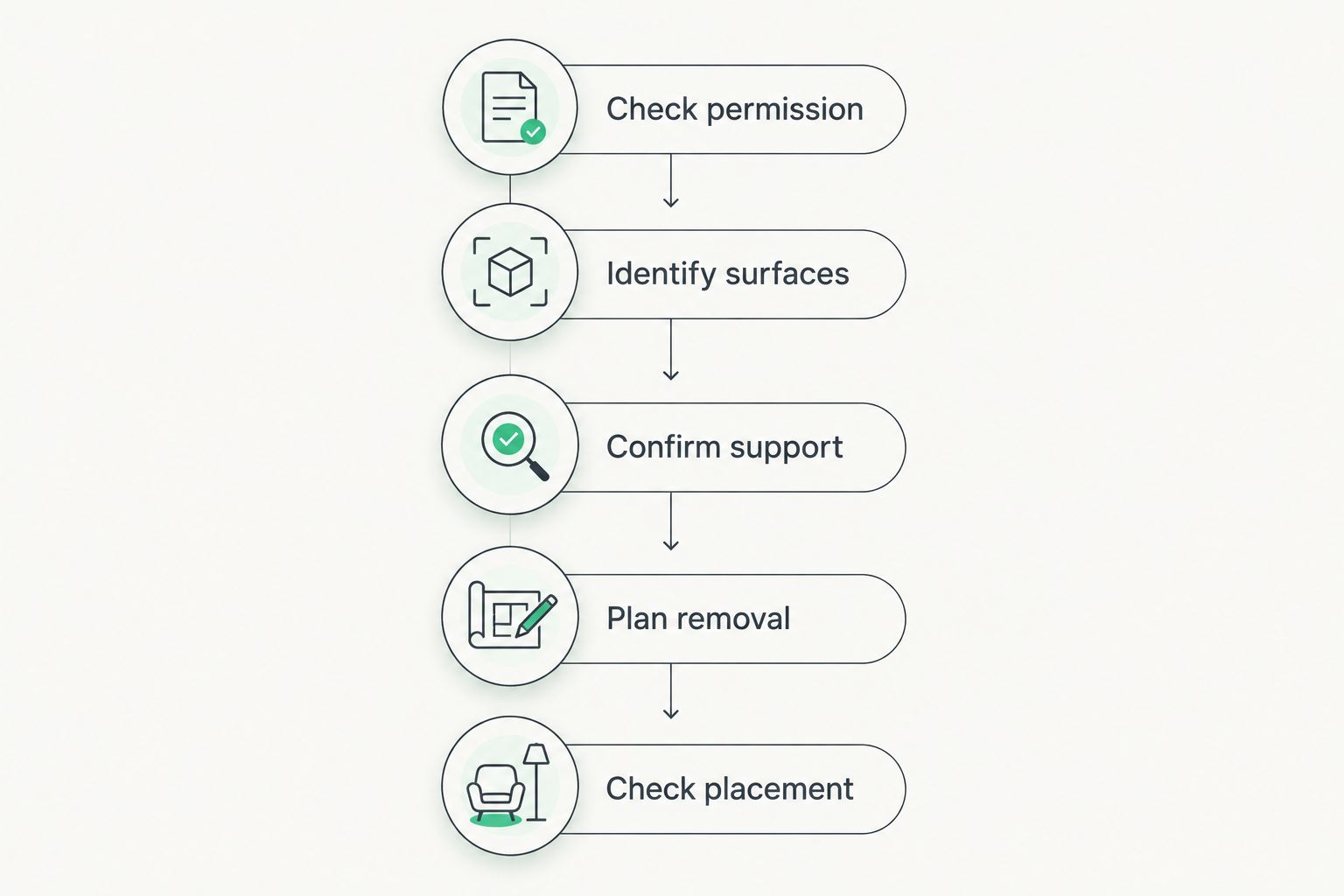
Use this sequence for your 2026 installation plan. Resolve each step before purchasing mounting materials.
- Check permission: Read the lease and obtain written approval for proposed attachments or alterations.
- Identify surfaces: Check paint condition, wallpaper, plaster, and any restrictions on attachment.
- Confirm support: Verify panel weight, backing weight, hardware compatibility, and stability.
- Plan removal: Establish how the assembly comes apart and what restoration the landlord requires.
- Check placement: Keep doors, outlets, ventilation, and walking routes accessible.
A removable adhesive label is not a guarantee against paint damage. Follow the adhesive manufacturer's surface restrictions and load instructions, and confirm that the panel manufacturer permits that attachment method. A small surface trial does not establish safe support for a heavier assembly.
Never leave a tall panel leaning unsecured against a wall. If the proposed stand requires building anchors for stability and your lease prohibits them, choose a different system.
How these options rank
This 2026 ranking puts independent support first because it avoids attaching treatment to the rental's surfaces. Compact felt assemblies follow for desk-focused layouts. Wood slats and hexagons earn distinct design slots, but their rental suitability remains conditional on the installation.
The comparison separates documented product details from installation requirements. It does not rank finish colors as acoustic improvements or treat absorption ratings as sound-isolation results.
Which renter-friendly acoustic panels should you choose?
Choose purpose-built freestanding fabric acoustic panels if you are undecided. They address the rental constraint directly, provided their bases fit and remain stable.
Choose Akustiq USA acoustic wood panels when the wood finish matters and an approved support arrangement is practical. Select slats for a continuous linear feature or hexagons for a shaped composition—not because either format guarantees damage-free removal.
For a 2026 move-out plan, prioritize intact reusable assemblies over panels cut around apartment-specific sockets, corners, and trim. Make the next installation part of the first decision.
FAQ
What's the best acoustic panel option for a rental with no drilling?
Purpose-built freestanding acoustic panels are the default choice when drilling is prohibited. Check their base footprint and stability, and distinguish acoustic products from ordinary privacy screens.
Can I hang acoustic wood panels with removable strips?
Use removable strips only when both the panel and adhesive manufacturers approve the exact application. Check the complete load, surface restrictions, and lease requirements; removable does not guarantee damage-free removal.
Will acoustic panels stop me hearing my neighbors?
Acoustic panels primarily reduce reflections inside your room, not sound transmission through the building. Neighbor noise requires attention to the wall, floor, ceiling, openings, and other transmission paths.
Are wood acoustic panels renter-friendly?
Wood acoustic panels are renter-friendly only when the installation meets the lease and has a safe removal plan. An independent frame or landlord-approved removable installation requires its own support design.
Does NRC 0.75 mean a room becomes 75% quieter?
No. NRC 0.75 is an absorption rating based on standardized testing, not a percentage reduction in room loudness or transmitted noise. Check the tested mounting arrangement before applying the rating to your project.
Are peel-and-stick backsplash tiles acoustic panels?
Do not treat peel-and-stick backsplash tiles as acoustic panels without absorption evidence for that product. A decorative surface and self-adhesive backing do not establish acoustic performance or damage-free removal.
Should I cover every wall in a rental with acoustic panels?
Do not start with full-wall coverage by default. Identify the troublesome activity, choose suitable treatment locations, and assess the result before expanding the installation.
One last thing
Design for the exit, not just the installation. Before attaching anything, picture carrying it through your doorway and setting it up in another apartment. If the plan depends on tearing panels away from painted drywall, choose a different mounting approach now.
Share:
Best black acoustic wall panels in 2026
Best walnut slat wall panels in 2026