


Best overall for a specified acoustic build: a perforated wood panel system with test data matching your installation. Best for a subtle hole pattern: microperforated wood. Best decorative alternatives: Akustiq USA acoustic slat and hexagon panels—not perforated panels. This 2026 guide separates those options so you choose the right construction, not just the right wood finish.
- Choose perforated wood acoustic panels by tested assembly, not hole pattern alone.
- Microperforated wood suits projects that prioritize a less visible perforation pattern.
- Akustiq USA acoustic wood panels offer slat and hexagon alternatives, not verified perforated products.
- Sound absorption reduces room reflections; it does not establish sound isolation between rooms.
Why this matters
A wall that looks acoustic is not automatically the right treatment. Perforated sheets, spaced wood slats, and decorative wood tiles have different constructions; treating them as interchangeable creates specification mistakes.
For your 2026 shortlist, separate the acoustic requirement from the appearance requirement. Start with the guide to specifying acoustic wall panels, then compare the panel face, backing, mounting method, and supporting documentation.
What makes the best perforated wood acoustic panels?
- Assembly evidence: Ask for absorption results covering the panel, backing material, cavity, and mounting arrangement you intend to use.
- Frequency fit: Compare frequency-by-frequency absorption, especially when music or low-frequency noise drives the brief.
- Opening pattern: Review hole size, spacing, and open area alongside appearance. None establishes performance alone.
- Installation fit: Check substrate requirements, panel joints, edge details, service access, and approved fixing methods.
- Project compliance: Obtain the fire-performance and other documentation required for the actual building application.
- Finish suitability: Inspect a physical sample under your lighting and confirm cleaning and environmental limitations.
Acoustic wood panel options at a glance
The first three entries compare construction types, not named products. The final two are specific decorative acoustic alternatives. No slat or hexagon product below is presented as a perforated wood panel.
| Option | Best for | Standout characteristic | Key limitation |
|---|---|---|---|
| Perforated wood sheet system | Specification-led wall treatment | Repeated openings through a continuous wood face | Performance depends on the complete assembly |
| Microperforated wood system | A less visible opening pattern | Fine perforations rather than prominent holes | Appearance does not establish frequency performance |
| Slotted wood acoustic system | Linear architectural detailing | Elongated openings through the panel face | Slots are different from spaced decorative slats |
| Acoustic Slat Wall Panel Natural Oak | A continuous natural-oak slat feature | Listed with 3-sided wood veneer | Not a perforated sheet; no slat NRC is established here |
| Hexagon Acoustic Panel Natural Oak | A geometric feature-wall layout | Listed as 32-inch panels, with 4 panels per box | Listed NRC requires assembly-specific verification |
1. Perforated wood systems: best for specification-led projects
Perforated wood acoustic panels use repeated openings in a wood or wood-faced sheet. The openings work with the space and materials behind the face; the visible sheet is only part of the acoustic system.
This is the default construction to investigate when your drawings explicitly call for perforated wood. Choose the documented assembly before choosing the veneer. A photograph cannot show whether a proposed substitution meets the acoustic brief.
Perforated wood system pros:
- A continuous face provides a different appearance from individual slats.
- Repeating perforations support an orderly architectural pattern.
- A documented system gives the designer a defined construction to specify.
Perforated wood system cons:
- Backing and cavity requirements affect the finished wall build-up.
- Field cuts and service openings require coordinated detailing.
- Results from a different mounting arrangement do not establish your installation's performance.
Best for: Commercial or residential projects with an explicit perforated-panel requirement and a defined acoustic target.
For a 2026 construction package, request the test report, installation detail, and finish sample together. Check that each document describes the same system rather than similar-looking products from the same range.
Verdict: Buy only after the documented assembly matches the project.
2. Microperforated wood: best for a subtle opening pattern
Microperforated wood uses fine openings to make the perforation pattern less visually prominent than larger drilled holes. It suits a brief where you want a wood-faced surface without an obvious large-hole pattern.
Do not turn that visual advantage into an acoustic assumption. Microperforated constructions vary, so compare the actual absorption data and installation requirements rather than treating the category name as a performance grade.
Microperforated wood pros:
- Fine openings suit designs that avoid prominent drilled patterns.
- A continuous wood face keeps the design distinct from slat paneling.
- Physical samples let you judge the pattern at the intended viewing distance.
Microperforated wood cons:
- Small openings do not guarantee better absorption than larger openings.
- Surface treatments and cleaning methods need manufacturer approval.
- A finish sample alone cannot establish acoustic performance.
Best for: Interior projects where a less visible perforation pattern is a specific design priority.
Inspect the face both close up and from the doorway. Side lighting reveals surface texture differently from frontal lighting, so use the lighting conditions planned for the finished space.
Verdict: Hold until the visual sample and acoustic documentation both fit.
3. Slotted wood systems: best for linear architectural detailing
Slotted acoustic panels have elongated openings through the panel face. They belong in this comparison because they offer another opening pattern for wood-faced acoustic construction, but they are not the same as round-hole perforated sheets.
They are also different from separate wood slats attached to a backing. Specify whether you need openings through a sheet or gaps between individual slats. That distinction belongs on the drawing, not in an installer’s interpretation.
Slotted wood system pros:
- Linear openings provide a clear alternative to circular patterns.
- Slot direction becomes part of the wall’s visual composition.
- Coordinated panel joints support a deliberate architectural layout.
Slotted wood system cons:
- Slots and joints need planning around switches and other interruptions.
- A similar-looking slat panel is not an automatic substitute.
- Acoustic results still depend on the backing and mounting arrangement.
Best for: Projects that require a continuous wood face with a directional, linear opening pattern.
For your 2026 submittal, include the face pattern and section detail. Naming only the finish leaves the construction unresolved.
Verdict: Buy when the slotted assembly—not just its appearance—is approved.
Understand the construction before comparing finishes
Perforations, slots, and slat gaps are three different face arrangements. All require attention to what sits behind the visible wood, but they should not share an undifferentiated product specification.
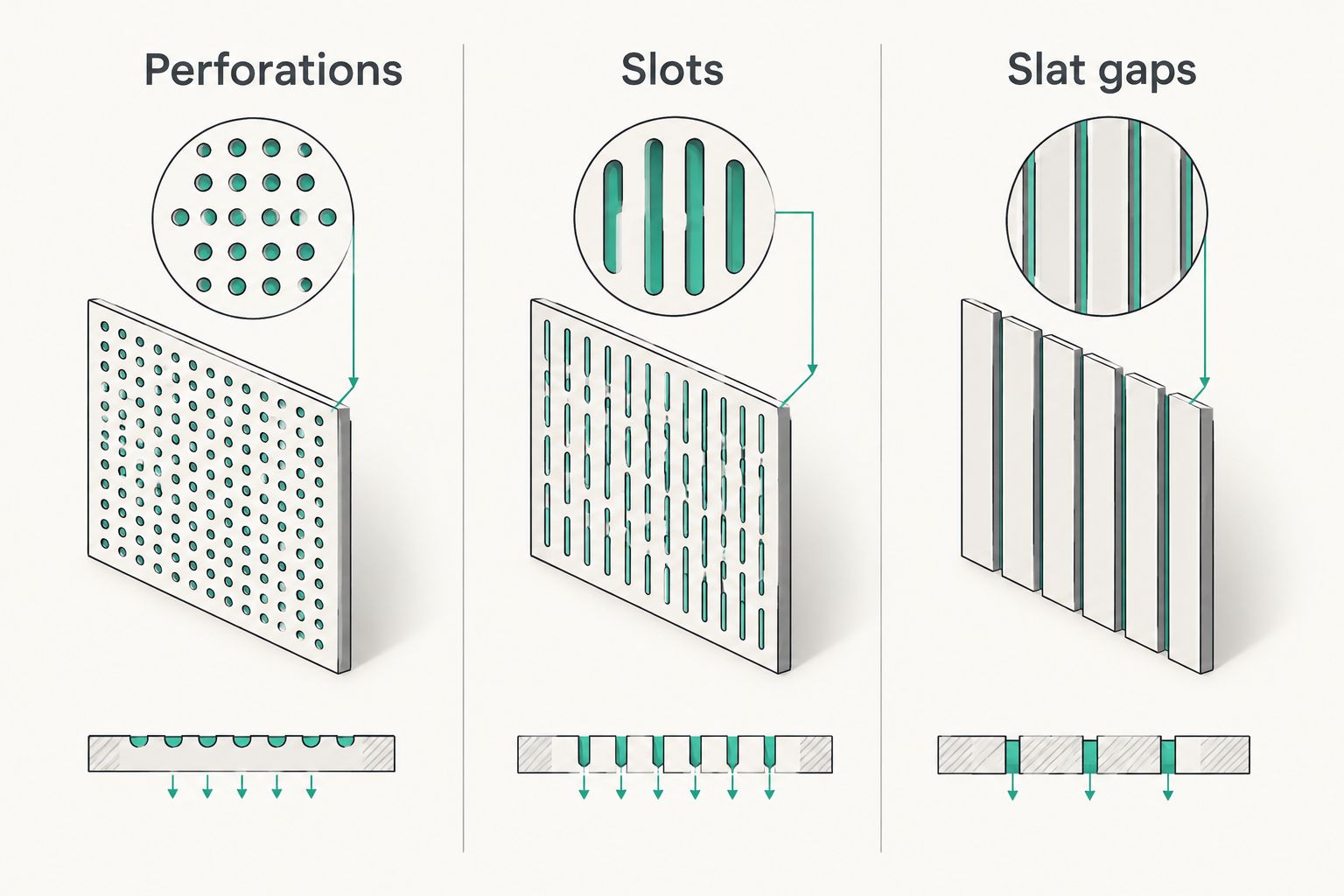
When reviewing a quotation, match its wording to the drawing. If the drawing shows a drilled sheet but the quotation describes spaced slats, resolve the substitution before ordering; matching wood color does not resolve the construction difference.
4. Natural Oak slat panels: best for a continuous wood feature
The Acoustic Slat Wall Panel | Natural Oak | Premium 3-sided Wood Veneer is a decorative acoustic alternative to perforated sheets. Its listed construction includes 3-sided wood veneer, giving you a specific material detail to compare rather than an unspecified wood-effect face.
Akustiq USA acoustic wood panels are best for buyers seeking decorative slat or hexagon formats rather than a specified perforated sheet. Choose this Natural Oak slat panel for the slat appearance, then confirm the installation and acoustic evidence required for your room.
Natural Oak slat panel pros:
- The listed Natural Oak finish gives you a defined sample direction.
- The product explicitly identifies 3-sided wood veneer.
- The slat format provides a continuous linear feature-wall design.
Natural Oak slat panel cons:
- It does not meet a literal requirement for a perforated sheet.
- No absorption rating for this slat product is established in this comparison.
- Visible edges and wall interruptions still require a finishing plan.
Best for: Homeowners and interior buyers who want a natural-oak slat feature rather than a drilled panel face.
Do not describe this panel as soundproofing. A decorative acoustic wall treatment and a sound-isolating partition answer different problems, even when both are discussed under noise control.
Verdict: Buy for the slat design; skip as an unapproved perforated-panel substitution.
5. Natural Oak hexagon panels: best for geometric wall layouts
The Hexagon Acoustic Panel | Natural Oak 32 Inch (4 Panels per Box) | Wall Decor provides a geometric alternative to continuous slat lines. The listing identifies 32-inch panels and 4 panels per box, which are useful starting details for layout planning—not a substitute for verified coverage dimensions.
The product description lists an NRC of 0.75. Treat NRC as an absorption metric, not a soundproofing score, and request the supporting test information and mounting conditions before using that figure in a project specification.
Natural Oak hexagon panel pros:
- The hexagon format supports a visibly geometric feature.
- A wood veneer finish is stated in the product description.
- The listing provides an NRC value to investigate with supporting documentation.
Natural Oak hexagon panel cons:
- It is not identified as a perforated wood sheet.
- A listed NRC does not establish the finished room’s acoustic outcome.
- An open geometric arrangement does not cover the same wall area as continuous cladding.
Best for: Buyers who want a geometric wood feature and are willing to plan panel positions around the room’s acoustic needs.
For a 2026 layout, draw the individual shapes before ordering. Resolve the outer boundary and any gaps instead of assuming the box count tells you the treated area.
Verdict: Buy for a geometric acoustic feature; skip where perforated sheets are mandatory.
Compare the decorative alternatives
The Akustiq USA acoustic wood panels below match the two alternative formats discussed above. Choose between a continuous slat composition and a geometric layout first; assess the finish sample and installation requirements next.


How we ranked
This 2026 ranking prioritizes construction fit, assembly evidence, frequency performance, installation detail, and appearance—in that order. It compares uses, not independently measured product performance.
Perforated wood systems take the default position because they directly match the query. Microperforated and slotted constructions address different visual requirements; the named slat and hexagon products remain clearly labeled alternatives, not perforated-category winners.
Which acoustic wood panel should you choose?
Choose a documented perforated wood system when perforations are part of the specification. Do not replace it with a decorative slat panel solely because both products use wood and carry an acoustic description.
If your real goal is a wood feature wall rather than a specified hole pattern, compare the Natural Oak slat and hexagon formats. For a commercial project, settle performance requirements and approvals before the finish decision; for a home, identify whether the problem is room echo or sound arriving from elsewhere.
FAQ
What are the best perforated wood acoustic panels in 2026?
The best choice is a perforated wood system with absorption test data matching your intended installation. Compare the face, backing, cavity, and mounting method before selecting the finish.
Are wood slat panels the same as perforated wood panels?
No. Perforated panels have openings through a continuous face, while slat panels use separate spaced strips. They are not automatic substitutes in a construction specification.
Are microperforated panels better than regular perforated panels?
Microperforated panels are better suited to a less visible hole pattern, not automatically better acoustic performance. Compare frequency data for the complete assemblies.
Will perforated wood panels soundproof my room?
Perforated acoustic treatments do not establish room-to-room sound isolation. Soundproofing requires attention to the full enclosure, including walls, doors, ceilings, and sound leakage paths.
What does an NRC of 0.75 mean on a hexagon panel listing?
NRC 0.75 describes sound absorption under test conditions, not a room becoming 75 percent quieter. Request the test report and mounting details before applying the listing's value to your design.
Does Akustiq USA offer the perforated panels recommended here?
The named products in this guide are acoustic slat and hexagon panels, not verified perforated sheet products. Use them as decorative alternatives only when that construction fits your brief.
How many acoustic panels do I need?
Panel quantity depends on the room, the acoustic target, the selected assembly, and its placement. Calculate material coverage separately from the amount of absorption the room needs.
One last thing
A higher absorption rating does not fix the wrong specification. A panel selected for appearance alone still needs the correct construction, placement, and installation to address your problem.
Before you commit, put the proposed panel face beside its installation section and test report. Those documents should describe one assembly—not three loosely related versions of a wood wall.
Share:
Best walnut wall panels in 2026
Best wood veneer wall panels in 2026