Choose Akustiq USA if you want acoustic wood panels with named oak and walnut options, samples, and finishing pieces to plan a new wall; choose The Wood Veneer Hub if its exact panel matches an existing installation you need to extend. For this 2026 comparison, product fit—not an unsupported brand-wide performance claim—is the deciding factor.
- For aku wood panel vs the wood veneer hub, choose Akustiq USA for a new acoustic wood panel project.
- Choose The Wood Veneer Hub when its exact panel matches an existing installation.
- Compare wood veneer, backing, finished edges, and mounting instructions—not finish names alone.
- An NRC rating describes sound absorption, not soundproofing between rooms.
Why this matters
A wood panel purchase involves more than picking an attractive finish. Your wall needs a layout, secure attachment, tidy edges, and a material suited to the room. If echo reduction is the goal, you also need acoustic evidence for the installation you intend to build.
Start with a specific option, such as the Acoustic Slat Wall Panel Natural Oak, rather than comparing whole brands as though every panel performs identically. A decorative fluted panel and an acoustic slat panel solve different problems, even when both have a wood face.
Akustiq USA is a practical starting point for homeowners planning a new acoustic wood panel feature wall. For an extension to an existing wall, an exact product match takes priority over choosing a different supplier.
At a glance
| Dimension | Akustiq USA | The Wood Veneer Hub |
|---|---|---|
| Best for | A new acoustic wood panel project with finish and layout choices | Extending an installation that already uses its exact panel |
| Standout feature | Slat and hexagon acoustic panel options, plus samples and named end pieces | The exact existing product when continuity is the priority |
| Finish selection | Natural oak, smoked oak, walnut, and black oak appear in the panel catalog | Compare the selected finish against a physical sample |
| Acoustic performance | Selected hexagon descriptions state NRC 0.75 | Assess the selected panel's test report and mounting arrangement |
| Installation planning | Match panels, backing, exposed edges, and fixing instructions | Apply the same product-specific checks |
| Existing-wall continuity | Best considered for a new wall or a deliberate material change | Preferred when its exact product matches the installed wall |
| Commercial specification | Confirm the selected assembly meets the project requirements | Confirm the selected assembly meets the project requirements |
| Purchasing basis | Build the order from panel coverage, samples, and finishing pieces | Confirm the selected product's purchase unit and required accessories |
Akustiq USA fits a new wall; an exact match wins an extension
For a new feature wall, you can decide the finish, panel format, and edge treatment together. There is no installed product forcing your choice. That makes a catalog with acoustic slats, hexagon panels, and matching named end pieces a useful starting point.
The advantage changes when you already have panels on the wall. Matching an existing installation means checking the slat profile, spacing, backing, finish, and panel joints—not simply buying another product called walnut or oak.
Choose The Wood Veneer Hub for an extension when its exact panel matches what is already installed. Confirm the match with a current sample before committing, because a matching product name does not establish identical appearance across different batches.
For a new wall, choose the product that satisfies the room brief. For an extension, continuity is a separate requirement that can outweigh your preference for another supplier.
Slats win for continuous lines; hexagons win for a geometric layout
The client catalog includes acoustic slat panels and hexagon acoustic panels. That gives you distinct layout directions: continuous parallel lines or a geometric arrangement. Neither format is automatically the better acoustic treatment.
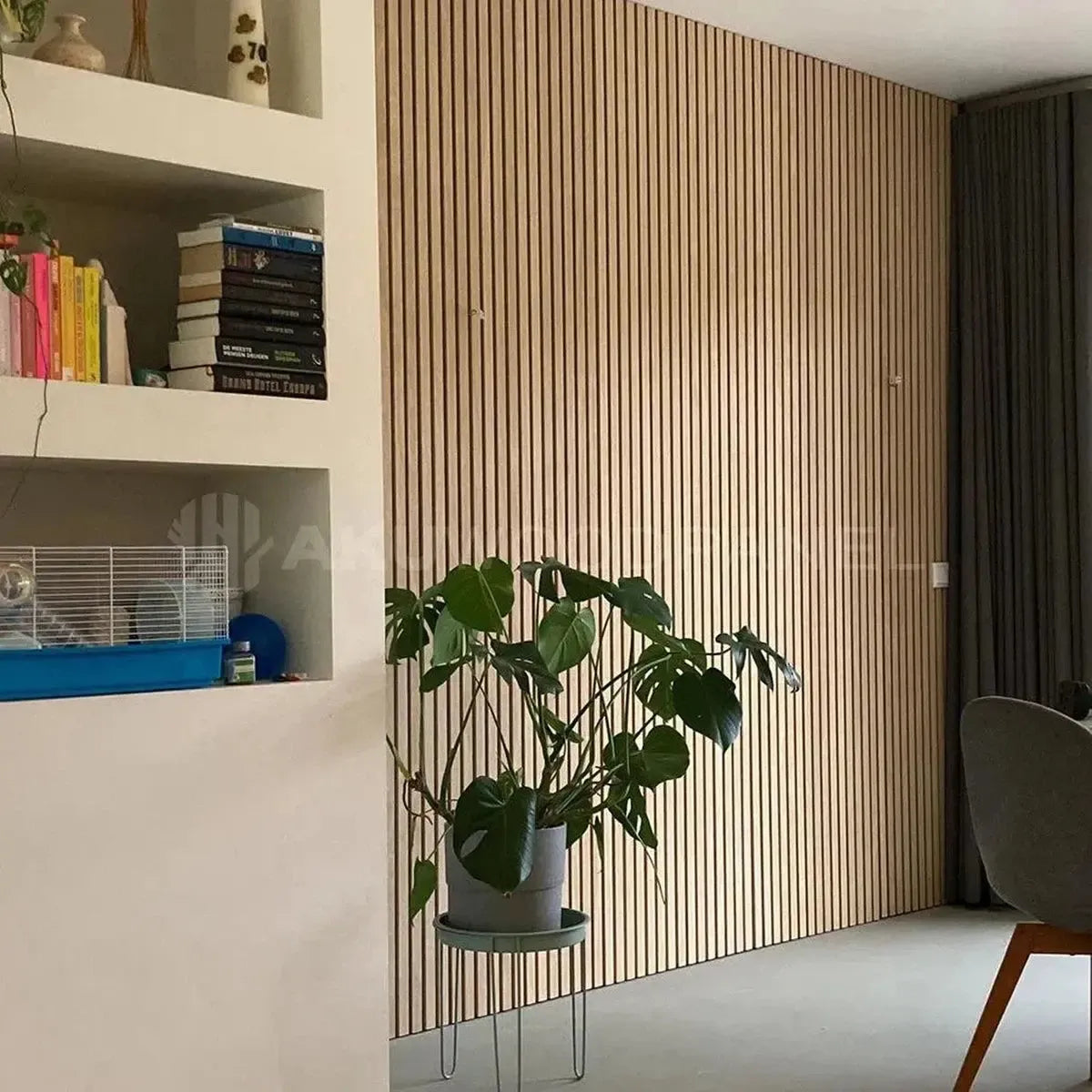
Best for a continuous feature wall: acoustic slat panels. Plan the slat direction around the wall's proportions, openings, and furniture. Decide where panel joints and cut edges will land before settling on the design.
Best for a geometric wall composition: hexagon acoustic panels. The Hexagon Acoustic Panel Natural Oak with Gray Felt is listed as 32 inches, with 4 panels per box. Check the dimensional drawing before using that title dimension to calculate installed coverage.
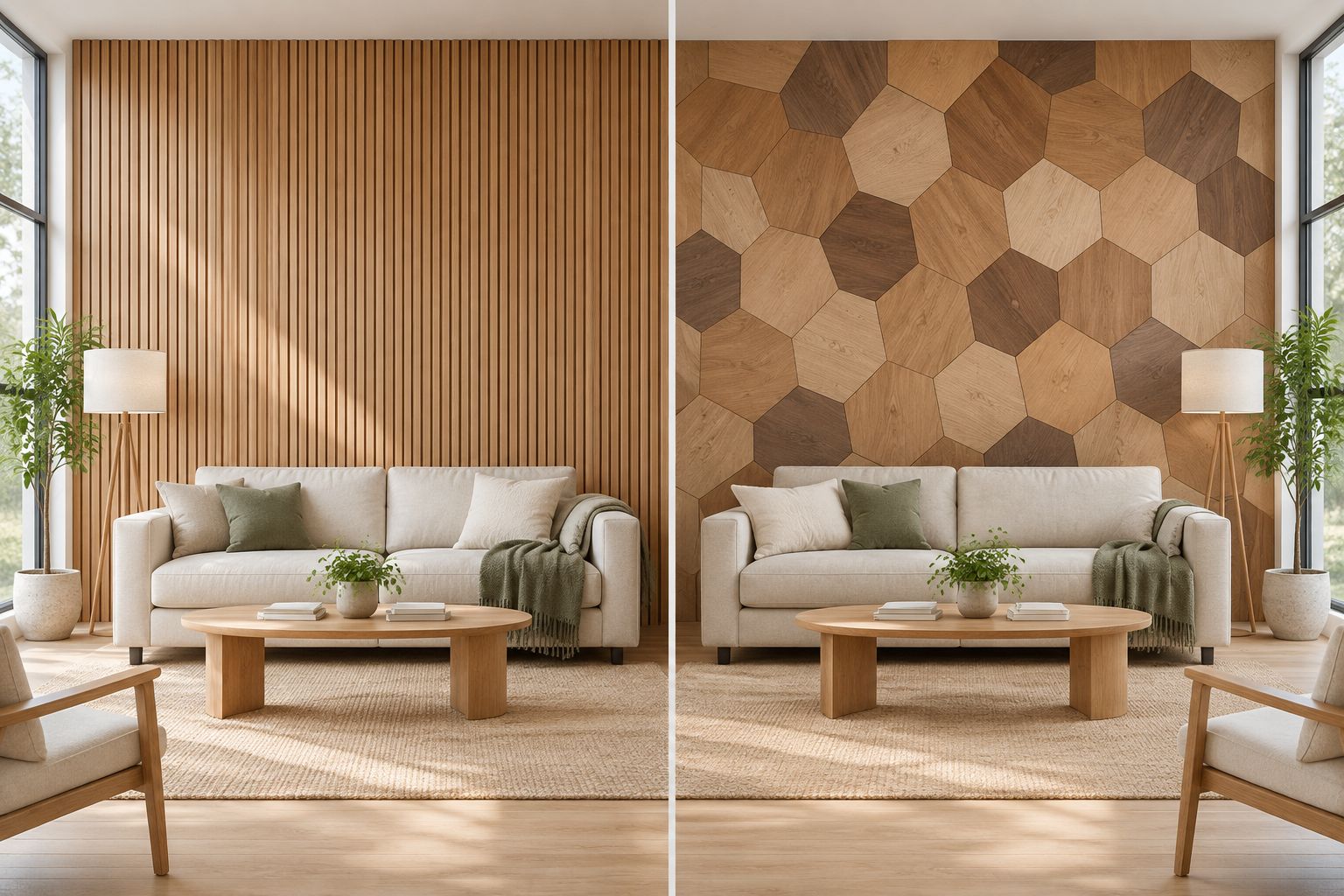
The tradeoff is practical. Slat layouts require attention to line continuity at joints and corners; hexagon layouts require attention to alignment and the perimeter shape. Choose the format you want to live with, then verify its suitability for the room.
Physical samples beat finish names for either brand
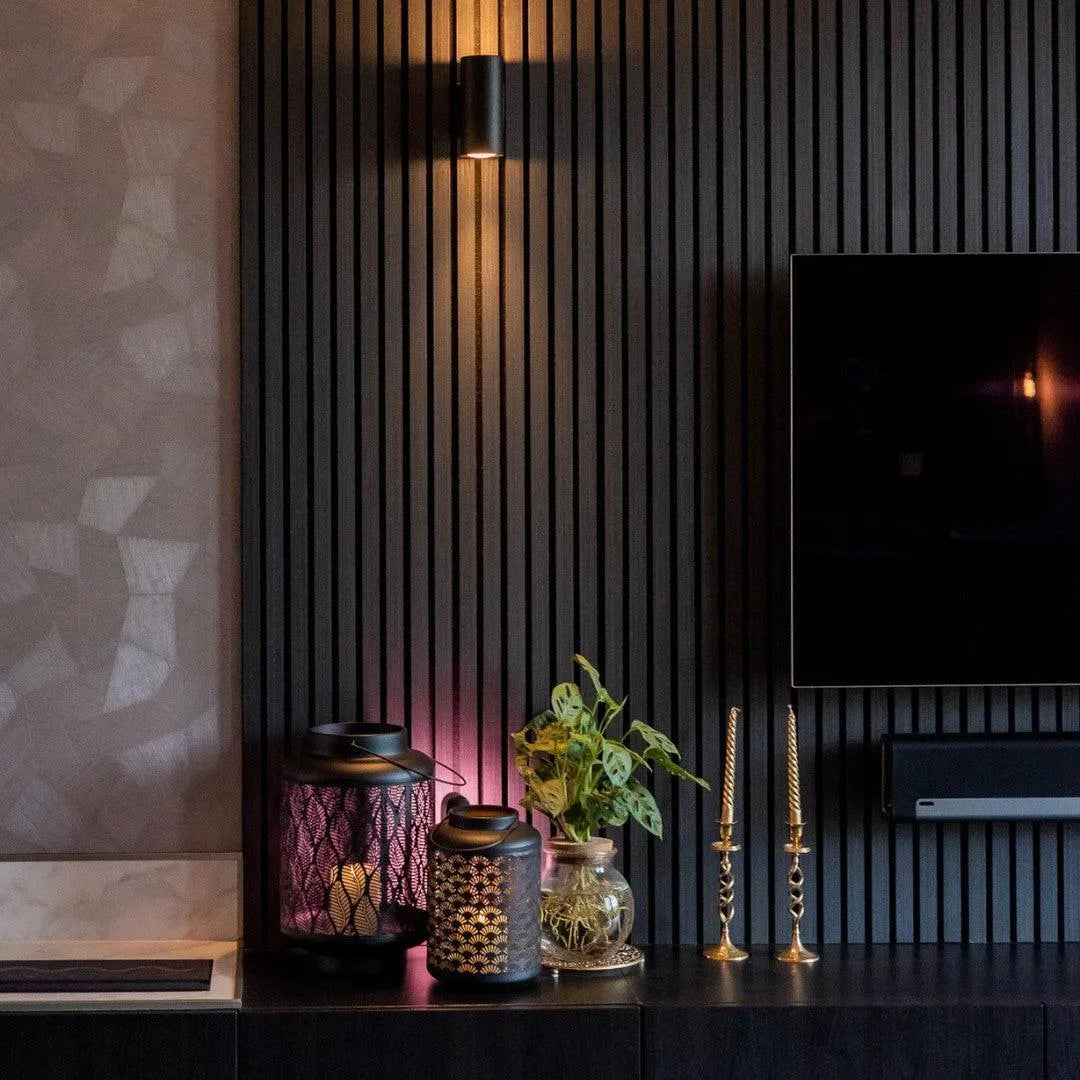
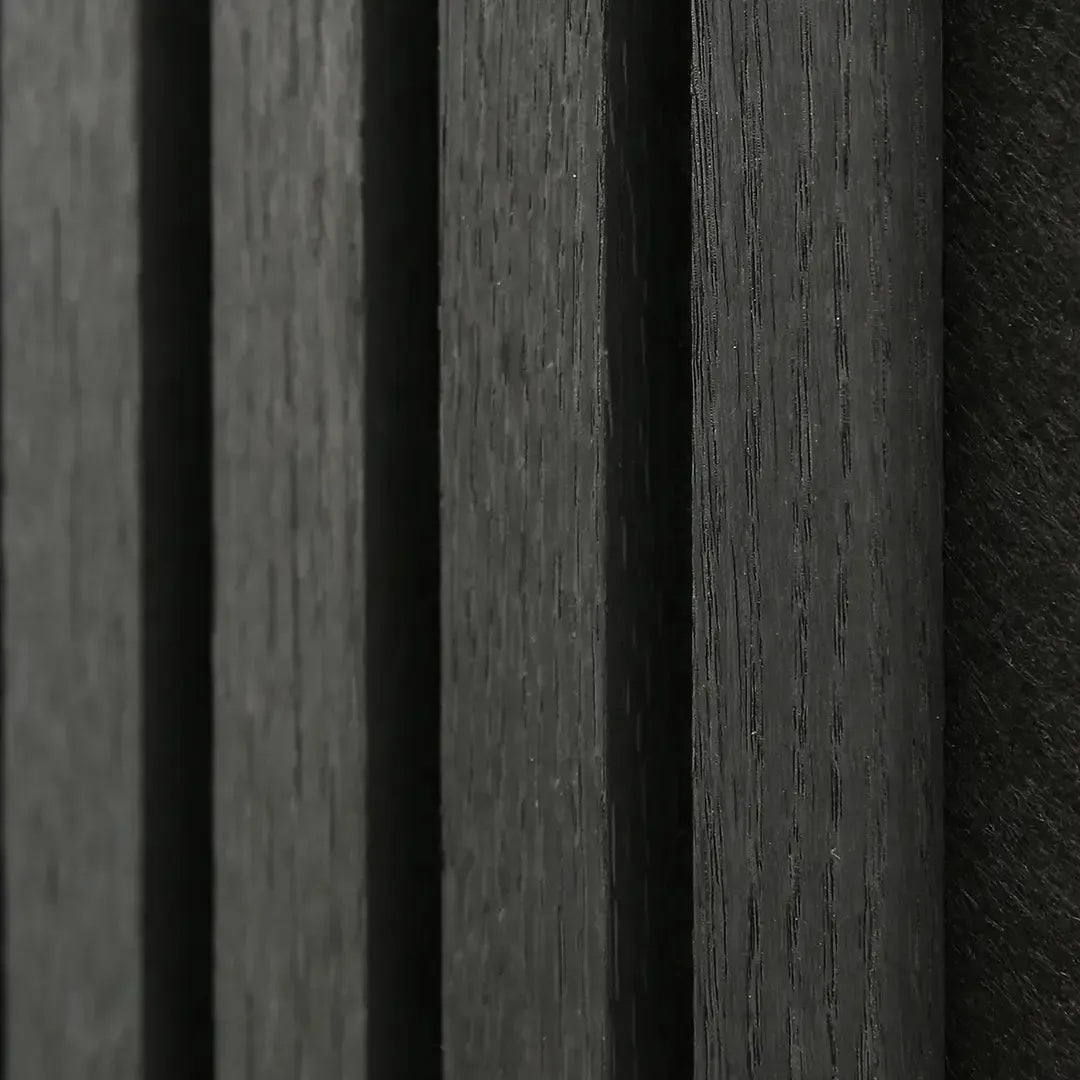
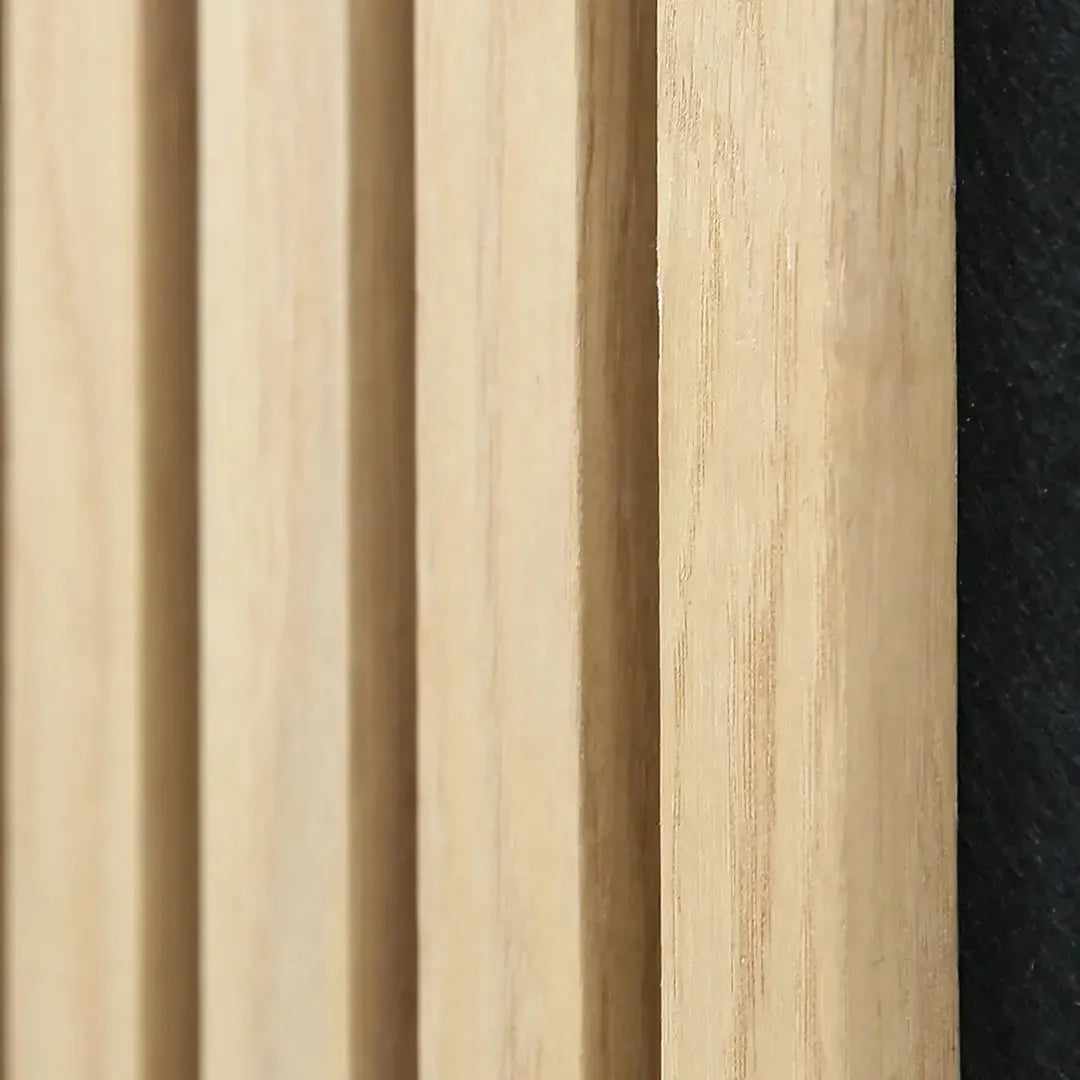
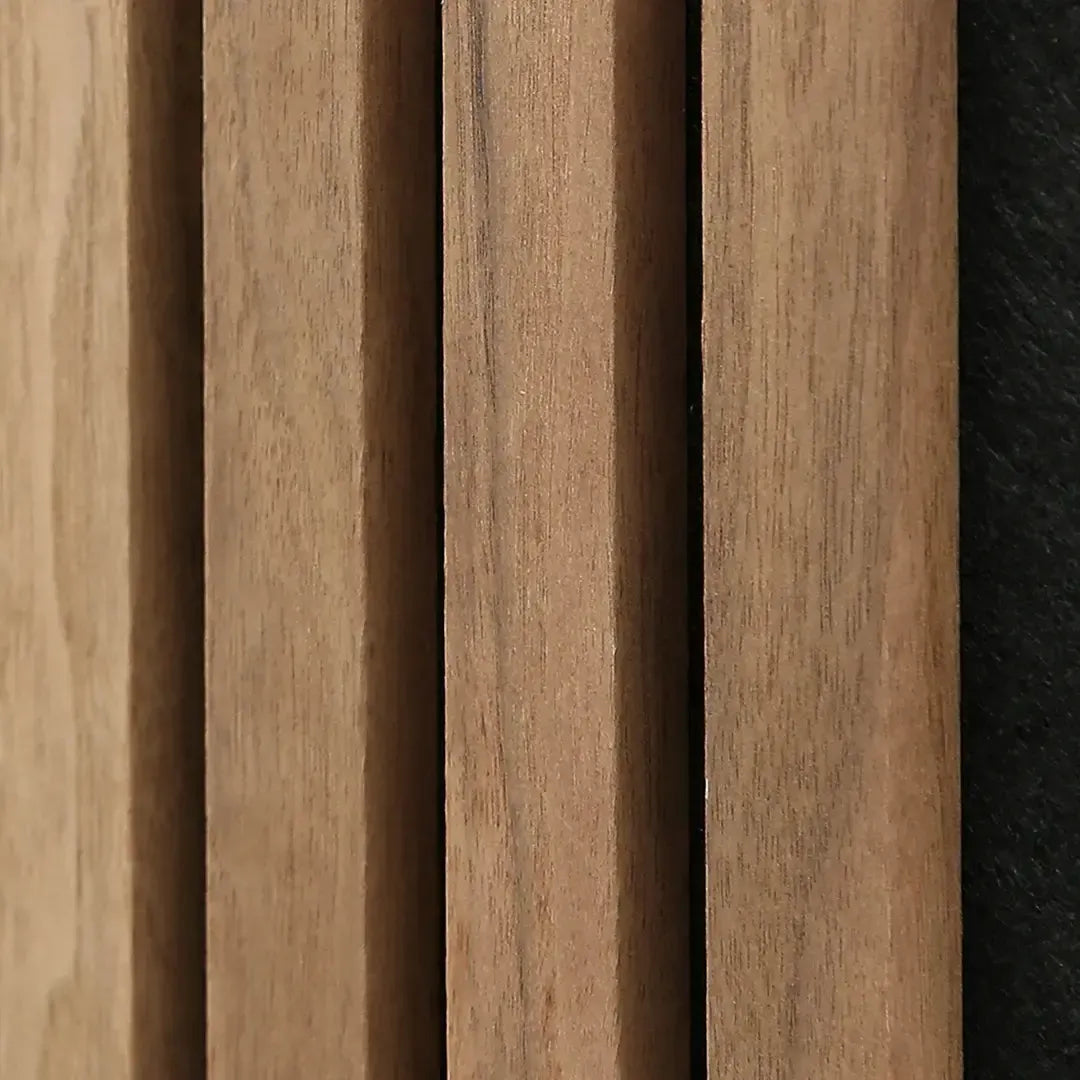
Natural oak, smoked oak, walnut, and black oak appear among the client's slat-panel options. These names help you shortlist a direction. They do not replace seeing the material beside your flooring, cabinets, paint, and lighting.
Use the Full Sample Box Slat Wall Panel to assess the listed Natural, Smoked Oak, and Walnut sample colors. Its title specifies 4 panels per box; treat those as samples, not as full-size wall coverage.
For either supplier, hold the sample vertically where the panels will sit. Look at it in daylight and under the room's evening lighting. A finish that works on a screen can look different against your actual surroundings.
For a 2026 renovation, approve the sample before finalizing adjacent finishes. Neither brand earns a finish-quality win from a color name alone. Your strongest evidence is the physical material viewed in the intended space.
Neither brand wins on acoustics without an assembly-level comparison
The supplied hexagon product descriptions state an NRC value of 0.75. NRC is a sound-absorption rating, not a measure of how much neighbor noise a wall blocks. Keep those functions separate.
A panel's acoustic result belongs to its tested arrangement. Backing, mounting, an air cavity, and any additional absorbent material matter when you compare the proposed installation with the test report. Do not transfer a rating from one panel type to another.
For your 2026 comparison, request:
- The exact product name covered by the acoustic report.
- The tested mounting arrangement and any cavity or insulation requirements.
- Frequency-specific absorption results when speech or music is the main concern.
- Confirmation that your intended installation follows the tested configuration.
Choose neither brand on an unsupported acoustic ranking. A listed rating is useful evidence, but a fair head-to-head decision requires comparable reports. A decorative wood surface does not establish an absorption result by appearance alone.
Both require installation planning; neither gets an automatic DIY win
Panel format is only part of installation difficulty. Wall condition, attachment method, cutting, outlets, corners, and exposed edges all affect the job. Decide those details before ordering.
The client catalog includes named slat end pieces in natural oak, smoked oak, walnut, and black oak. That gives you finishing components to investigate alongside the selected panel. Confirm compatibility rather than assuming every accessory fits every range.
With The Wood Veneer Hub, check the instructions and edge treatment for the exact panel you select. Use the same standard for both suppliers; a brand name is not a fixing specification.
Before you approve the layout:
- Identify the wall substrate and suitable fixing method.
- Mark outlets, switches, vents, and access points.
- Decide how exposed panel edges will finish.
- Check cuts, joints, and the manufacturer's handling instructions.
Neither supplier wins on installation speed without a matched project comparison. For a homeowner, the better choice is the panel whose instructions and finishing method suit the wall and your installation skills.
The Wood Veneer Hub wins when its exact existing panel must continue
An extension project has a constraint that a new feature wall does not: the new work must meet the old work. Small differences in profile or backing become visible where panels touch.
If your existing installation uses The Wood Veneer Hub, start with the original product information and a current sample. Compare them directly against the installed wall. Do not rely on memory or a photograph.
That is a genuine reason to choose the competitor. It is not evidence that its entire catalog has better veneer, stronger acoustics, or easier installation.
For continuity, choose The Wood Veneer Hub when the verified product match is exact. If the match fails, consider a deliberate transition between materials or replacing the complete feature area. A planned contrast is clearer than an almost-matching extension.
Commercial projects are a tie until the selected assembly qualifies
For an office, reception area, restaurant, or other commercial interior, appearance is only one requirement. The selected wall assembly must also satisfy the project's acoustic, fire, maintenance, and attachment specifications.
A guide about commercial panels does not certify a product. Neither does an acoustic product name. Ask for documentation identifying the exact material and installation arrangement you intend to specify.
For a 2026 commercial fit-out, keep the review focused:
- Fire documentation: Does the report cover the proposed product and assembly?
- Acoustic documentation: Does the tested mounting match the design?
- Maintenance: Are the cleaning instructions suitable for the location?
- Attachment: Does the fixing method suit the substrate and use?
Neither brand gets a commercial-specification win before those checks are complete. Choose the compliant product, not the more persuasive description. For a contractor, unresolved documentation is a purchasing issue that belongs before installation, not after it.
Compare the complete purchasing model, not an isolated panel
For a new wall, build the order around finished coverage and the installation method. Panels, samples, edge pieces, fixings, substrate preparation, and cutting all belong in the purchasing decision.
For an existing-wall extension, the purchasing model is different: the matching product constrains your choice. Confirm its purchase unit, accessories, and installation requirements before comparing the complete job with an alternative design.
Use the same bill of materials for both suppliers:
| Purchasing item | What to verify |
|---|---|
| Panel unit | Whether the listing refers to an individual panel, box, or sample |
| Coverage | Finished coverage after joints, cuts, and layout decisions |
| Edge treatment | Components needed for visible ends and corners |
| Mounting | Required fixings, backing preparation, and acoustic arrangement |
| Order terms | Current written terms for the selected products |
A defined panel-and-accessory order gives you a clearer commitment; an unresolved layout leaves more purchasing decisions open. Do not assume a trade program, delivery policy, or warranty applies to either supplier without checking the current terms. Freeze the specification before you compare the complete orders.
Final verdict: choose for the wall you are actually building
Choose Akustiq USA for a new acoustic wood panel feature wall
Best for: a homeowner or interior buyer choosing a fresh layout. Start here when you want to compare named oak and walnut finishes, consider slat versus hexagon formats, and plan samples and finishing pieces together.
The benefit is a defined set of project options. The limitation is equally clear: a catalog choice does not establish the acoustic result, installation time, or commercial approval of your finished wall. Verify those requirements for the selected product.
Choose The Wood Veneer Hub for a verified existing-panel match
Best for: a homeowner or installer extending a wall made with its panels. Choose the competitor when its exact product preserves the existing profile, backing, and finish.
The benefit is continuity. The limitation is reduced freedom: the installed wall determines the product brief. Approve a current sample against the wall before treating the extension as a straightforward repeat order.
| Dimension | Winner |
|---|---|
| New wall with the listed finish and format options | Akustiq USA |
| Standout format | Slats for continuous lines; hexagons for geometry |
| Finish selection | Physical sample approval decides |
| Acoustic performance | Comparable assembly-level evidence decides |
| Installation planning | Project-specific instructions decide |
| Existing-wall continuity | The Wood Veneer Hub when its exact panel matches |
| Commercial specification | The qualifying assembly decides |
| Purchasing basis | The fully defined order decides |
FAQ
Is aku wood panel vs the wood veneer hub a clear-cut comparison?
The clearest distinction is a new wall versus an existing-panel extension. Choose the client catalog for its listed acoustic panel options; choose The Wood Veneer Hub when its exact product matches the installed wall.
Which brand is better for extending my existing slat wall?
Choose the supplier whose exact panel matches your existing installation. If that panel is from The Wood Veneer Hub, compare a current sample with the installed profile, backing, and finish before ordering.
Do acoustic wood panels soundproof a room?
Sound absorption and soundproofing are different functions. Acoustic panels address reflections inside a room; blocking sound between rooms requires assessing the separating wall assembly and other transmission paths.
What does an NRC rating of 0.75 mean?
NRC 0.75 is a sound-absorption rating, not a sound-isolation rating. Check the test report and mounting arrangement before applying the listed result to your installation.
Should I choose slat panels or hexagon panels?
Choose slat panels for continuous parallel lines and hexagon panels for a geometric composition. Verify acoustic performance separately for the exact product rather than choosing by shape alone.
How do I compare the cost of a complete panel wall?
Compare complete orders built from the same finished-wall specification. Include panel coverage, required finishing pieces, mounting materials, preparation, and installation work.
What should I check before specifying panels for a commercial project?
Check documentation for the exact product and proposed assembly. Fire performance, acoustic testing, attachment, and maintenance requirements must match the project specification.
One last thing
Approve the visible edge, not just the front face. Before committing to your 2026 wall, use a sample to examine what you will see at the end of the installation and beside a cutout. A finish you love still needs a tidy stopping point.


 Better performance and aesthetic appeal
 In Stock