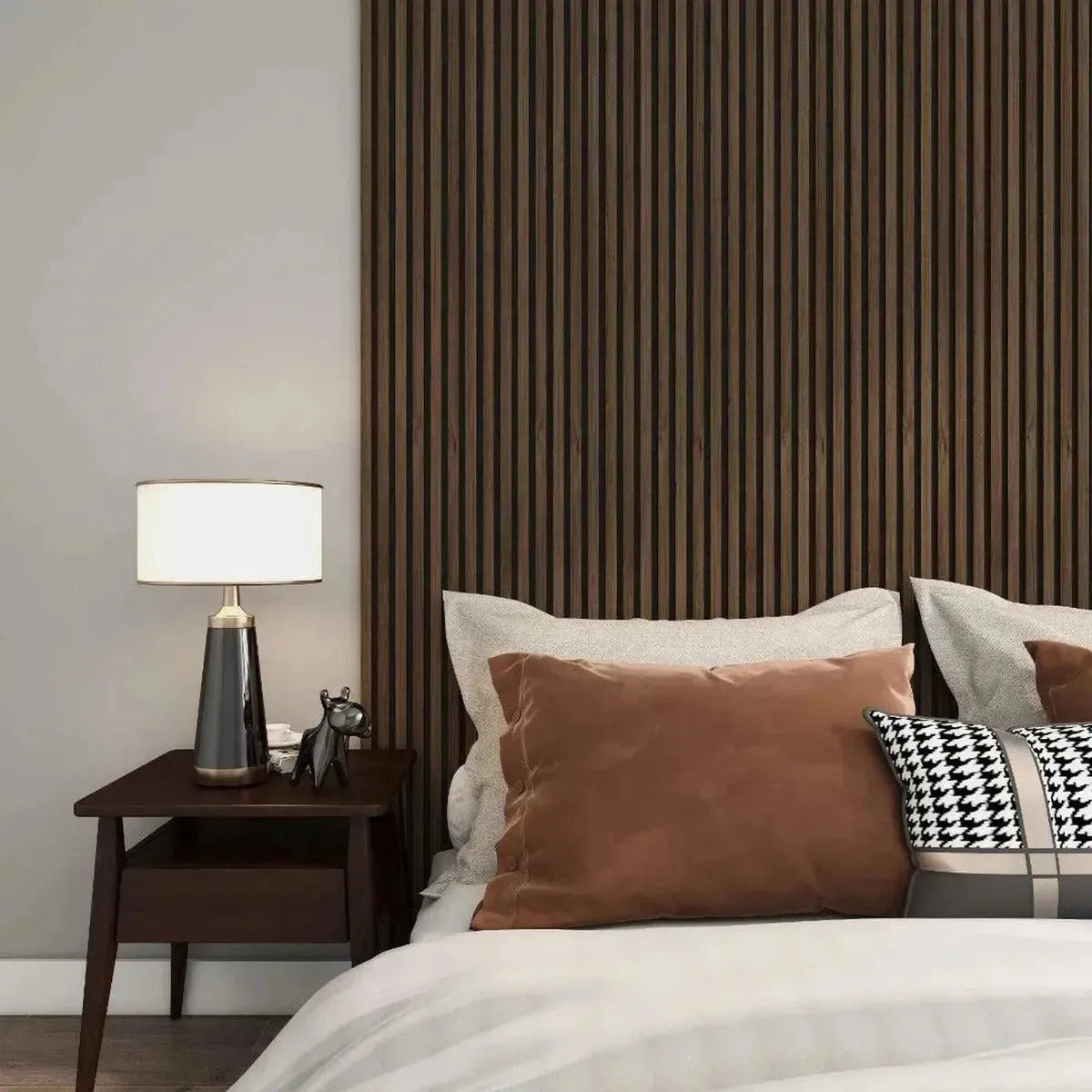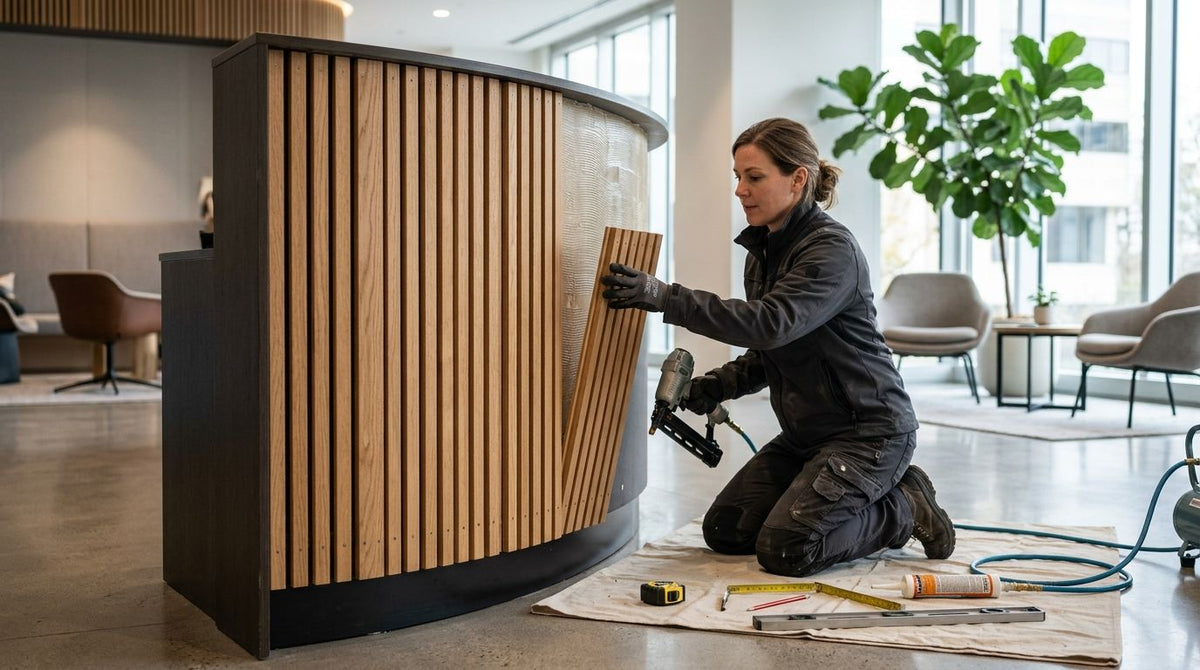
Rigid wood slat panels only bend along a shallow arc — the moment a reception desk's curve tightens past that point, the veneer cracks at the grain line instead of following it. The fix is simple: run flexible fluted panels around the tight curve, keep rigid slat sections on the straight returns, and close every transition with a matching end piece so the seam disappears.
- Installing wood slat panels on a curved desk means switching to flexible fluted panels wherever the radius tightens.
- Rigid slat panels only handle a shallow bow — force them past that and the veneer splits at the corners.
- Akuwood Panel's flexible fluted design conforms to continuous curves without cracking.
- Small-format 3D wood tiles are a workaround for compound curves where even fluted panels won't seat flat.
- End pieces close the raw edge where slat meets fluted panel — skip them and the curve reads unfinished.
Why this matters
A reception desk is the first surface a visitor's hand and eye land on, and in 2026 more offices are specifying real wood veneer over laminate specifically because it holds up to daily wear better and reads as a material upgrade at the front door. Get the curve wrong and the flaw sits at eye level for every visitor who walks in. Acoustic slat panels also do double duty — the felt backing behind the slats knocks down the boomy slap-back that hard reception counters create in open lobbies, so the material choice affects sound as much as looks. Check Akuwood Panel's panel range before you order, because the wrong panel type for a curved application means a redo, not a touch-up.
How do you install wood slat panels on a curved reception desk?
You install wood slat panels on a curved reception desk by building a continuous curved backer first, running flexible fluted panels around the tight radius, keeping rigid slats on the straight sides, and finishing every transition with an end piece. Here's the sequence that avoids a redo:
- Measure the tightest radius on the desk — usually the front curve, not the side returns.
- Map where slats stop and fluted panels start. Straight runs keep rigid slats; anything curved gets a flexible fluted panel.
- Build a continuous curved backer — bent plywood or thin MDF — before any panel touches the desk. Panels need a solid, curve-matched substrate underneath, not open air.
- Dry-fit the flexible fluted panel around the curve with no adhesive first. Check for gaps where the panel wants to spring back.
- Adhere in short sections, working from one end of the curve to the other with a wood-veneer-compatible construction adhesive, pressing firmly as you go.
- Trim and set the end piece at every point where a fluted section meets a straight slat run.
- Let the adhesive cure fully before mounting hardware, a countertop overhang, or anything that puts load on the curve.
- Inspect under raking light once cured — grain misalignment and adhesive squeeze-out both show up under low-angle light long before they show up in normal room lighting.
| Panel type | Best for | Curve behavior | Edge finishing | Verdict |
|---|---|---|---|---|
| Flexible fluted panel | Tight curves, wraparound desk fronts | Bends around a continuous radius | End piece where it meets slat sections | Buy |
| Rigid slat panel | Straight runs, gentle bows only | Shallow arc, cracks past that point | Standard end piece | Hold |
| Small-format 3D wood tile | Compound curves, tight corner spots | Each tile seats flat on its own | Grout-line style finish, no end piece needed | Buy |
Flexible fluted panels: the fix for tight curves
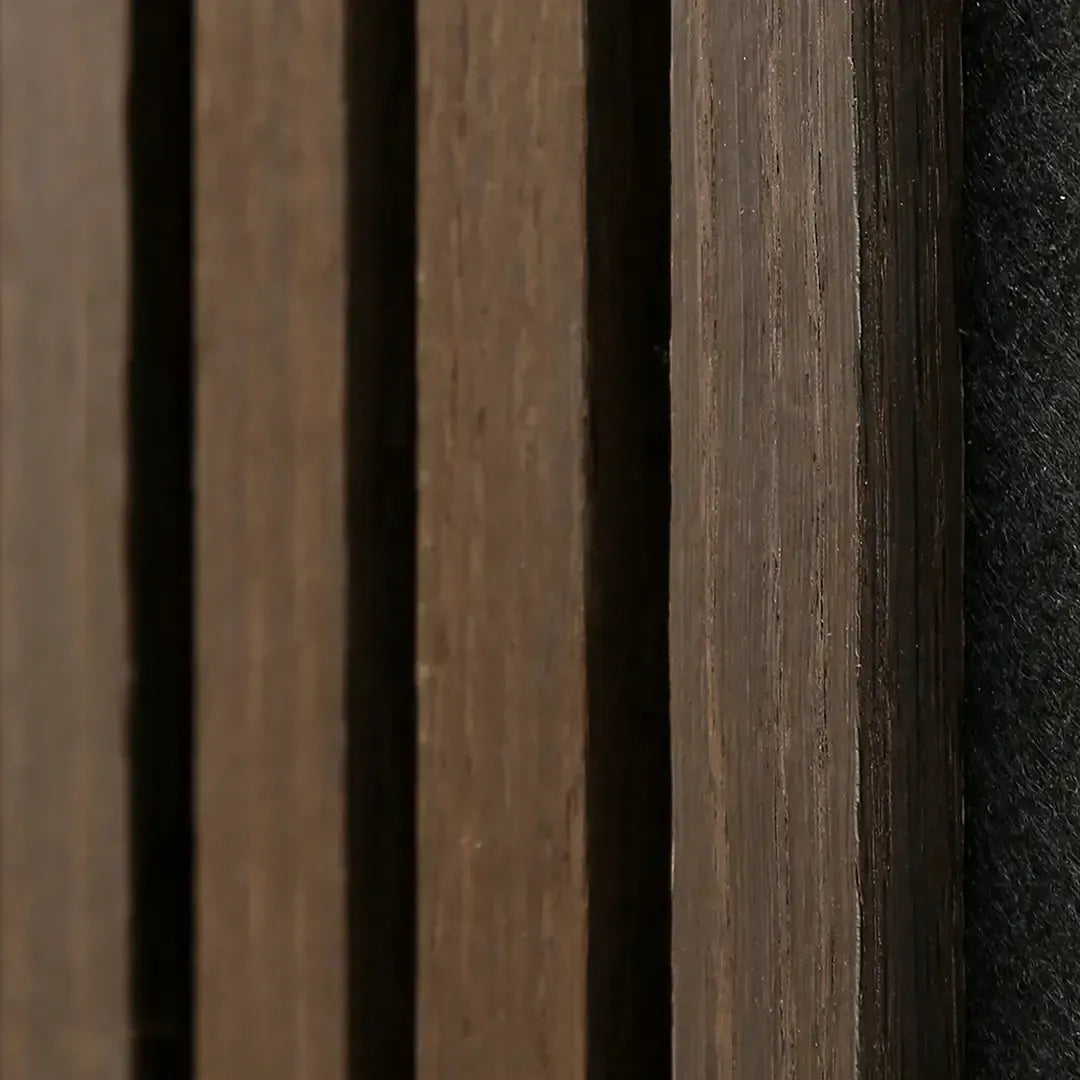
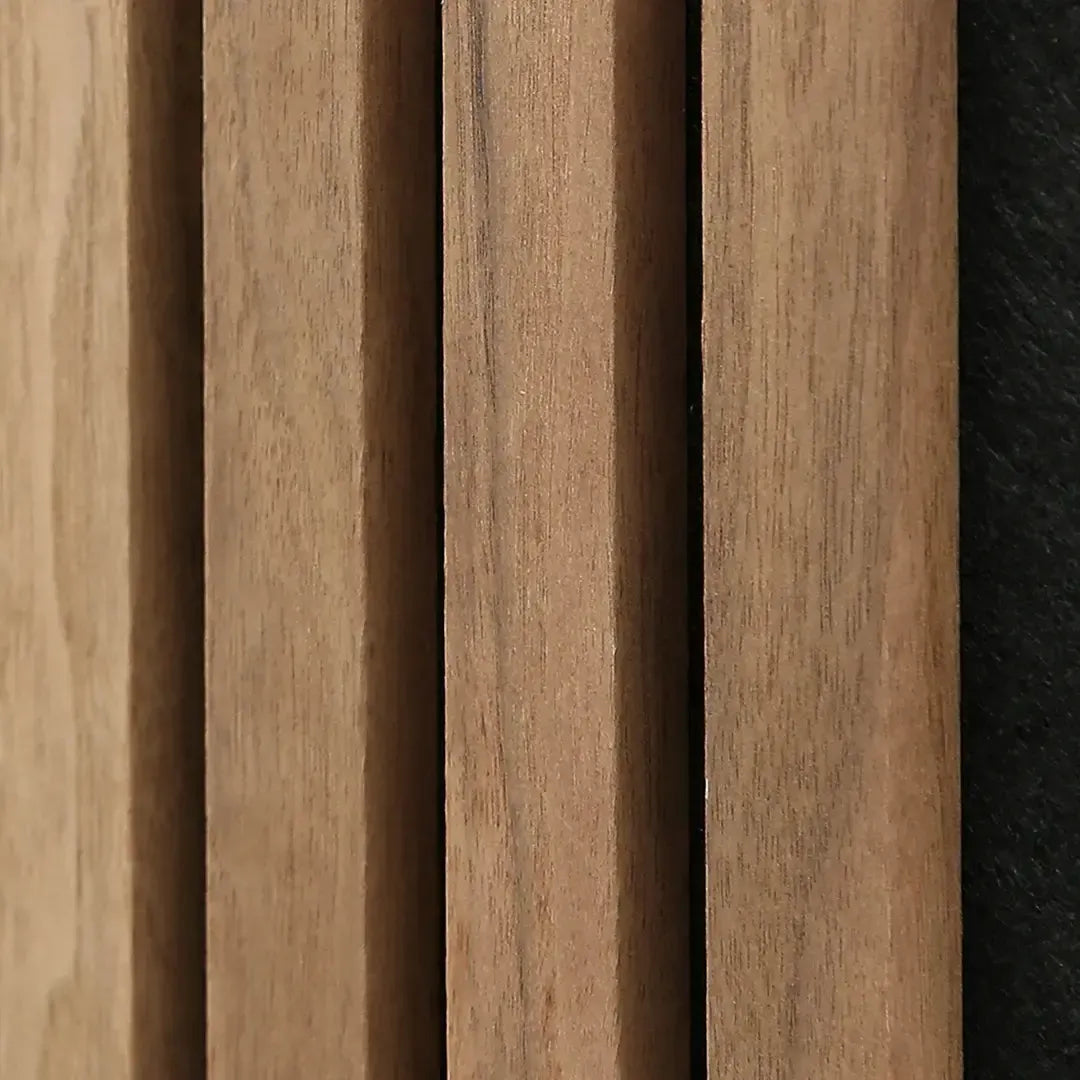
A flexible fluted panel is built to conform to a curve instead of resisting it, which is exactly what a rigid slat panel can't do once the radius drops below a shallow bow. The walnut flexible fluted panel from Akuwood Panel is designed for exactly this kind of application — desk fronts, curved columns, rounded reception counters — where a flat rigid panel would need to be scored and coaxed into shape. Buy this for any curve tighter than a gentle bow; don't force a rigid slat panel to do the job instead.
Rigid slat panels: fine for gentle bends only
Rigid slat panels still work on the straight side returns of a reception desk and on any curve shallow enough that the panel bows without stress on the veneer. Push them past that point and the wood grain splits at the tightest part of the arc, usually right at the front corner where the desk curves hardest. Hold rigid slats for straight and gently curved sections; switch to fluted the moment the radius tightens.
Why curve tolerance varies
Not every panel bends the same amount before it fails, and the difference comes down to a handful of factors:
- Veneer thickness — thinner veneer flexes further before the grain splits.
- Backer substrate — a curved plywood or MDF backer supports the panel through the bend; an unsupported panel stresses at the tightest point.
- Groove spacing — fluted panels are engineered with grooves that let the panel flex; slat panels aren't.
- Mounting method — adhesive in short sections follows a curve better than long mechanical fasteners, which fight the bend.
- Desk radius consistency — a desk with a single, even curve is far easier to panel than one with tightening and loosening sections along the same run.
Small-format tiles as a workaround for compound curves
When a reception desk has a compound curve — one that tightens and loosens in the same run, or wraps in two directions — even a flexible fluted panel can struggle to seat flat everywhere. Small-format 3D wood wall tiles solve this because each tile is an independent piece, so the panel doesn't have to bend as one continuous unit. It behaves more like mosaic tiling than a single sheet, which is exactly why it works on shapes that defeat both rigid slats and long fluted runs.


“If a slat panel needs more than a gentle bow to cover the curve, switch to a flexible fluted panel before the veneer cracks.”
Can you install wood slat panels on a curved wall without a backer board?
No — a curved wood panel install needs a continuous curved backer, whether it's a reception desk or a wall, because the panel needs a solid surface to follow through the bend. Without one, the panel flexes unevenly and stresses at whatever point has the least support, which is usually where it cracks first. Build the backer to match the finished radius before any panel goes on.
Do flexible fluted panels need special adhesive for curves?
Flexible fluted panels need a wood-veneer-compatible construction adhesive applied in short sections along the curve, not one bead run the full length. Working in short sections lets you press each part flat before the adhesive grabs, which matters more on a curve than on a straight wall where the panel isn't fighting to spring back.
How tight a curve can wood panels handle before they crack?
A rigid slat panel handles a shallow bow and nothing tighter — push it further and the veneer splits at the grain line, usually right at the tightest point of the arc. A flexible fluted panel is built for continuous curves that rigid slats simply can't take, which is the entire reason the two products exist as separate categories rather than one flexible-for-everything option.
FAQ
What's the best wood panel for a curved reception desk in 2026?
A flexible fluted panel is the best option for a curved reception desk in 2026 because it conforms to the radius without cracking the veneer. Rigid slat panels stay reserved for the straight or gently bowed sections of the same desk.
Is a flexible fluted panel better than a rigid slat panel for curves?
Yes, a flexible fluted panel is better than a rigid slat panel for any curve tighter than a shallow bow. Rigid slats are still the right call for straight runs since they're a simpler, faster install there.
How much wood panel do I need for a curved desk front?
Measure the curved run separately from the straight sides since the two use different panel types, then add extra length for trimming at each end piece transition. Order a sample of the flexible fluted panel first to confirm the curve behavior before committing to the full run.
Can rigid slat panels be scored to bend around a curve?
Scoring a rigid slat panel to force a bend risks cracking the veneer at the score line under load, which is exactly the failure this guide is built to avoid. Use a flexible fluted panel instead of scoring a rigid panel for any curve beyond a shallow bow.
Do curved panel installs need end pieces?
Yes, end pieces close the raw edge at every point where a fluted section meets a straight slat run or where the panel run simply stops. Skipping the end piece leaves an unfinished seam that's obvious under reception lighting.
How long does a curved reception desk panel install take?
A curved panel install takes longer than a flat wall because of the dry-fit, short-section adhesive work, and cure time before hardware goes on. Budget extra time for the curve compared to a straight desk front of the same length.
Can small wood tiles replace fluted panels on a compound curve?
Small-format 3D wood tiles work well on a compound curve because each tile seats independently instead of bending as one continuous sheet. They're a practical workaround where even a flexible fluted panel can't follow a curve that tightens and loosens in the same run.
One last thing
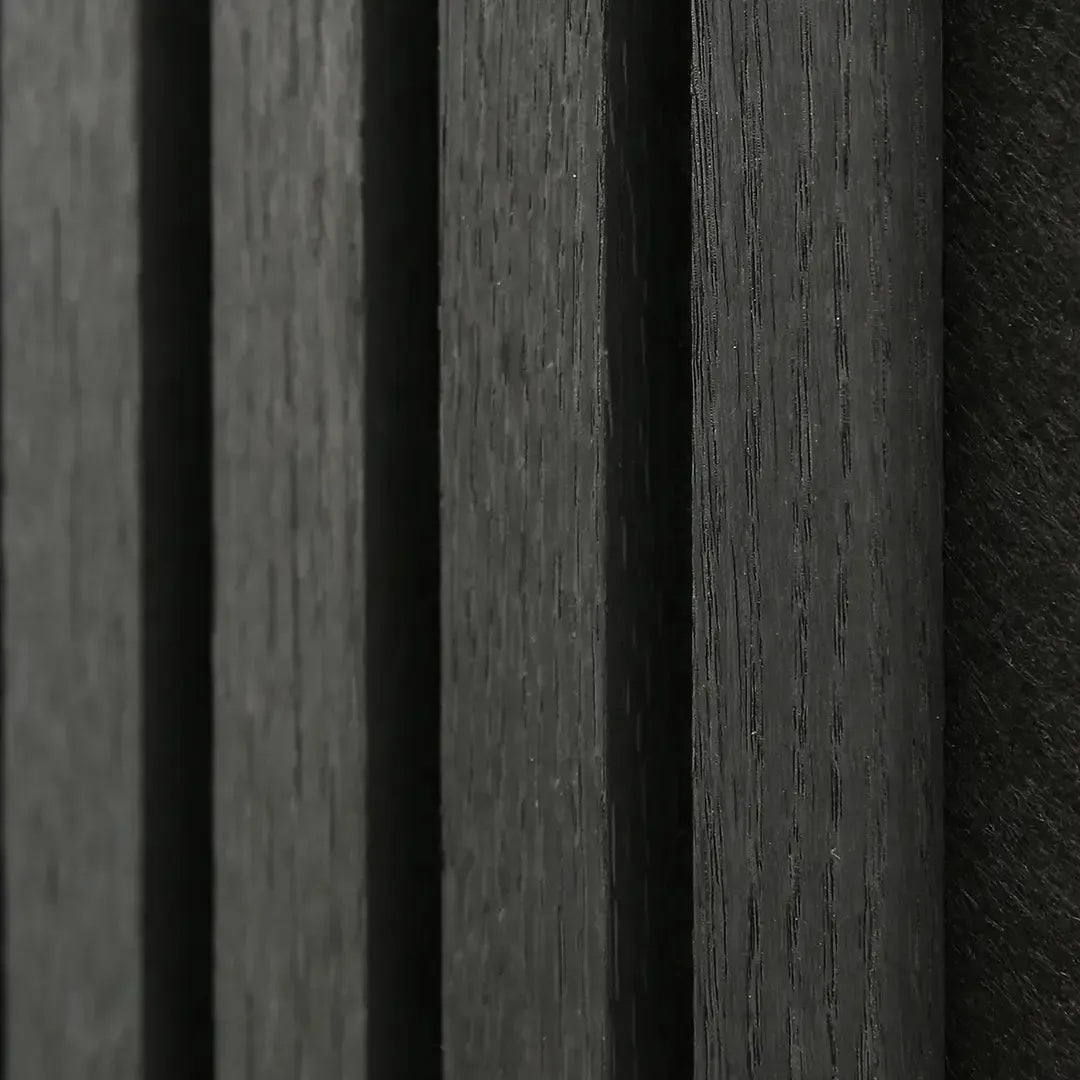
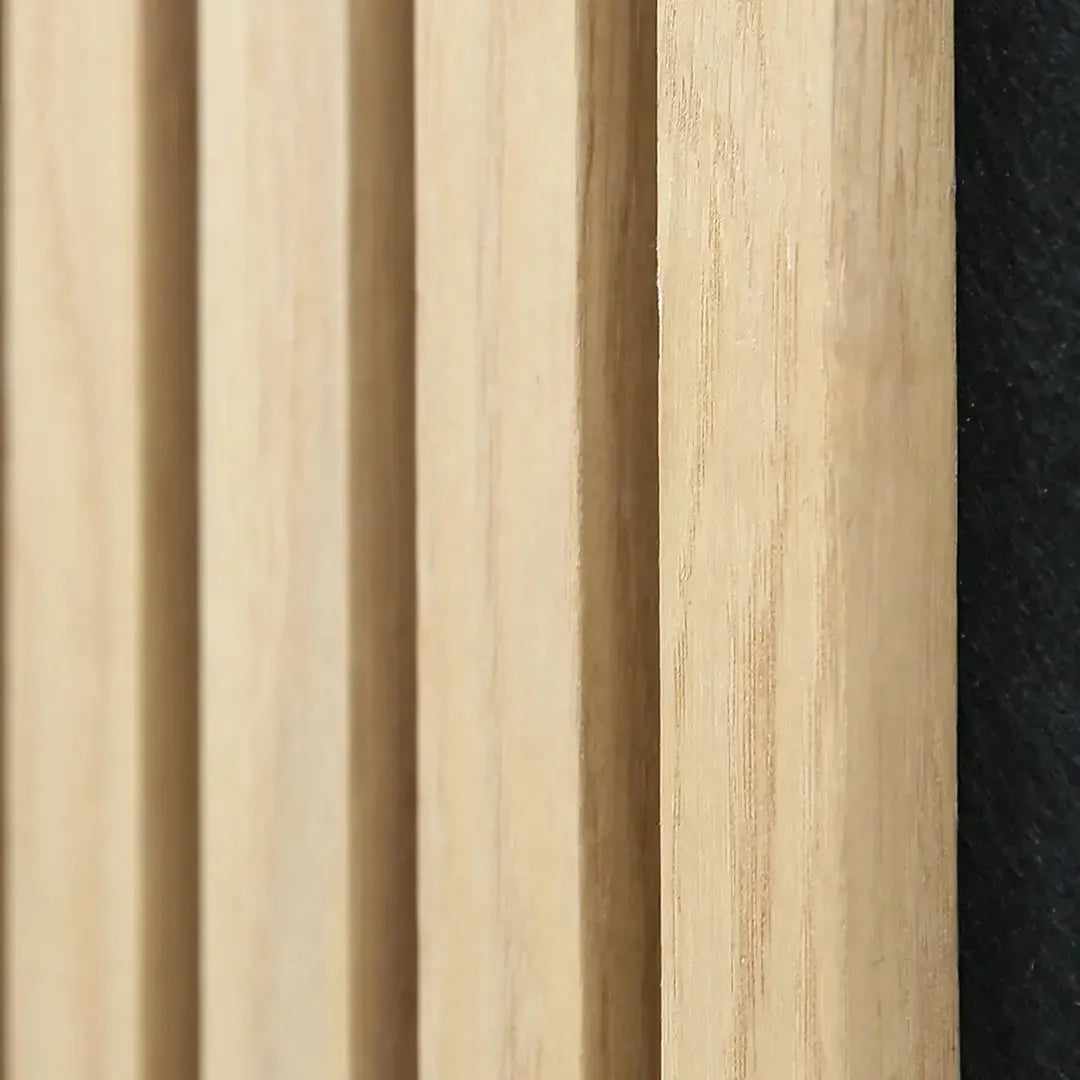
Run the grain direction the same way across the whole curve — slat to fluted to end piece — because a reception desk sits under direct overhead lighting all day, and a grain mismatch at the transition point is the first thing a visitor's eye catches. Match the panel finish (natural oak, walnut, smoked oak) across every section type before you order, not after the curved section is already installed, since color lots can shift slightly between production runs in 2026 and a mismatch is far easier to catch on a sample than on a finished desk.


 Better performance and aesthetic appeal
 In Stock