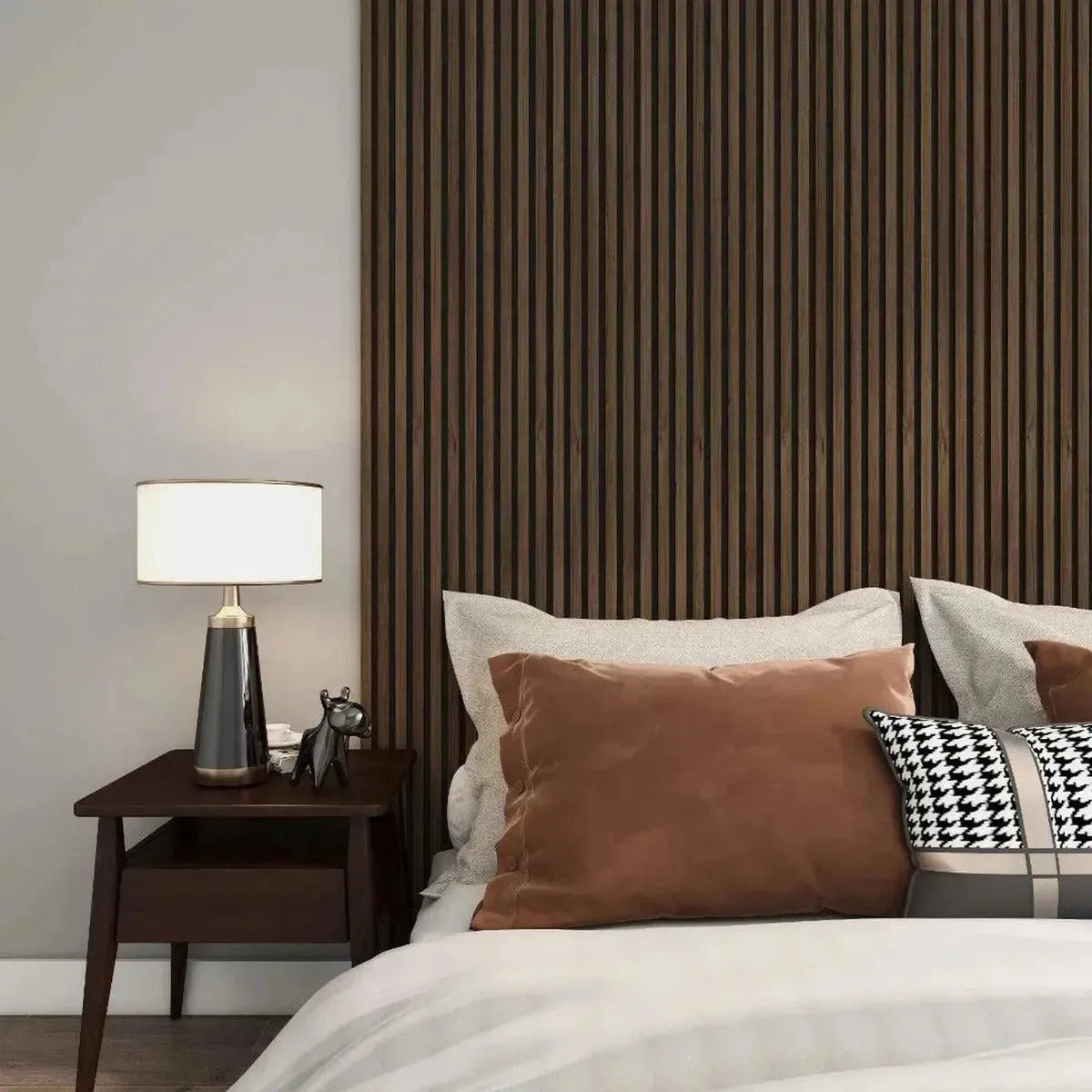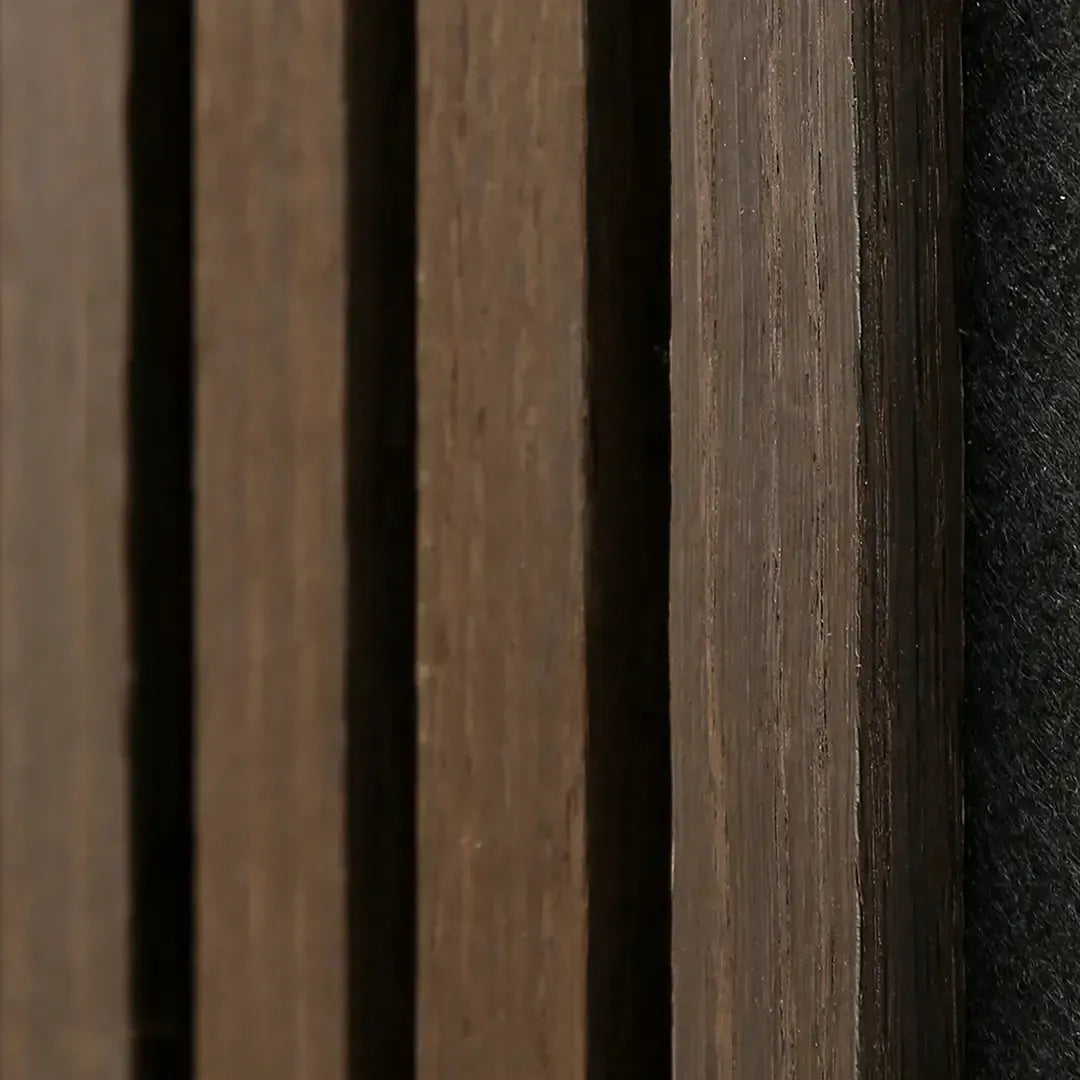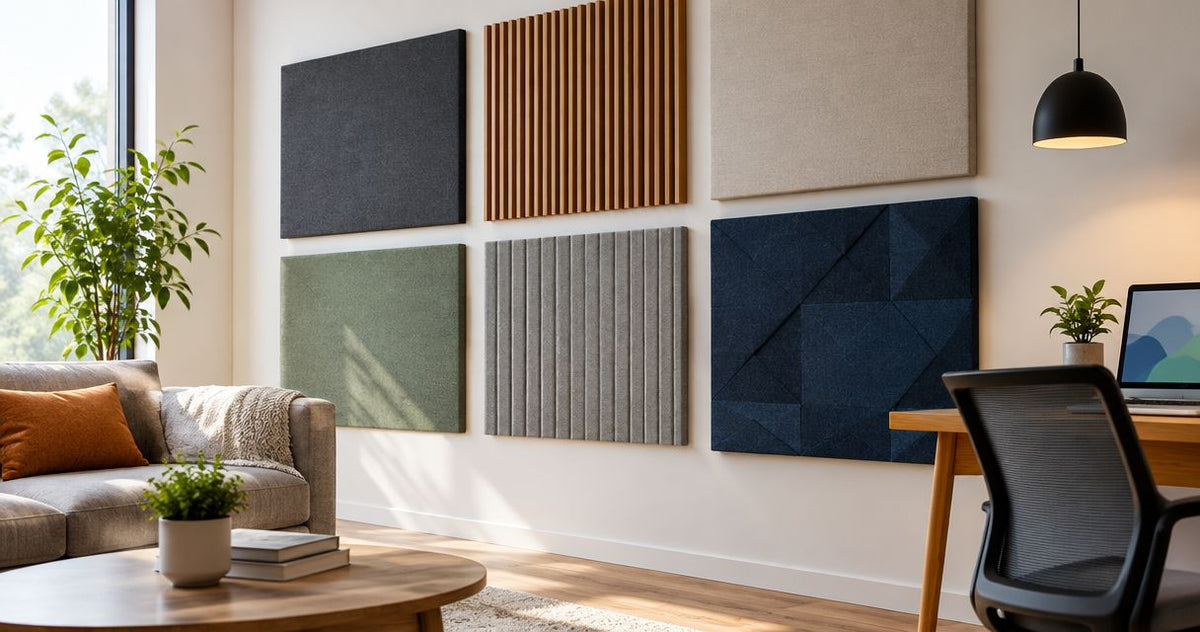
Acoustic wall panels sold in 2026 span a wide NRC range, from felt-backed slat panels that absorb most mid-range noise to solid wood tiles that barely touch it — the backing layer, not the wood veneer, decides where a panel lands on that scale.
- Acoustic slat wall panel with gray felt backing scores highest on NRC rating, typically 0.60-0.85, because the felt does the absorbing.
- Standard wood slat panels without felt backing land around NRC 0.15-0.30 — good for diffusion, weak for absorption.
- Fluted and 3D wood wall panels are decorative first; NRC rarely climbs past 0.15 without an absorptive backing.
- Hexagon acoustic panel with gray felt matches slat-panel absorption while adding a geometric pattern.
- Buy felt-backed slat or hexagon panels for real echo control in 2026; buy fluted or 3D tile panels for looks, not acoustics.
Why this matters
NRC, the Noise Reduction Coefficient, measures how much sound a material absorbs on a 0-to-1 scale, averaged across four frequency bands under ASTM C423. A rating of 0.80 means a panel absorbs roughly 80% of the sound that hits it; a rating of 0.10 means almost all of it bounces back into the room. Anyone shopping for acoustic wall panels in 2026 tends to assume any slatted wood surface does the same job. It doesn't.
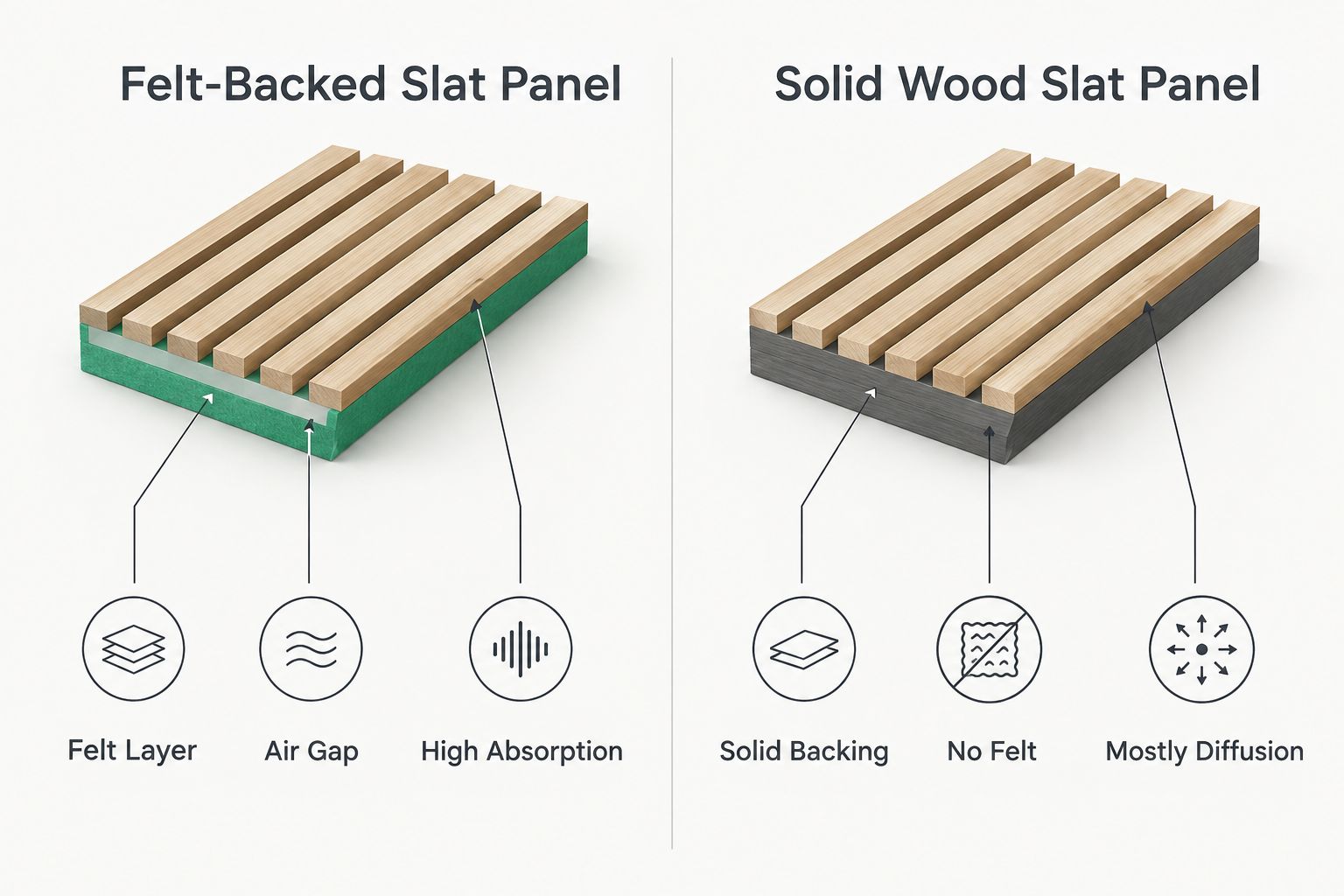
The wood veneer you see is cosmetic. The layer behind it decides the NRC rating. AKU Woodpanel's acoustic slat wall panel with gray felt backing builds that absorbing layer into the panel itself, while a plain slat panel mounted over drywall relies mostly on air gaps between the slats. That construction difference is what shows up in the numbers below, not the finish or the price.
Best overall: acoustic slat wall panel with gray felt backing for the highest realistic NRC rating without moving to custom acoustic treatment. Best for pattern-driven walls: hexagon acoustic panel with gray felt, which matches slat-panel absorption inside a honeycomb layout. Best budget pick: standard walnut slat wall panel with no felt backing, when moderate diffusion is enough and the room isn't genuinely loud. Best for decorative diffusion in high-traffic zones: fluted wall panel, chosen for visual rhythm over sound control. Skip for acoustic control: 3D wood wall panel tiles — they add texture to an accent wall but don't move the NRC needle in any meaningful way.
What makes the best acoustic wall panel for NRC rating
- Backing material — felt, PET fiber, or foam behind the wood veneer does the absorbing; the veneer barely touches sound on its own
- Air gap behind the panel — mounting on furring strips adds low-frequency absorption that flush mounting doesn't get
- Slat width to gap ratio — narrower gaps between slats expose more absorptive surface area to the room
- Panel thickness and density — thicker felt or foam layers absorb a wider frequency range
- Test mounting type — NRC figures published under ASTM C423 Type A (flush) mounting run lower than Type E (with air gap) for the identical panel
- Surface pattern — perforated, grooved, or solid faces change how much sound actually reaches the absorbing layer
Acoustic wall panels by NRC rating: at a glance for 2026
| Panel type | Best for | Typical NRC range | Key limitation |
|---|---|---|---|
| Slat wall panel with gray felt backing | Overall acoustic performance | 0.60-0.85 | Costs more per panel than non-felt slats |
| Hexagon acoustic panel with gray felt | Pattern-driven feature walls | 0.60-0.80 | More cutting waste at wall edges |
| Standard slat wall panel, no felt | Budget-conscious light diffusion | 0.15-0.30 | Limited absorption in speech-frequency range |
| Fluted wall panel | Decorative diffusion in hallways and retail | 0.05-0.15 | Not built to reduce echo meaningfully |
| 3D wood wall panel tile | Texture-focused accent walls | Under 0.10 | No acoustic function at all |
1. Acoustic slat wall panel with gray felt backing: best acoustic wall panel for whole-room echo control
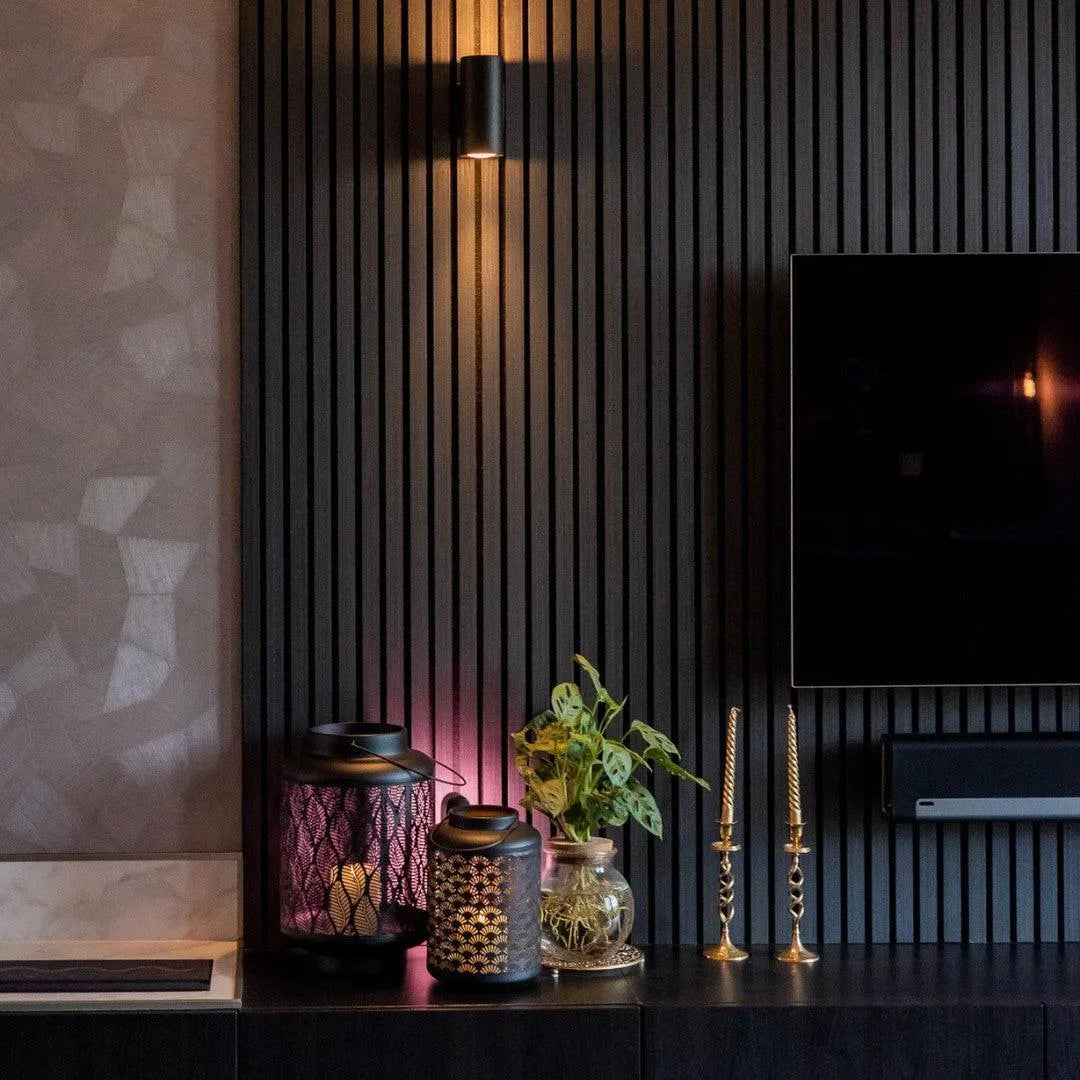
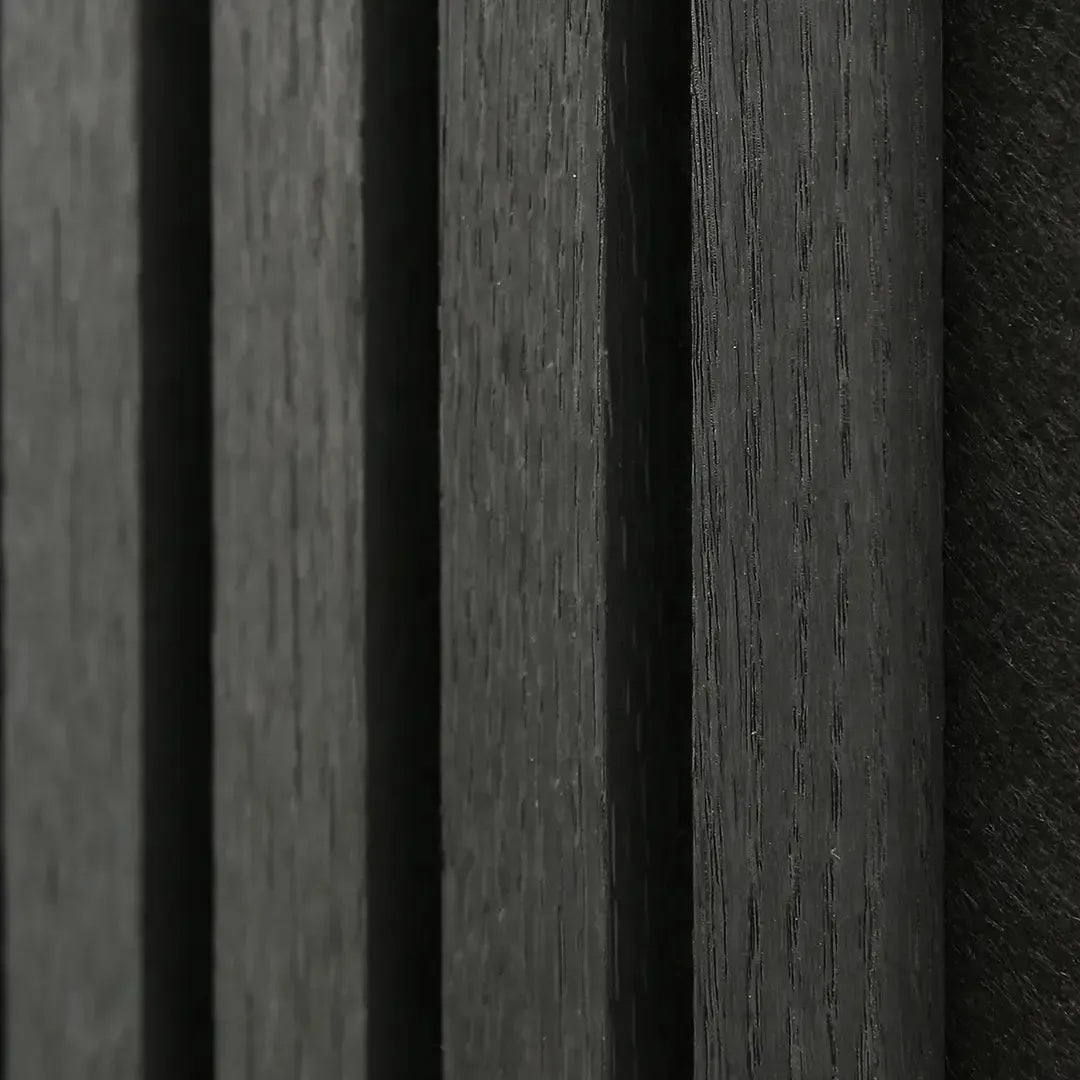
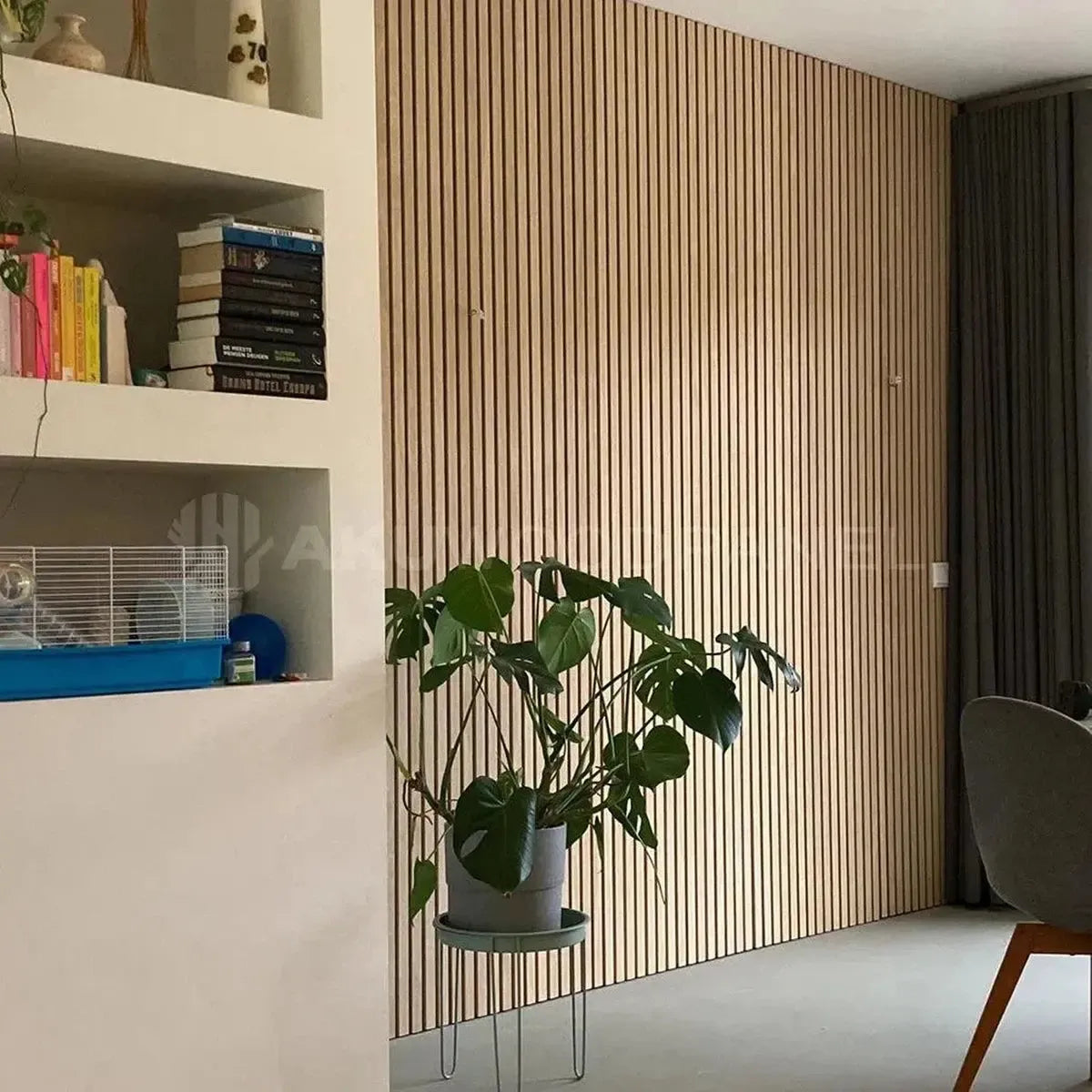
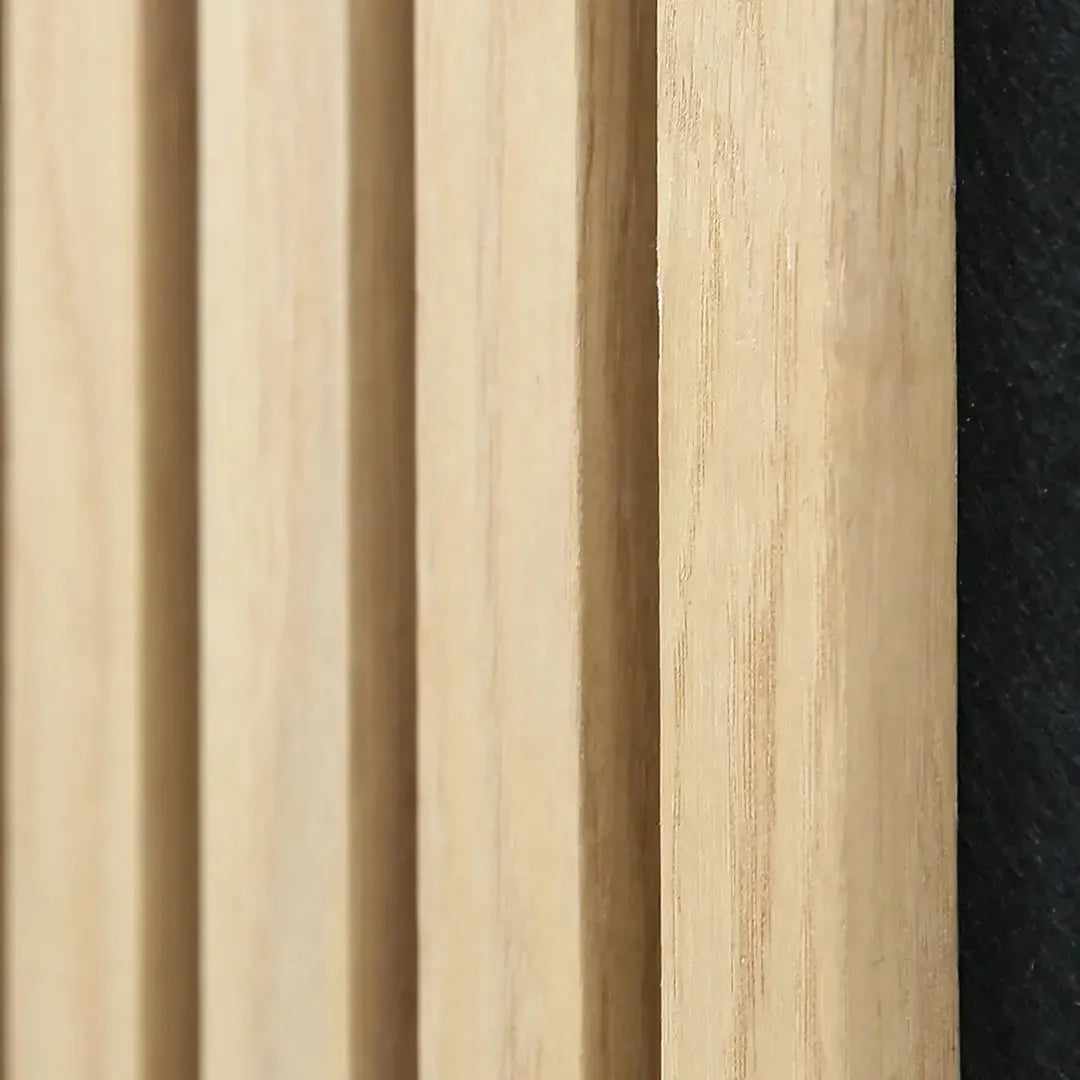
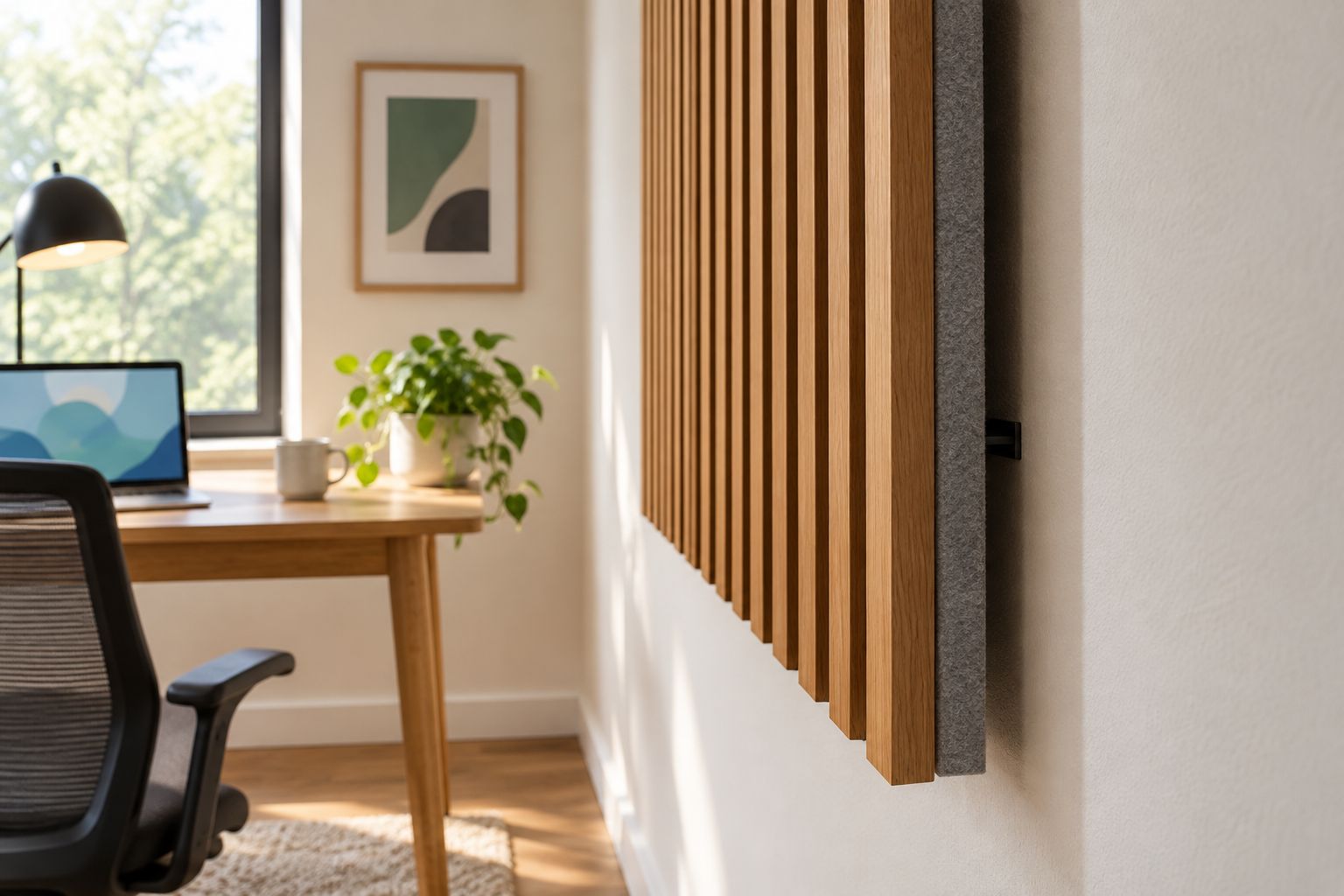
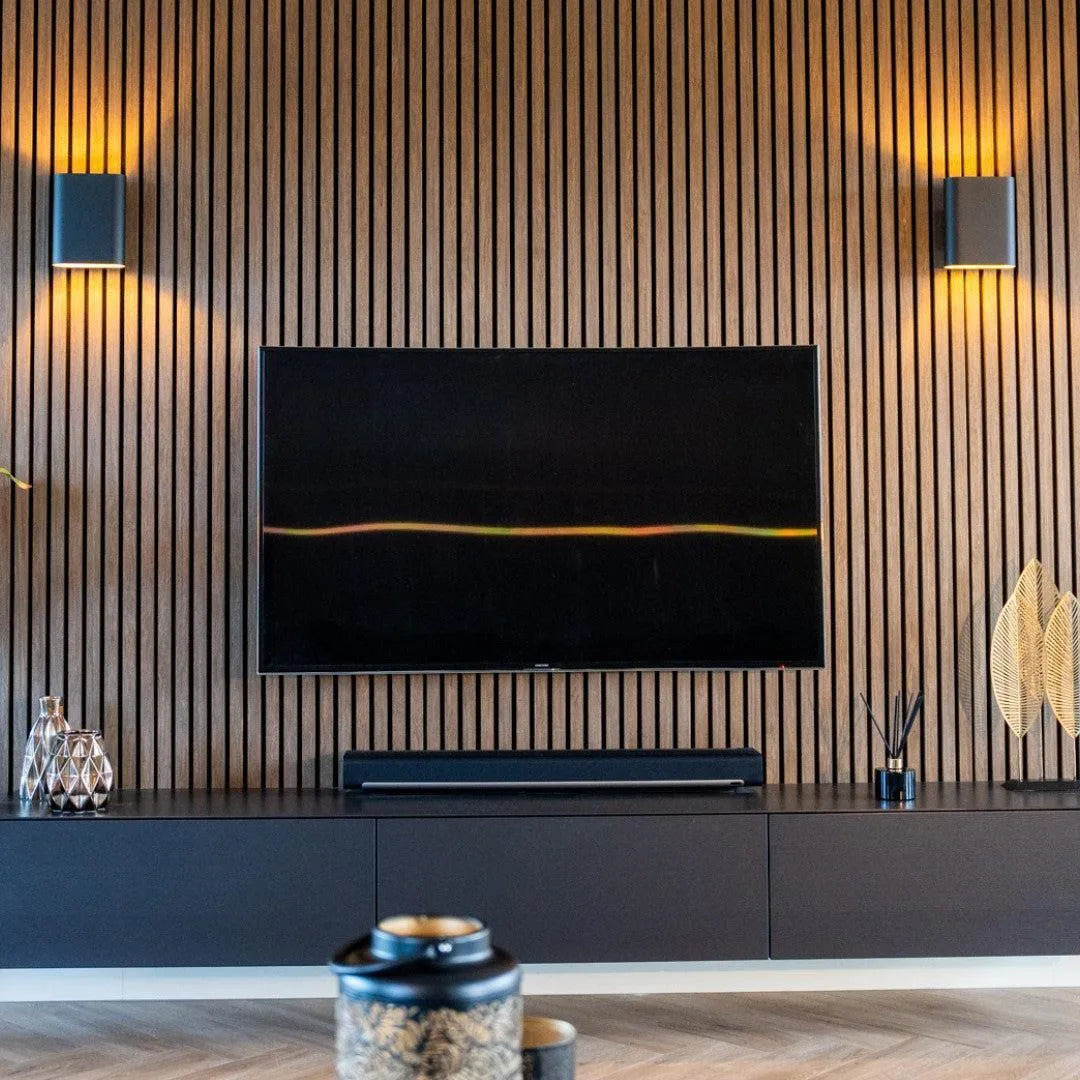
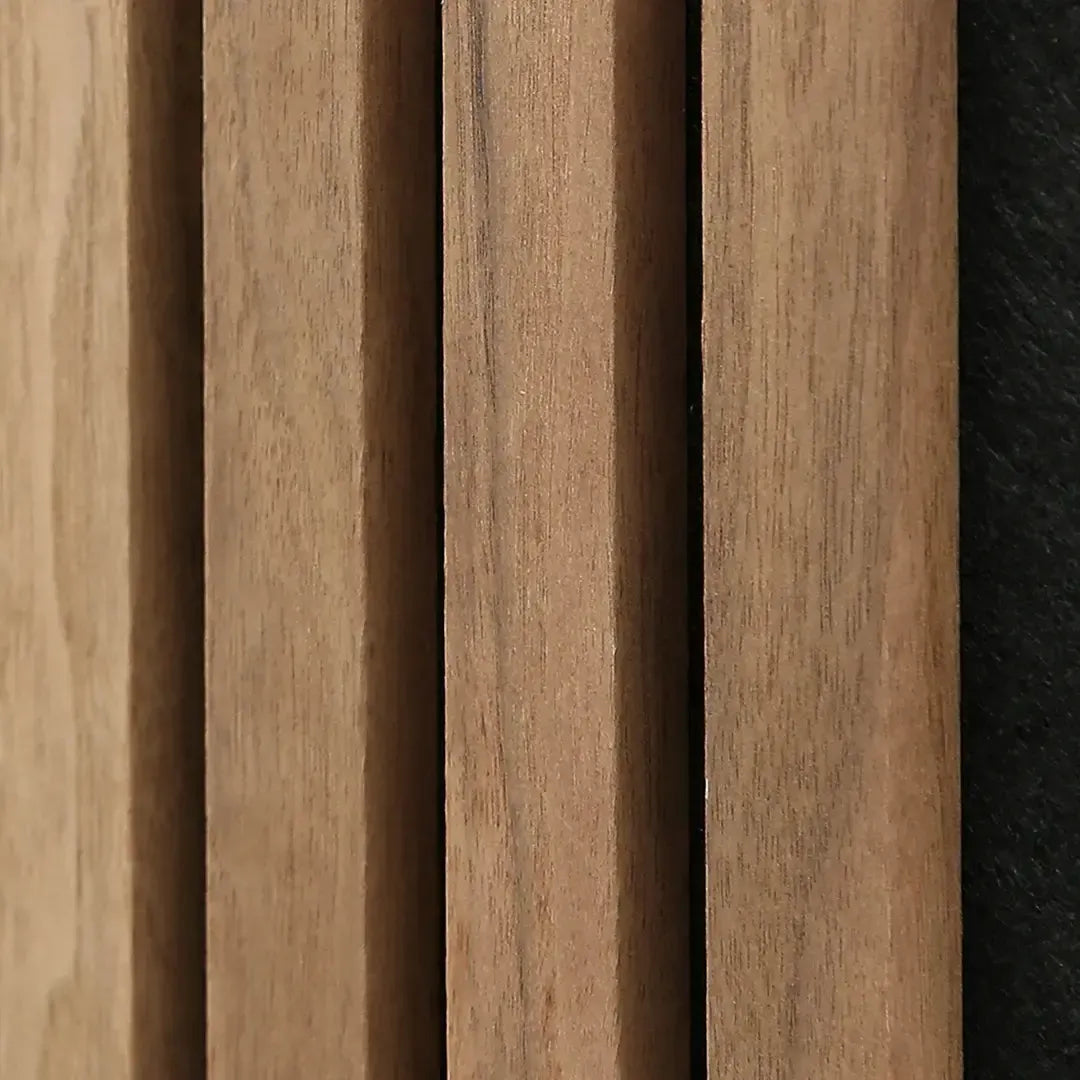
AKU Woodpanel's acoustic slat wall panel with gray felt backing pairs real wood veneer slats with a felt layer bonded to the back of the panel. The felt sits inside the slat gaps and does the actual absorbing — a bare wood slat over drywall just bounces sound back into the room.
Slat wall panel with gray felt pros:
- Highest NRC range in the acoustic lineup compared here
- Real wood veneer face, not a printed laminate
- Works as a full accent wall or a smaller feature-wall dose
Slat wall panel with gray felt cons:
- Costs more per panel than the plain slat version
- Gray felt shows through the gaps, which not every buyer wants
- Absorption depends on mounting with an air gap behind the panel, not flush
Best for: living rooms, home offices, and open-plan spaces where echo is the main complaint. Buy.
2. Hexagon acoustic panel with gray felt: best acoustic wall panel for pattern-driven feature walls
The hexagon acoustic panel with gray felt uses the same absorbing principle as the slat panel — felt behind a wood-veneer face — but arranges the wood into a honeycomb pattern instead of straight runs. NRC lands in a similar 0.60-0.80 range because the acoustic mechanism doesn't change, only the geometry.
Hexagon acoustic panel pros:
- Matches slat-panel absorption while reading as a more graphic wall
- Doubles as sound treatment and a design statement
- Available in the same gray felt finish as the slat line
Hexagon acoustic panel cons:
- More cuts and offcuts at wall edges than a straight slat run
- Pattern can compete visually with other bold elements in the room
- Coverage math is less forgiving than a rectangular slat layout
Best for: feature walls in offices, retail, or living rooms where shape is part of the brief. Buy.
3. Standard slat wall panel, no felt backing: best acoustic wall panel for budget diffusion
The walnut slat wall panel without felt backing keeps the wood-slat look at a lower NRC rating. Air moves between the slats and the wall, giving some diffusion, but nothing behind the panel absorbs mid- or high-frequency sound the way felt does. Expect NRC in the 0.15-0.30 band, not the 0.60-plus range of the felt-backed version.
Standard slat panel pros:
- Lower cost than the felt-backed version for the same wood look
- Still breaks up flat, reflective wall surfaces
- Easier to keep clean with no felt to trap dust
Standard slat panel cons:
- Won't meaningfully cut echo in a room with a real acoustic problem
- Performs closer to a diffuser than an absorber, whatever the listing implies
- Not a substitute for felt-backed panels in home theaters or open offices
Best for: rooms where the wood look matters more than the acoustic spec and background noise is mild. Hold — step up to the felt-backed version if echo is the actual complaint.
4. Fluted wall panel: best acoustic wall panel for decorative diffusion, not absorption
AKU Woodpanel's fluted wall panel is a solid, grooved wood surface with no perforation and no absorptive backing. The grooves scatter sound in different directions rather than absorbing it — that's diffusion, not absorption, and NRC only measures absorption. A solid grooved wood surface like this typically sits in the 0.05-0.15 range, close to painted drywall.
Fluted wall panel pros:
- Strong vertical-line visual effect for hallways, TV walls, and reception areas
- Solid wood surface holds up well in high-traffic zones
- Works as a design statement independent of any acoustic goal
Fluted wall panel cons:
- Does not meaningfully reduce echo or reverberation
- Sold in the same aisle as acoustic panels, which confuses shoppers
- No felt or foam-backed option currently in the fluted line
Best for: hallways, retail walls, and accent surfaces where the goal is visual rhythm, not sound control. Wait — hold off if acoustic performance is the actual requirement and look at the felt-backed slat or hexagon panel instead.
5. 3D wood wall panel tile: best for texture-only accent walls
AKU Woodpanel's 3D wood wall panel tiles are solid wood tiles carved into a raised pattern — finishes like Deep Dusk Walnut and Rich Pine. They're a texture product, not an acoustic one: no felt, no perforation, no engineered air gap. NRC sits under 0.10, functionally close to a bare painted wall.
3D wood tile pros:
- The most sculptural, dimensional finish in the catalog
- Solid wood construction holds detail well over time
- Works on small accent areas like a fireplace surround or headboard wall
3D wood tile cons:
- Zero meaningful acoustic benefit
- Higher material use per square foot than flat slat panels for the same wall area
- Not a fit for any room where echo or noise is the driving problem
Best for: accent walls chosen purely for texture and depth. Skip for anyone shopping specifically on NRC rating.
“If a wood wall panel doesn't list a felt or foam backing, assume its NRC rating is closer to 0.15 than 0.85.”
How we ranked
The ranking above follows the criteria listed earlier: backing material first, then air gap, slat-to-gap ratio, panel thickness, and how the panel is meant to be mounted. Felt-backed panels rank at the top because the felt does the acoustic work, not the wood. Fluted panels and 3D wood tiles rank at the bottom because they're built and marketed on pattern and texture — the NRC math just confirms what the construction already tells you.
Which acoustic wall panel should you choose in 2026?
If echo or reverberation is the actual complaint, buy an acoustic slat wall panel or hexagon acoustic panel with gray felt backing — both land in the 0.60-0.85 NRC range and do real acoustic work. If the wood look matters more than the acoustic spec and the room is only mildly noisy, the standard slat panel without felt is a reasonable compromise at a lower NRC. Save fluted panels and 3D wood wall tiles for walls where the brief is purely visual — hallways, feature walls, headboards — and pair them with separate acoustic treatment if the room actually echoes.
FAQ
What is a good NRC rating for wall panels?
An NRC rating of 0.60 or higher counts as good acoustic performance for a wall panel in 2026 — it means the panel absorbs at least 60% of the sound hitting it. Ratings under 0.20 offer little more than a hard wall.
Which acoustic wall panel has the highest NRC rating?
Slat and hexagon panels with felt backing sit highest, typically in the 0.60-0.85 NRC range, because the felt layer behind the wood veneer does the absorbing. Panels without a felt or foam backing rarely clear 0.30.
Do wood slat panels without felt backing absorb sound?
They absorb very little; NRC typically lands around 0.15-0.30 for slat panels with no absorptive backing. The air gaps between slats create some diffusion, not absorption.
Is NRC rating the same as STC rating?
No. NRC measures how much sound a surface absorbs inside a room; STC measures how much sound a wall assembly blocks from passing through to another room. Acoustic wall panels affect NRC, not STC.
Can 3D wood wall tiles reduce echo?
Not meaningfully. Solid 3D wood wall tiles have no felt, foam, or air gap behind them, so NRC stays under 0.10 — close to a bare painted wall.
Are hexagon acoustic panels as effective as slat panels?
Yes, when both carry the same felt backing. NRC depends on the absorbing layer, not the shape, so a felt-backed hexagon panel performs similarly to a felt-backed slat panel.
What NRC rating do fluted wood panels have?
Fluted wood panels typically test in the 0.05-0.15 NRC range because they're a solid, grooved surface with no absorptive backing. They diffuse sound visually more than they absorb it acoustically.
How much wall coverage do acoustic panels need to make a difference?
Coverage requirements vary by room size and existing hard surfaces, so check panel-specific coverage guidance before ordering. As a rule, partial coverage on one or two walls reduces echo more than a thin layer spread across every surface.
One last thing
Mounting method changes the number more than most buyers expect: the same felt-backed slat panel tested flush against drywall under ASTM C423 Type A can score noticeably lower than the identical panel mounted with a furring-strip air gap under Type E, because the gap itself adds low-frequency absorption. Before ruling any acoustic wall panel in or out on NRC rating alone in 2026, ask how it's meant to be mounted — a felt-backed panel installed flush against the wall loses part of the advantage it's rated for.
 Better performance and aesthetic appeal
 In Stock