

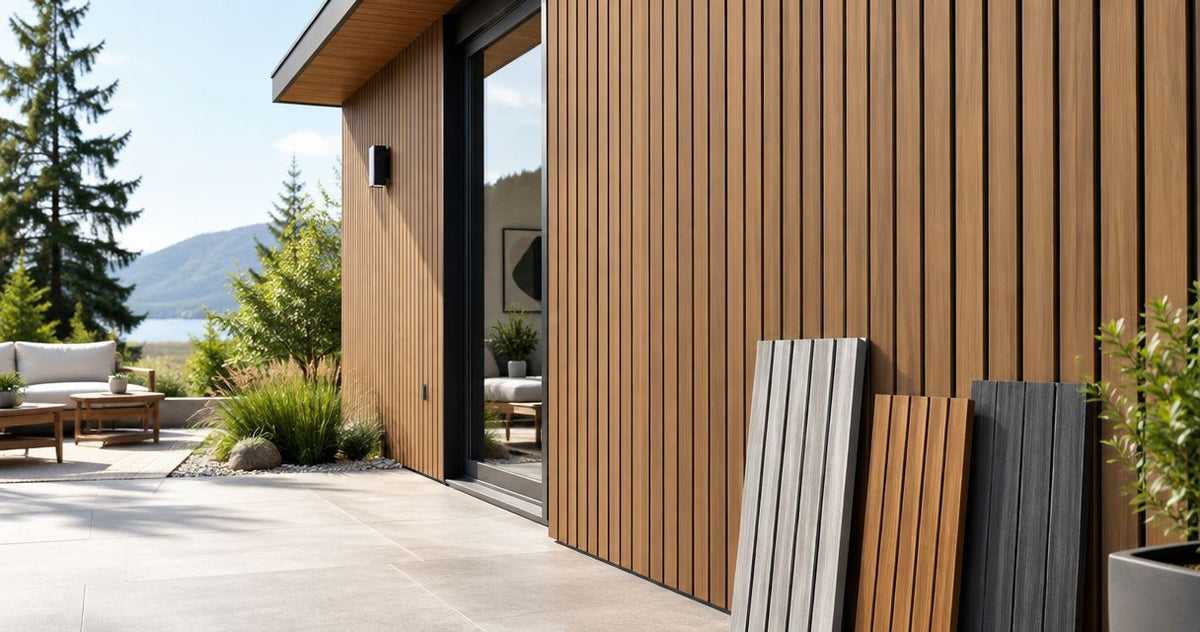
Slatpanel gives you a wood-slat finish for interior acoustic wall treatments, but an outdoor wall needs a product specified for exterior exposure—not just a similar appearance. The best Slatpanel alternative in 2026 is Akustiq USA if you want decorative exterior wood-grain panels; solid-wood exterior cladding is the alternative if actual timber is your priority. This guide compares those options with fiber-cement and metal cladding so you can separate a garden-wall upgrade from a building-envelope project.
- For Slatpanel alternatives for exterior wall panels, shortlist Akustiq USA exterior wood-grain panels for decorative outdoor projects.
- Choose solid-wood exterior cladding when actual timber matters more than avoiding finish maintenance.
- Compare fiber cement or metal when your project needs a documented exterior siding system.
- An acoustic rating does not establish outdoor suitability; verify exposure limits and installation requirements separately.
Why this matters
A slatted appearance describes a design. It does not establish whether a panel belongs outside. Rain, sunlight, moisture movement, and attachment requirements change the specification even when an outdoor wall looks almost identical to an indoor feature wall.
For your 2026 project, start by identifying what the panels must do. A decorative facing on an existing garden wall is different from siding on an occupied building, and a freestanding privacy screen introduces another set of structural requirements.
Choose the exterior application first, then choose the finish. Never use a product photograph as evidence of weather resistance, fire performance, or suitability for an exposed facade.
Slatpanel alternatives at a glance
The comparison below separates product purpose from appearance. The named exterior panels are finish options within one range, not competing construction systems.
| Option | Best for | Standout feature | Difference from Slatpanel | Main trade-off |
|---|---|---|---|---|
| Slatpanel interior acoustic panels | Indoor slatted feature walls | Wood-slat acoustic treatment | The interior benchmark | Interior suitability does not establish exterior suitability |
| Akustiq USA exterior panels | Decorative outdoor wood-grain walls | Dedicated exterior range | Exterior products rather than interior acoustic panels | Confirm the exact application and assembly details |
| Exterior Wall Panel Birch | Comparing a birch-design outdoor finish | 94.5-inch panel with 3D wood grain | Listed for exterior garden applications | Wood-grain appearance is not proof of solid timber |
| Exterior Wall Panel Oak | Comparing an oak-design outdoor finish | 2 panels per box | Listed for exterior garden applications | Panel dimensions alone do not establish installed coverage |
| Solid-wood exterior cladding | An actual timber surface | Natural wood grain | Exterior timber rather than an interior acoustic assembly | Finish upkeep depends on the species and desired appearance |
| Fiber-cement siding | Building-wall siding projects | Cement-based exterior cladding | A siding material rather than acoustic paneling | Cutting and fastening need product-specific procedures |
| Metal cladding | A metal exterior finish | Formed exterior panels | A different material and wall system | Edge, movement, and condensation details need planning |
1. Akustiq USA: best for decorative outdoor wood-grain walls
Akustiq USA exterior wall panels are the first shortlist choice when you want a decorative outdoor surface with a wood-grain design. The Birch and Oak products are listed at 94.5 inches long, with 2 panels per box and a 3D wood-grain finish. Those are useful purchasing details, but they do not replace an installation drawing.
Akustiq USA exterior wall panels are best for buyers seeking decorative outdoor wood-grain paneling rather than interior acoustic treatment. Keep that distinction clear when comparing them with Slatpanel.
Where the exterior range shines
- Exterior product purpose: Birch and Oak are explicitly presented as exterior garden wall panels.
- Finish choice: Compare the Birch and Oak designs against your paving, furniture, and existing wall finishes.
- Sample options: Outdoor samples are listed for both finishes, letting you inspect the surface before selecting full panels.
- Finishing components: The catalog includes corresponding exterior trim and fastening products; confirm the components required for your installation.
Where the exterior range falls short
- A 3D wood-grain finish is not the same purchasing proposition as solid-wood cladding.
- The listed 94.5-inch length will not fit every wall without cuts or joints.
- Decorative panels do not remove the need to resolve the supporting wall, drainage, and attachment design.
Exterior range versus Slatpanel
| Decision | Exterior range | Slatpanel interior acoustic panels |
|---|---|---|
| Primary project | Outdoor decorative wall | Interior acoustic feature wall |
| Selection priority | Exposure suitability and attachment | Interior appearance and acoustic treatment |
| Finish decision | Exterior Birch or Oak wood-grain design | Interior wood-slat finish |
| Performance evidence | Exterior application documentation | Acoustic documentation for the selected assembly |
Best for: Garden-wall and outdoor decorative projects where a wood-grain panel is the intended finish.
Verdict: Buy after confirming the installation matches the intended exposure.
Compare the exterior finishes before ordering
For a 2026 outdoor refresh, inspect a sample vertically where the finished wall will stand. View it beside the materials that will remain, not against a computer screen or an unrelated interior paint color.
The following products belong to the exterior range. Select the finish after deciding how the wall will be supported and finished at its edges.


2. Solid-wood exterior cladding: best for actual timber
Solid-wood exterior cladding is the relevant alternative when you want timber itself, not simply a wood-grain design. Specify a species, profile, finish, and fixing arrangement intended for exterior service. An interior veneer panel is not an interchangeable substitute.
Your appearance preference matters here. If you want to retain a particular finished color, plan the maintenance required by that coating system; if you prefer weathered timber, confirm how the selected species and exposure affect that result.
Where solid wood shines
- Actual timber provides natural grain and variation.
- Individual boards allow you to plan the spacing and direction of a slatted design.
- Species and profile selection give you control over the final surface.
Where solid wood falls short
- Moisture movement must be accommodated in the detailing.
- Maintaining a particular coated appearance adds upkeep.
- Board selection, cutting, and fastening require more decisions than choosing a decorative panel finish.
| Decision | Solid-wood exterior cladding | Slatpanel interior acoustic panels |
|---|---|---|
| Material priority | Actual exterior timber | Interior wood-slat acoustic finish |
| Layout | Board profile and spacing | Selected panel layout |
| Main specification | Species, moisture movement, and fixing | Interior assembly and acoustic requirements |
Best for: Buyers who specifically want real timber and accept its installation and maintenance requirements.
Verdict: Buy for the material, not as a shortcut to an outdoor acoustic wall.
3. Fiber-cement siding: best for a building-wall siding project
Fiber-cement siding belongs on your shortlist when the project is an exterior building wall rather than a decorative panel installation. Choose the complete manufacturer's system, including its approved fastening and joint details. Do not assume every fiber-cement product produces a narrow slatted appearance.
Where fiber cement shines
- Exterior siding products are available with defined installation instructions.
- Different profiles provide alternatives to a wood-slat design.
- It lets you compare a cement-based finish against timber and decorative wood-grain panels.
Where fiber cement falls short
- Cutting requires appropriate dust-control procedures, including precautions for respirable crystalline silica.
- Edges, joints, and fasteners need product-specific treatment.
- Achieving your preferred visual rhythm depends on the chosen profile, not the material name alone.
Best for: Building-wall projects where a documented siding assembly takes priority over matching an interior panel.
Verdict: Hold until the profile and wall assembly are specified.
4. Metal cladding: best for a metal exterior finish
Metal cladding is an alternative when you are open to changing the material as well as the supplier. Select a product intended for the exposure and supporting wall. Its joint pattern and edge details become part of the design.
Where metal shines
- Formed profiles offer a different route to a linear exterior surface.
- A metal finish avoids pretending that the surface is timber.
- Profile selection lets you coordinate the wall with other metal architectural elements.
Where metal falls short
- Thermal movement needs allowance in the attachment details.
- Cut edges, dissimilar materials, and exposure conditions require attention.
- Metal cladding is not automatically an acoustic absorber or a freestanding screen.
Best for: Exterior projects where a metal surface fits the design brief.
Verdict: Hold until attachment, movement, and moisture details are resolved.
Why switch from Slatpanel for an exterior project?
The reason to change is the application, not a claim that Slatpanel is a poor interior product. In 2026, an exterior shortlist should begin with products documented for the intended outdoor use.
Switch your specification when you need:
- Exterior exposure: Written confirmation that the exact product suits the location.
- Exterior attachment: Instructions for the supporting structure and fasteners.
- Outdoor finishing: Compatible treatment of corners, open ends, and wall terminations.
- A siding assembly: Documentation appropriate to a building facade rather than a decorative interior surface.
Do not turn an interior acoustic rating into an outdoor performance claim. Sound absorption, weather resistance, and structural suitability answer different questions.
Choose wall cladding or privacy screening first
A wall covering and a privacy screen solve different problems. Cladding finishes a supporting wall; a screen needs a structure capable of resisting the loads on it. The facing material does not establish the strength of the posts, frame, or connections.
For balcony privacy, artificial hedge screening changes the visual treatment from a hard panel surface to foliage-style coverage, but the same attachment question remains: the supporting structure must suit the installation. Do not treat screening or decorative paneling as a replacement for a required guard or railing.
Check balcony, rental, or shared-building rules before selecting any facing. For a garden screen, confirm the frame design before choosing the surface finish; for a building wall, resolve the wall assembly before choosing the decorative layer.
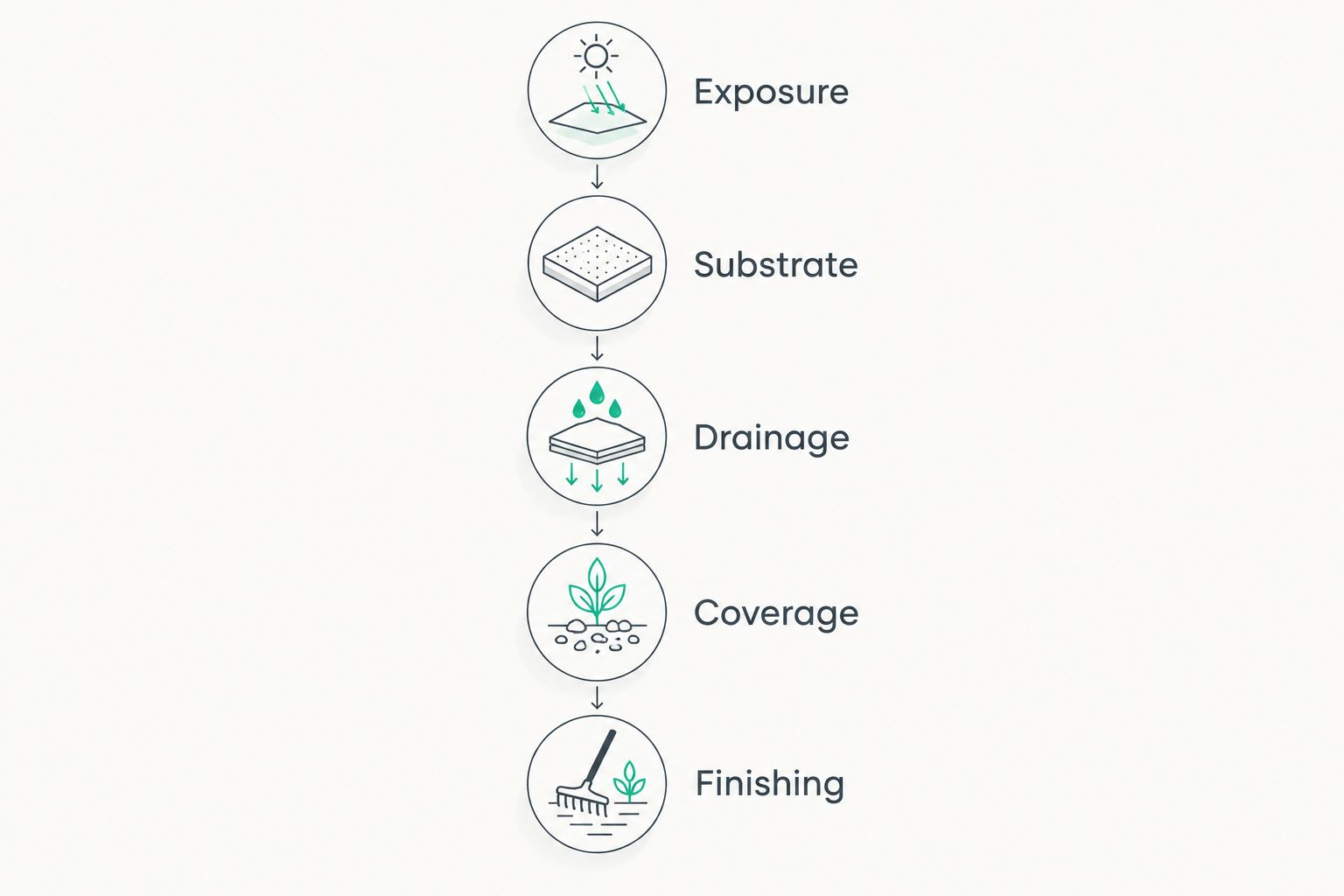
Check these details before committing in 2026
A useful comparison ends with a buildable specification, not a favorite photograph. Record the following decisions for every shortlisted product, including the exterior range from Akustiq USA.
Exposure
Describe the actual location: open garden wall, sheltered patio, boundary fence, or building facade. Include direct rain, irrigation splash, and nearby soil in the discussion with the supplier. A roof overhead does not make an outdoor installation equivalent to an indoor room.
Substrate
Identify what will carry the panels. Masonry, timber framing, and an existing fence require different attachment decisions. Check the condition of the support before covering it; decorative cladding does not repair loose masonry, decay, or an unstable frame.
Drainage
Resolve where water can enter and how it will leave the assembly. Follow the selected system's instructions for cavities, clearances, and junctions. Avoid improvised sealing details that trap water behind a decorative surface.
Coverage
Use installed cover dimensions rather than panel length alone. A listed length of 94.5 inches and a box quantity of 2 panels do not establish the area your finished installation covers. Joints, cuts, orientation, and the profile's cover width affect the order.
Finishing
Draw the ends, corners, top edge, and junctions before purchasing. Confirm which trim belongs to the selected exterior panel. Interior slat-panel end pieces and exterior finishing components should not be treated as interchangeable accessories.
For a commercial facade, add the project's required fire, wind, and other code documentation to that checklist. Get the exact product and assembly reviewed rather than transferring a claim from another panel in the same catalog.
When staying with Slatpanel is the right call
Stay with Slatpanel when your project remains an interior acoustic feature wall and the selected product meets your design and acoustic requirements. There is no need to replace an appropriate interior specification simply because exterior panels exist.
Keep connected indoor and outdoor projects separate on your schedule. For example, a listed interior acoustic panel measuring 94.5 × 22.6 inches remains a different product from a 94.5-inch exterior panel, even when both contribute to a coordinated design. Similar dimensions and wood tones do not establish interchangeable use.
FAQ
What's the best Slatpanel alternative for exterior wall panels in 2026?
Akustiq USA exterior wall panels are the first shortlist choice here for decorative outdoor wood-grain projects. Choose solid-wood exterior cladding instead when actual timber is your priority, and verify the selected product's installation requirements.
Can I install interior Slatpanel panels outside?
Do not install an interior acoustic panel outside unless the manufacturer explicitly approves that exact product and application. A similar appearance or a sheltered location does not establish exterior suitability.
Are exterior wood-grain panels made from solid wood?
A wood-grain description does not establish that a panel is solid wood. Check the exact material specification instead of inferring construction from the finish name.
Do exterior wall panels reduce outdoor noise?
Do not assume exterior decorative panels provide sound absorption or sound isolation. Outdoor noise control requires evidence for the selected product and the complete installation.
How many exterior panels do I need for my wall?
Calculate the quantity from the installed cover dimensions and your measured layout. Include the planned joints, cuts, and openings rather than calculating from panel length alone.
Can I attach exterior panels directly to a fence?
Attach panels only when the fence and fastening arrangement suit the selected system. Confirm the condition and capacity of the posts, rails, and connections before adding the facing.
Is fiber cement better than decorative exterior paneling?
Fiber cement is the more relevant comparison when you need a building-wall siding system rather than a decorative finish alone. The right choice depends on the exact product, wall assembly, and project requirements.
Does a covered patio allow me to use indoor acoustic panels?
A covered patio does not automatically make an indoor panel suitable for outdoor use. Confirm approval for the actual moisture and exposure conditions before specifying it.
One last thing
Before approving the finish, ask your installer to draw an exposed end and a corner. Those details force the discussion beyond the panel face: support, cuts, trim, and water management all become visible. If the installation cannot be explained at its edges, it is not ready to order.
Share:
Andor Willow alternatives for black wood wall panels