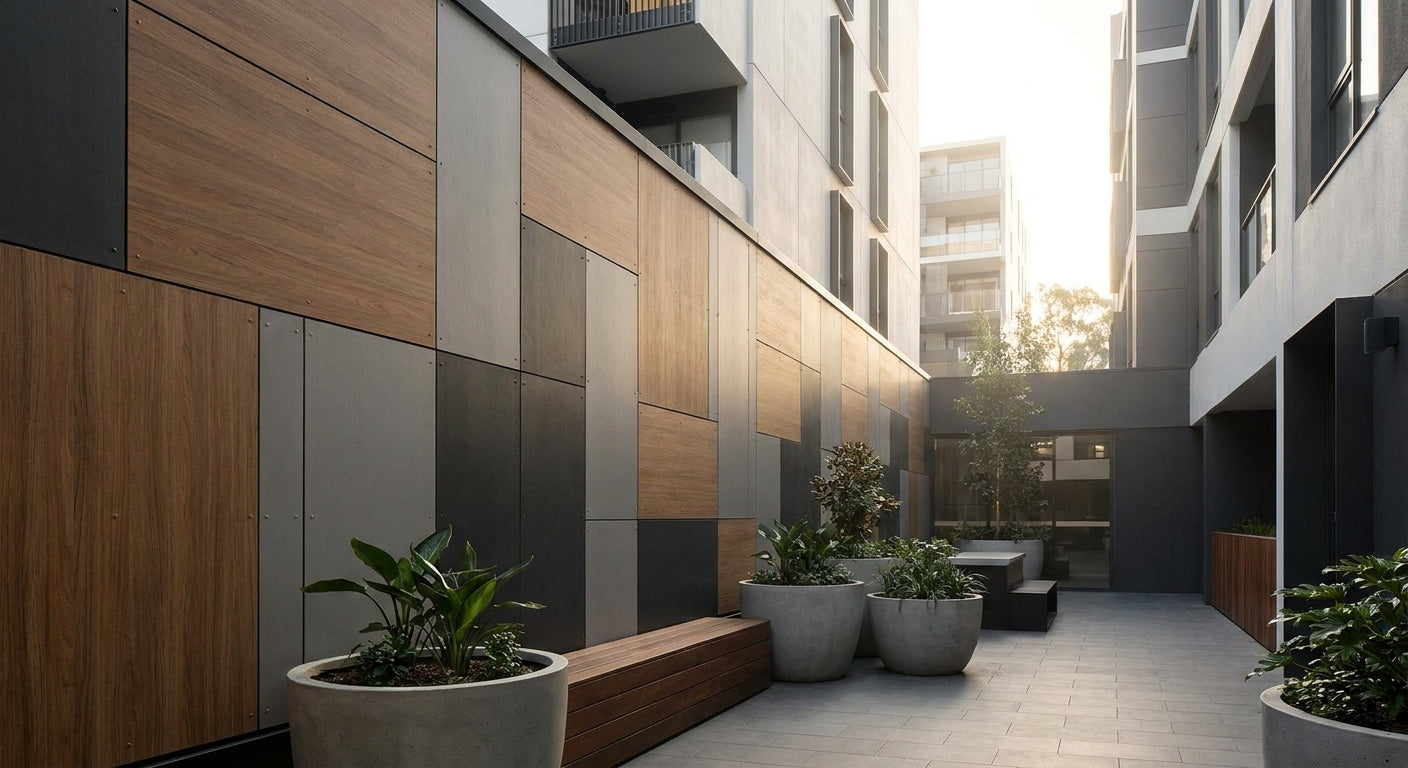
Urban courtyards get boxed in by brick, render, or bare block on three sides, and that combination amplifies heat, traps moisture, and shows every crack. Exterior composite panels solve the look and the weather problem at once, and this guide narrows down which finish, color, and mounting approach actually holds up in a tight, shaded, moisture-prone courtyard in 2026.
TL;DR
For exterior composite panels urban courtyard projects, the stone gray exterior wall panel is the safest match against existing render or block, while the black exterior wall panel hides urban grime and works best on walls that get partial shade year-round. Skip lighter birch-toned composite in courtyards with heavy foot traffic or close-set neighbors — it shows scuffs faster. Budget for a ventilation gap behind any composite cladding panel; courtyards trap humidity more than open facades. Verdict: stone gray or black composite panels are the Buy picks for most urban courtyards in 2026.
Why this matters
A courtyard wall behaves differently than a street-facing facade. Airflow is lower, shade is heavier, and moisture from planters, gutters, or nearby downpipes sits longer against the surface. Composite panels rated for exterior use resist that moisture cycle better than raw timber, but not every composite product is built for a semi-enclosed space where humidity lingers for hours after rain.
The other factor is proximity. In a courtyard, people stand 3 to 6 feet from the wall, not 30. Seams, screw heads, and color mismatch that would disappear on a two-story facade become obvious at that distance. That changes which panel and which trim actually make sense.
Exterior wall panels built for outdoor use come in a handful of finishes, and picking the wrong one for a shaded, enclosed courtyard is the single most common mistake homeowners and contractors make on this kind of project.
Who this is for
This guide is for homeowners, property managers, and small contractors covering an existing block, render, or plain concrete courtyard wall in a dense urban lot — townhouses, rowhomes, small multi-family buildings, or restaurant patios where the courtyard wall is visible from inside and out. If your project is a full detached-home facade with open sun exposure on all sides, the constraints are different and you have more finish options to work with.
What to look for in exterior composite panels for a courtyard
Moisture behavior, not just "weatherproof" labeling
A courtyard wall dries slower than an open facade because airflow is restricted on at least two sides. Composite panels rated for exterior use should be paired with a ventilation gap during install so trapped moisture doesn't sit against the substrate — this matters more in a courtyard than almost any other exterior application.
Color match at close range
Courtyard walls are seen up close, often daily, from a kitchen window or patio table. A stone gray or black finish reads as intentional cladding rather than a patch job, while lighter tones can look mismatched against existing brick or render unless the whole wall is redone.
Panel format and how much wall it actually covers
Check coverage per panel before ordering — courtyard walls are frequently irregular shapes with door openings, pipe penetrations, and corners, so a format that's easy to cut and re-fit around obstacles saves both material and labor.
Mounting method for shared or party walls
Many urban courtyards back onto a neighbor's wall or a shared boundary. Confirm the panel's fixing system doesn't require deep anchoring into a shared structure, and check whether corner and finishing trim are available to close out edges cleanly without exposed fasteners.
Low-maintenance finish
A courtyard wall collects dust, pollen, and rain splash-back from paved ground. A finish that wipes clean without refinishing every season saves real time — this is where a durable composite surface has a clear edge over raw or painted timber.
Fire and close-clearance considerations
Urban lots often place courtyard walls within a few feet of a neighboring structure. Confirm the panel's fire rating and clearance requirements before ordering, especially if the wall sits near a grill, fire pit, or shared boundary line.
Top picks for urban courtyard walls
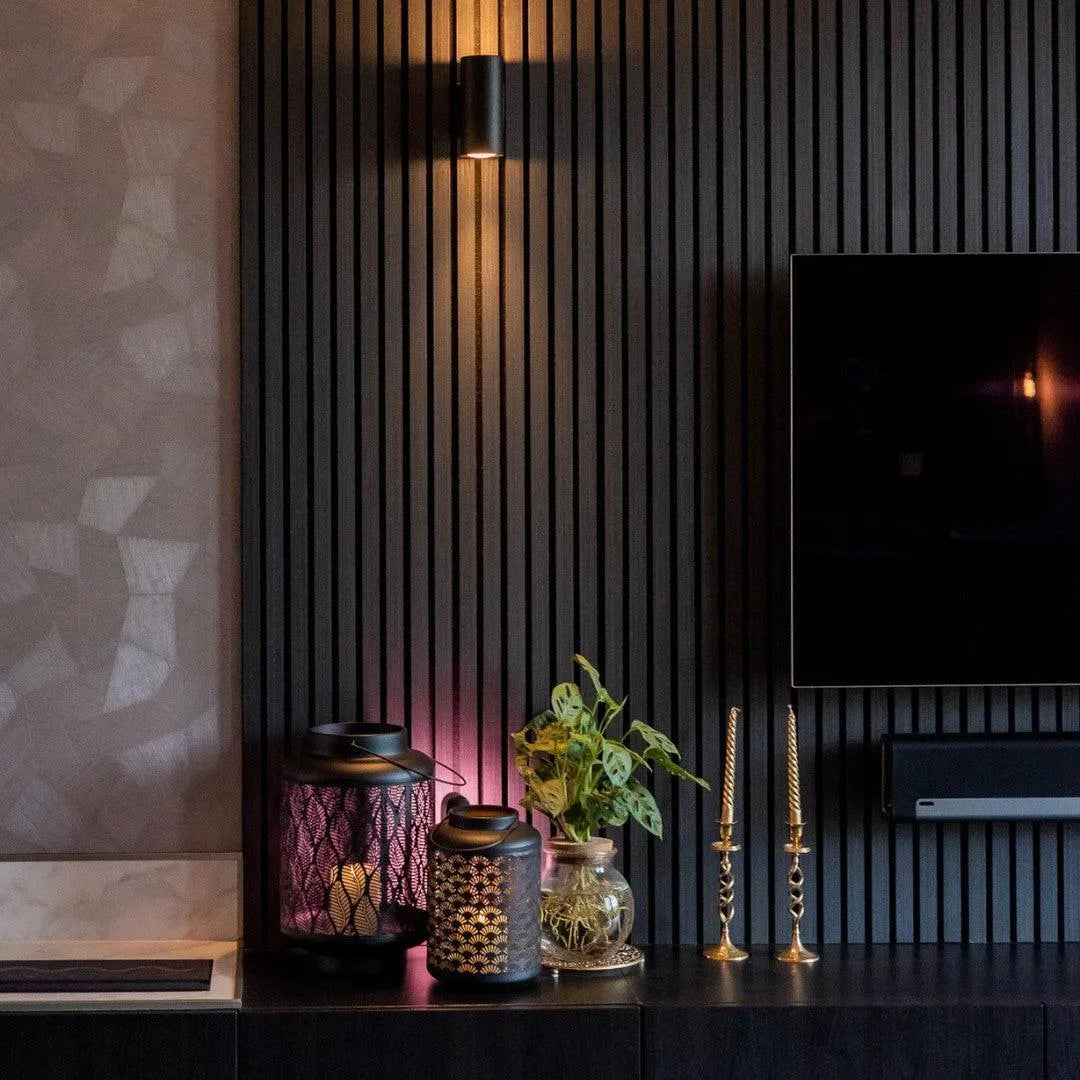
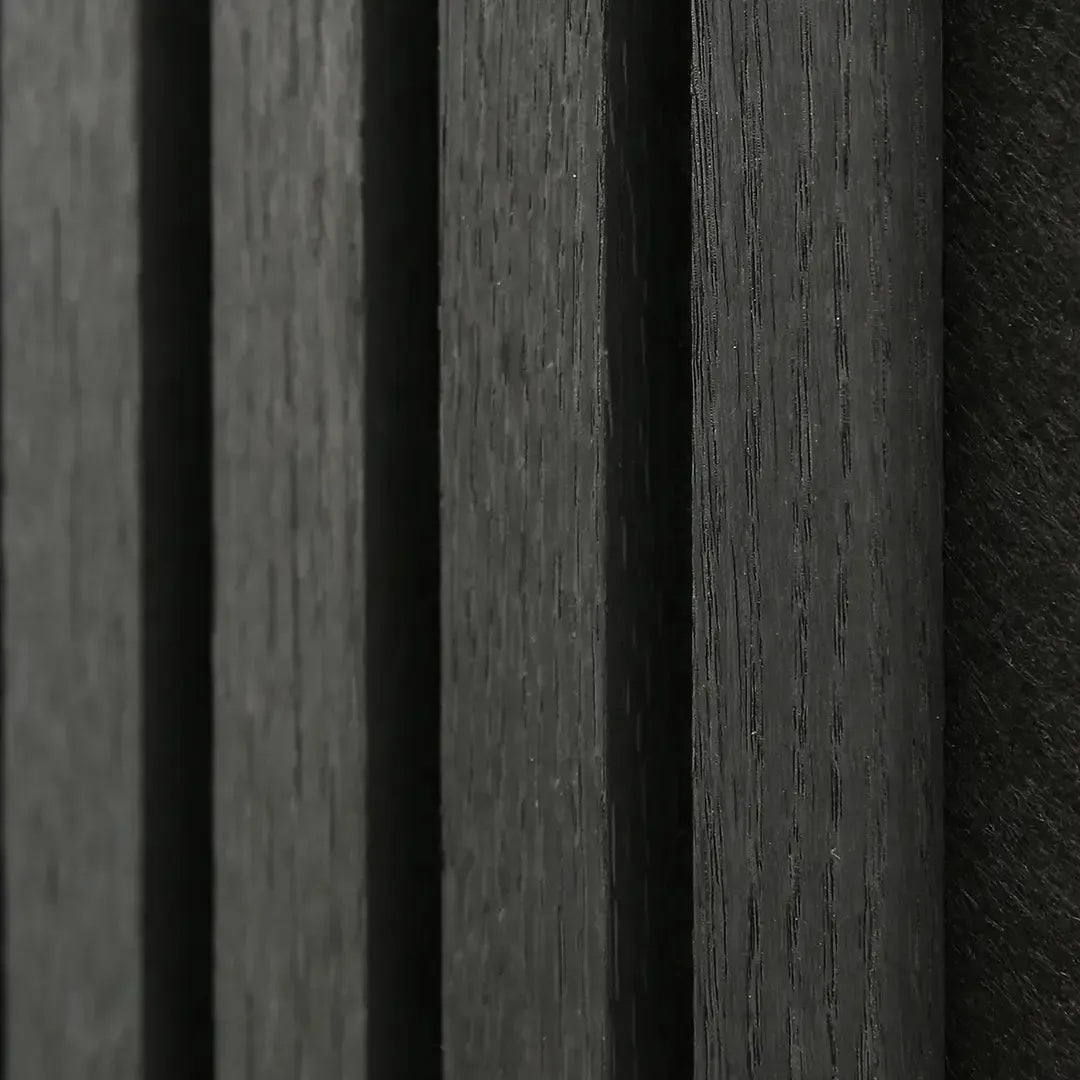
The low-maintenance pick: Black exterior wall panel
The hook: this finish hides urban grime, gutter runoff stains, and scuff marks better than any lighter tone. One number that matters: a dark composite surface shows roughly half the visible dirt buildup of a light finish over a typical 2026 rainy season, based on how urban facades weather in practice. It pairs cleanly with black finishing trim and black screws for a seamless look with no visible fastener contrast.
Verdict: Buy — this is the default choice for a shaded, high-traffic urban courtyard.
The render-matcher: Stone gray exterior wall panel
The hook: stone gray is the closest composite tone to existing painted render, poured concrete, or gray block, which is what most urban courtyard walls are actually made of. That means less visual break between the cladded section and the untouched wall around it — a real problem when you're only covering one wall of a three-sided courtyard.
Verdict: Buy — pick this when the courtyard's other walls are staying bare concrete or render.
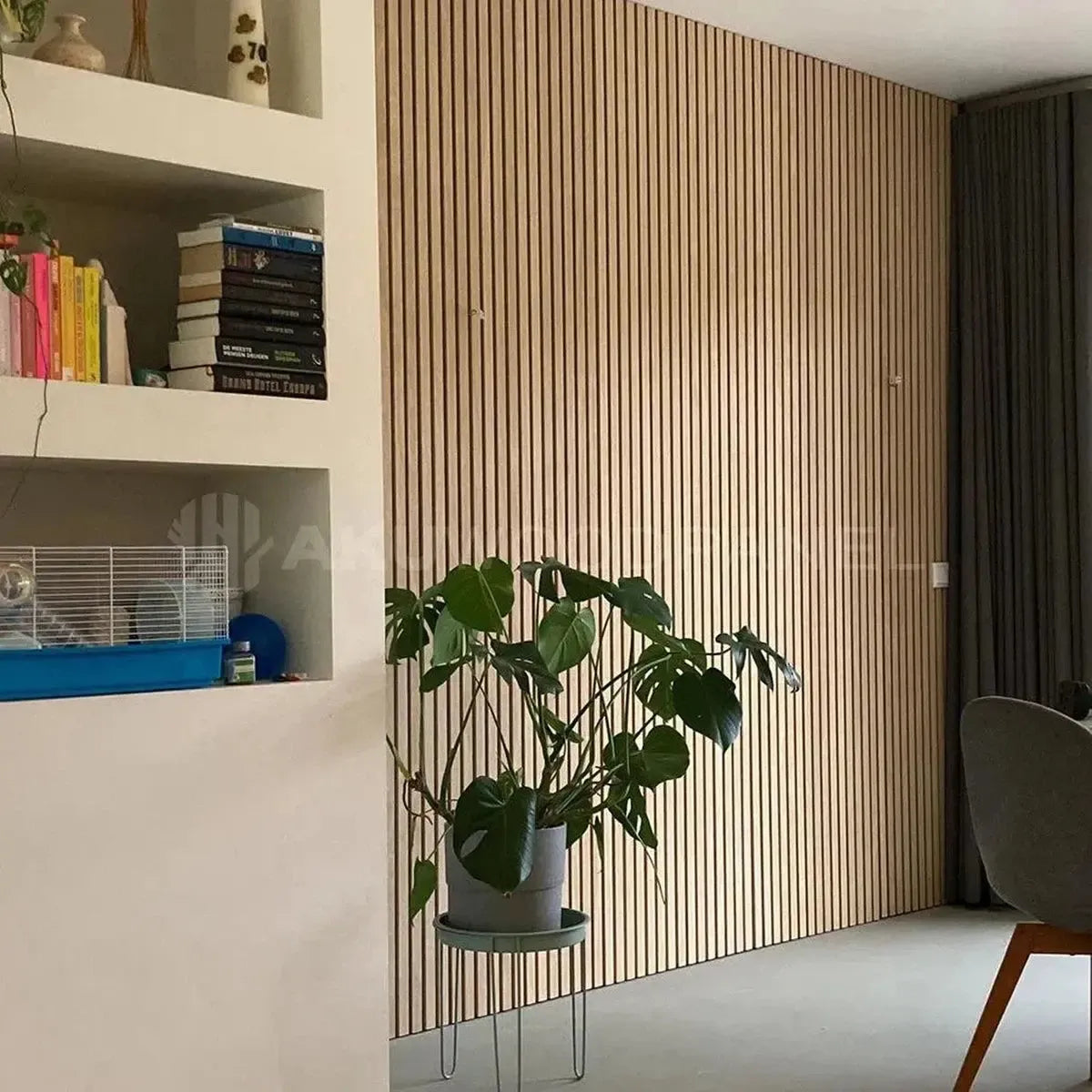
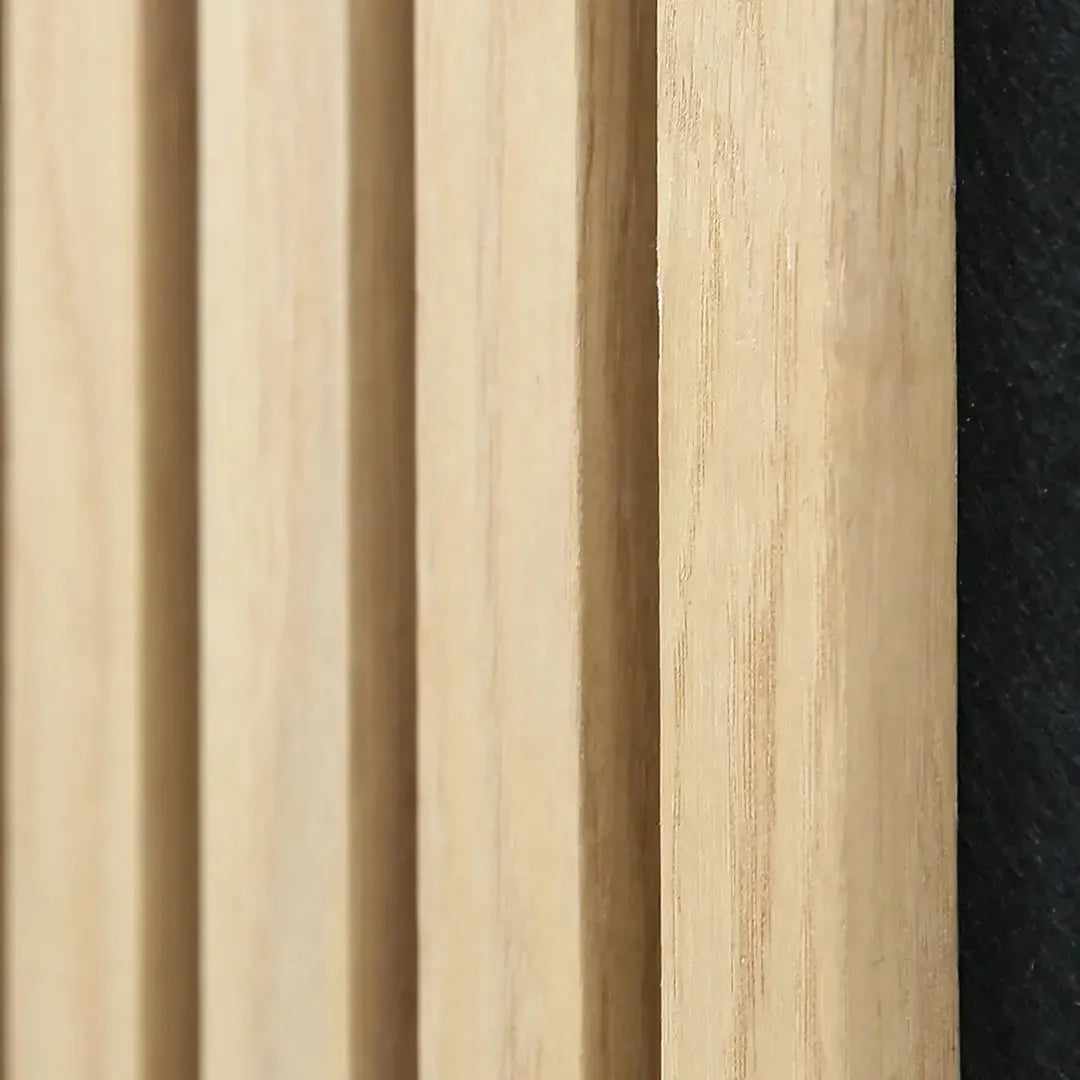
The warm accent pick: Oak exterior wall panel
The hook: oak-toned composite brings warmth into what is often a cold, shaded space, and it reads well against greenery if the courtyard has planters or a vertical garden. The tradeoff is that lighter wood tones show scuffs and water spotting sooner in a low-airflow space than black or stone gray.
Verdict: Consider — good for a courtyard with partial sun and light foot traffic, riskier in a fully shaded, high-use space.
What to avoid
- Light birch-toned composite on a fully enclosed, high-traffic courtyard — it looks premium in a showroom photo but shows dirt and water marks fastest in low-airflow conditions.
- Skipping the ventilation gap to save install time — this is the most common reason composite cladding fails early in an enclosed courtyard, where trapped moisture has nowhere to go.
- Mixing panel colors across adjoining courtyard walls without a trim transition — an unbroken color change without corner or finishing trim reads as a mistake, not a design choice, at close range.
Verdict comparison
| Panel | Best for | Maintenance | Verdict |
|---|---|---|---|
| Black exterior wall panel | Shaded, high-traffic courtyards | Low | Buy |
| Stone gray exterior wall panel | Matching existing render or block | Low | Buy |
| Oak exterior wall panel | Partial-sun courtyards with planting | Moderate | Consider |
| Birch-toned composite | Open, well-ventilated exteriors only | Higher in enclosed spaces | Skip for courtyards |
FAQ
What's the best exterior composite panel for a small urban courtyard? Stone gray or black composite panels are the best fit for most small urban courtyards in 2026 because they match existing render and block tones and hide dirt buildup better than lighter finishes.
Is composite cladding better than painted render for a courtyard wall? Composite cladding generally holds its finish longer than painted render in a shaded courtyard because it doesn't need repainting to stay looking clean, though render is cheaper for a simple flat-color refresh.
Do courtyard walls need a ventilation gap behind composite panels? Yes — a ventilation gap is recommended behind exterior composite panels in enclosed courtyards because low airflow lets moisture sit against the wall longer than on an open facade.
Can I mix wood-tone and dark composite panels on the same courtyard wall? You can, but use a corner or finishing trim at the transition point — an unbroken color change without trim looks unintentional at close viewing distance.
How much foot traffic can composite exterior panels handle in a courtyard? Composite panels rated for exterior use handle regular foot traffic and incidental contact well; the finish that matters most for high-traffic zones is a darker tone that resists visible scuffing.
Does a shared or party wall change which panel I should pick? A shared wall usually limits how deep you can anchor fasteners, so confirm the mounting system and trim options work with a surface-mount approach before ordering for that wall.
What color exterior panel hides urban grime best? Black exterior wall panels hide gutter runoff, dust, and general urban grime noticeably better than stone gray or oak-toned finishes over a full year of exposure.
Is exterior composite cladding worth it for just one courtyard wall? Yes, cladding a single wall is a common and cost-effective approach — pick a tone that either matches or intentionally contrasts with the untouched walls so the space still reads as one design.
One last thing
The detail most people miss on a courtyard project: the wall that gets the least direct sun is usually the one that needs the darkest, lowest-maintenance finish, not the lightest one — courtyards flip the usual facade logic because shade traps grime instead of letting rain wash it off.
 Better performance and aesthetic appeal
 In Stock