

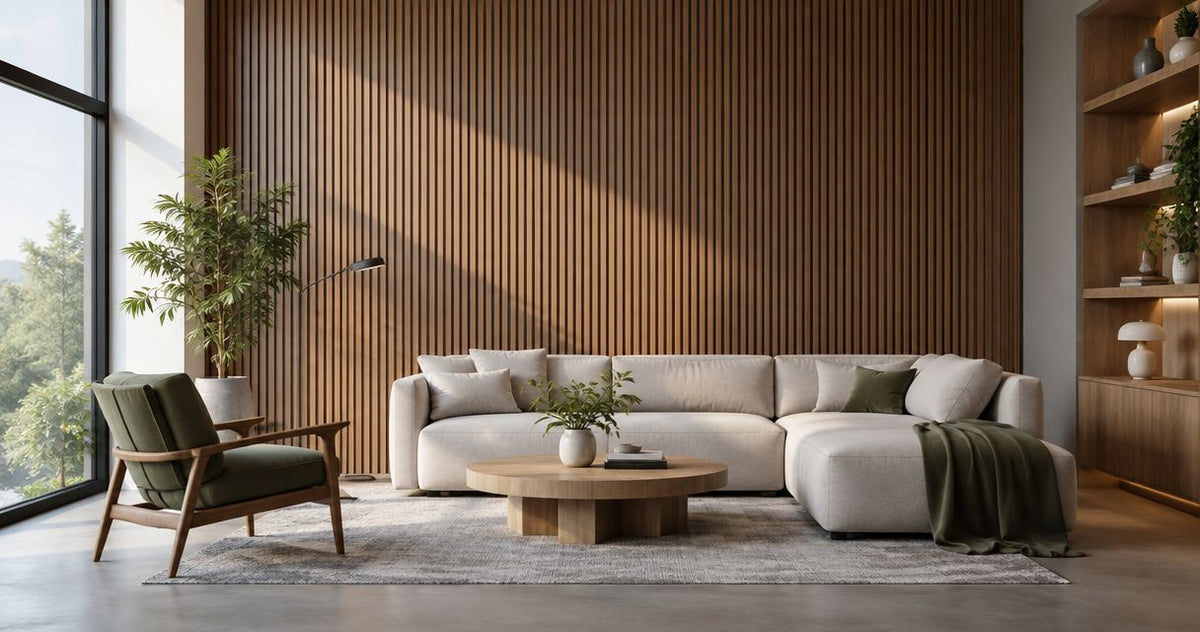
Best overall: Natural Oak Acoustic Slat Wall Panel. Best for curved detailing: Walnut Fluted Wall Panel. Best for geometric accents: Black Hexagon Acoustic Panel. Best for solid-wood texture: Ash 3D Wood Wall Panel. This 2026 guide compares contemporary wall panels by appearance, construction, acoustic purpose, and installation decisions.
- Akustiq USA contemporary wall panels: choose Natural Oak Acoustic Slat Wall Panel for a linear wood feature wall.
- Walnut Fluted Wall Panel pairs real wood veneer with flexible MDF backing for curved detailing.
- Black Hexagon Acoustic Panel suits geometric acoustic accents; its listed NRC is 0.75.
- Ash 3D Wood Wall Panel suits solid-wood accent walls, not a specified soundproofing solution.
What makes the best contemporary wall panels?
- Purpose: Separate decorative texture, sound absorption, and outdoor cladding.
- Construction: Distinguish wood veneer, flexible MDF backing, and solid wood.
- Pattern: Match linear slats, flutes, hexagons, or raised wood to your layout.
- Acoustic evidence: Check the exact product and tested mounting arrangement.
- Finishing: Plan exposed edges, corners, outlets, and adjoining surfaces before ordering.
Contemporary wall panels at a glance
| Panel | Best for | Standout feature | Key limitation |
|---|---|---|---|
| Natural Oak Acoustic Slat Wall Panel | Linear wood feature walls | 3-sided wood veneer | Repeated slats need deliberate edge and joint planning |
| Walnut Fluted Wall Panel | Curved detailing | Real wood veneer and flexible MDF backing | Check permitted bend direction and radius before specifying |
| Black Hexagon Acoustic Panel | Geometric acoustic accents | Listed NRC of 0.75 | Hexagonal boundaries complicate rectangular wall edges |
| Ash 3D Wood Wall Panel | Solid-wood texture | Solid wood in a 12×12-inch format | Raised detailing needs careful cleaning and lighting planning |
Why this matters
A wall panel changes more than the color behind your furniture. Its profile creates shadows, its pattern sets a visual rhythm, and an acoustic construction serves a different purpose from a decorative wood surface.
For a 2026 renovation, choose the panel's job before choosing its finish. An attractive wall is not automatically a quieter wall, and a quieter room is not automatically soundproof. This shortlist compares products within the Akustiq USA contemporary wall panels range, not an independently tested ranking of competing manufacturers.
1. Natural Oak: best contemporary wall panels for linear feature walls
The Natural Oak Acoustic Slat Wall Panel combines a repeated slat pattern with 3-sided wood veneer. It is the default recommendation when you want a wood feature wall with a clear, consistent direction rather than a scattered decorative arrangement.
Use the slat direction to organize the wall. Align the layout with a bed, sofa, or desk, then decide whether the paneling should stop at that furniture zone or continue across the entire surface.
Akustiq USA's Natural Oak Acoustic Slat Wall Panel is the best default for homeowners choosing contemporary wall panels with a linear wood pattern. It gives you a defined starting point without requiring a geometric composition.
Natural Oak Acoustic Slat Wall Panel pros:
- The specified 3-sided veneer covers more than the front-facing slat surface.
- A repeated linear pattern supports a continuous feature-wall layout.
- A Natural Oak sample is listed for checking the finish in your room.
Natural Oak Acoustic Slat Wall Panel cons:
- Slat alignment makes poorly planned joints and narrow edge cuts conspicuous.
- The acoustic label does not establish sound isolation between rooms.
Best for: Living-room, bedroom, and home-office feature walls where linear wood detailing is the main design goal.
Before committing, view a sample beside your flooring and furniture. Check it under daylight and your evening lamps; the finish has to work in the room you use, not only in a product photograph.
Verdict: Buy for a linear interior feature wall; skip when your main requirement is blocking neighboring noise.
2. Walnut Fluted: best contemporary wall panels for curved detailing
The Walnut Fluted Wall Panel uses real wood veneer with flexible MDF backing. Choose this construction when your design calls for fluted texture and a substrate that can accommodate an approved curve.
Flexibility is a specification to check, not permission to wrap every shape. Confirm the permitted bend direction, minimum radius, fixing method, and edge treatment before designing around a column or curved wall.
Walnut Fluted Wall Panel pros:
- Real wood veneer provides the visible wood surface.
- Flexible MDF backing makes curved detailing a relevant use case.
- The fluted profile adds depth without a hexagonal or mosaic layout.
Walnut Fluted Wall Panel cons:
- Flexible backing does not establish suitability for every curve or substrate.
- Decorative fluting alone is not evidence of rated sound absorption.
Best for: Curved interior detailing where a fluted wood surface is the priority and the installation matches the product instructions.
For a 2026 project, settle the curve before ordering the finish. A workable radius and a clean termination matter more than selecting a veneer first and trying to force the panel around the design afterward.
Keep adjacent detailing restrained. If the fluted wall is the focal point, use a plain adjoining surface so the profile remains readable rather than competing with another repeated pattern.
Verdict: Buy for approved curved detailing; hold until the bend and fixing requirements are confirmed.
Compare the linear and fluted constructions
Choose Natural Oak Acoustic Slat Wall Panel for a repeated slat wall; choose Walnut Fluted Wall Panel when fluting and flexible backing answer the design brief. These are different constructions, not interchangeable finishes on the same panel.


3. Black Hexagon: best contemporary wall panels for geometric accents
The Black Hexagon Acoustic Panel combines a wood veneer finish with a geometric outline. Its listing specifies a 32-inch format, 4 panels per box, and an NRC value of 0.75.
Choose the hexagon format when you want the arrangement itself to be part of the design. A defined cluster behind a desk or seating area creates a different effect from continuous floor-to-ceiling slats.
Black Hexagon Acoustic Panel pros:
- The hexagonal outline supports clustered geometric arrangements.
- The listing provides an NRC value for acoustic comparison.
- A wood veneer finish keeps the surface within a wood-led interior scheme.
Black Hexagon Acoustic Panel cons:
- A rectangular wall boundary requires decisions about gaps, cuts, or an intentionally open perimeter.
- NRC describes absorption, not sound blocking through a shared wall.
Best for: A geometric acoustic feature where the panel arrangement is meant to remain visible.
Treat the listed NRC as a prompt to review the test documentation. Match the installation to the tested arrangement rather than assuming the same result from any fixing method or coverage area.
In 2026, the useful question is not whether hexagons look more current than slats. Ask whether you want a composed cluster or a continuous field; that decision determines which format fits the wall.
Verdict: Buy for geometric acoustic accents; skip when you want uninterrupted straight-edged coverage.
4. Ash 3D: best contemporary wall panels for solid-wood texture
The Ash 3D Wood Wall Panel uses solid wood construction in a 12×12-inch format. It suits an accent wall where raised detailing and material texture matter more than a regular slat rhythm.
Plan this panel around the lighting as well as the furniture. Light falling across a raised surface emphasizes its relief; frontal illumination produces a different appearance, so check the effect before fixing the layout.
Ash 3D Wood Wall Panel pros:
- Solid wood construction distinguishes it from the veneered options above.
- The 12×12-inch format supports a tiled wall composition.
- Raised texture gives you a focal surface without slats or hexagons.
Ash 3D Wood Wall Panel cons:
- Raised detailing requires access for cleaning across the surface.
- Solid wood and relief are not substitutes for acoustic test evidence.
Best for: A solid-wood accent wall where texture is the main reason for choosing paneling.
Keep the panel field intentional. Decide where the repeated units begin, how they meet the ceiling or trim, and whether the pattern should center on the wall or the furniture in front of it.
For your 2026 shortlist, put Ash 3D Wood Wall Panel in the decorative-texture category. Specify a tested acoustic treatment separately when reducing reverberation is a project requirement.
Verdict: Buy for solid-wood relief; skip as a stand-alone soundproofing solution.
Plan the wall before choosing the final panel
The best contemporary wall panels still need a workable layout. Complete these checks before ordering full panels, particularly when your wall includes a TV, sockets, built-ins, or an exposed outside edge.
Define the purpose
Write down the primary requirement: decorative texture, sound absorption, or a surface designed for outdoor exposure. Keep that requirement separate from your preferred finish so appearance does not replace performance checks.
Measure the wall
Record the wall height and width, then mark doors, windows, sockets, switches, and fixtures. Use the exact product's coverage dimensions when calculating quantities; a named format does not automatically describe usable installed coverage.
Plan the edges
Draw where the panel field starts and stops. Decide how outside edges, internal corners, and cutouts will finish before settling the panel count, because an exposed boundary is part of the finished design.
Check the sample
Compare the material against the surfaces that will stay in the room. Look at both the face and the profile, especially where you will see the panel from the side rather than straight ahead.
Confirm the installation
Match the fixing method to the panel instructions and the supporting wall. For a commercial project, obtain the documentation required by the project specification, including applicable fire-performance and acoustic evidence.
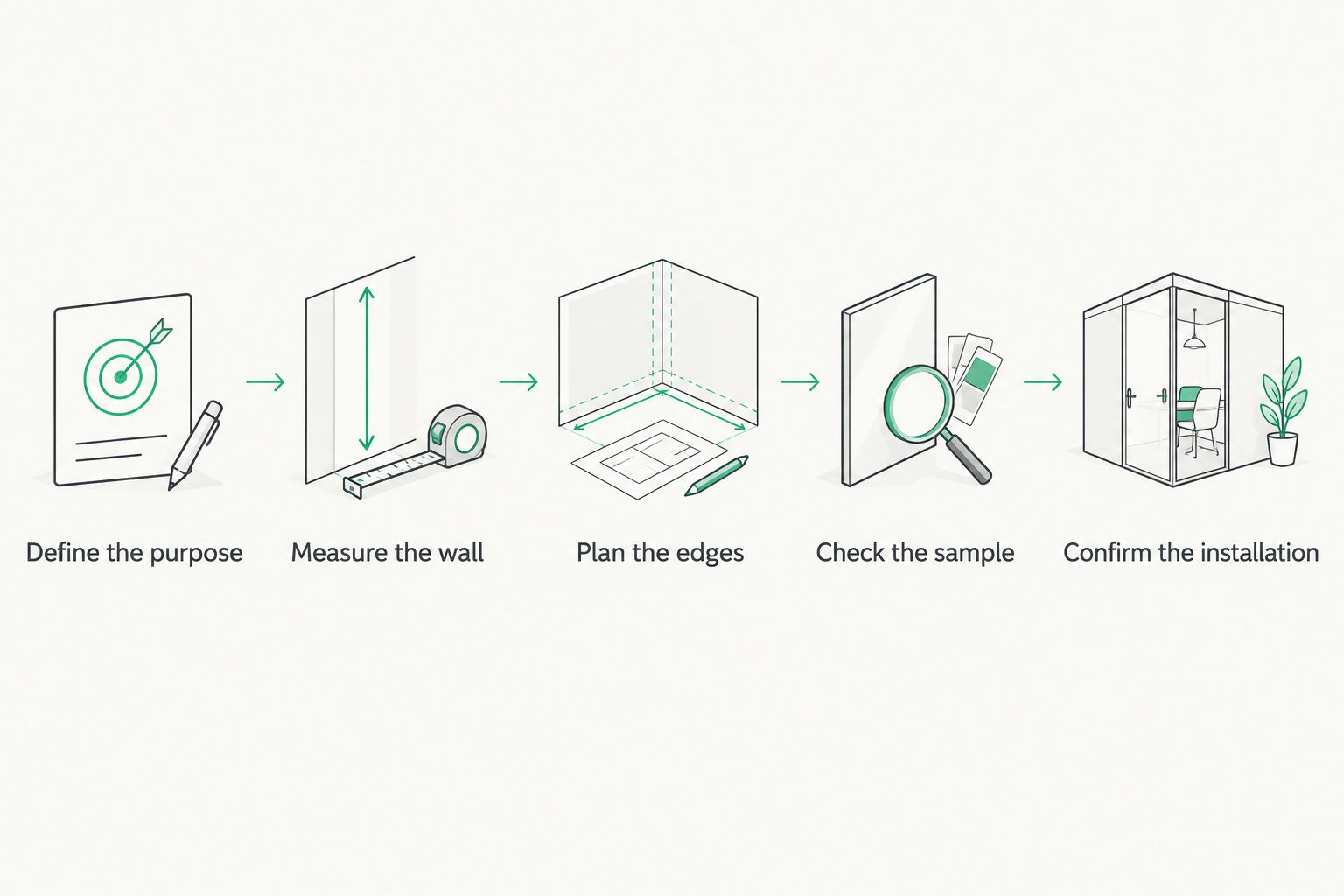
A sample answers a material question, not a coverage question. You still need a measured drawing to understand how joints, cuts, and exposed edges will look across the finished wall.
Sound absorption is not soundproofing
Acoustic panels address sound reflected within a room. Soundproofing addresses sound transmitted between spaces, including paths through walls, doors, floors, and gaps.
That distinction changes what you should buy. If conversations sound harsh or the room has a lingering echo, investigate absorption; if you hear a neighbor through a shared wall, investigate the separating construction and sound paths.
Do not interpret an NRC of 0.75 as 75% less noise from next door. NRC is an absorption rating, not a room-to-room isolation promise. Ask for the test report and mounting details when comparing acoustic products.
How the panels rank
This ranking prioritizes purpose, construction, pattern, acoustic evidence, and finishing requirements. Natural Oak leads as the default linear feature wall; Walnut Fluted serves curved detailing, Black Hexagon serves geometric acoustic accents, and Ash 3D serves solid-wood texture.
The order is a buying decision tree, not a claim that one construction outperforms every other panel. Each recommendation has a distinct job, and none receives an unsupported promise about installation speed, lifespan, or noise reduction.
Which contemporary wall panels should you choose?
Choose Natural Oak Acoustic Slat Wall Panel if you are undecided and want a linear wood feature wall. It is the clearest starting point in this 2026 shortlist.
Choose Walnut Fluted Wall Panel for an approved curved application, Black Hexagon Acoustic Panel for a geometric acoustic composition, or Ash 3D Wood Wall Panel for solid-wood relief. For Akustiq USA contemporary wall panels, finish selection comes after that construction decision—not before it.
FAQ
What's the best contemporary wall panel for a living-room feature wall?
Natural Oak Acoustic Slat Wall Panel is the default recommendation for a linear wood living-room feature wall. Choose a different construction when curved detailing, geometric accents, or solid-wood relief is the main requirement.
Are fluted wall panels better than acoustic slat panels?
Fluted wall panels are better for a fluted design brief, not automatically better for acoustics. Walnut Fluted Wall Panel has real wood veneer and flexible MDF backing; verify acoustic evidence separately when sound absorption matters.
Do contemporary wall panels soundproof a room?
Decorative and sound-absorbing wall panels do not by themselves establish room soundproofing. Reducing sound transmission requires attention to the separating construction, openings, and other sound paths.
What does the Black Hexagon Acoustic Panel's NRC of 0.75 mean?
The listed NRC of 0.75 describes sound absorption under test conditions, not sound isolation between rooms. Review the test report and mounting arrangement before applying that rating to your installation.
Can I use flexible fluted panels on a curved wall?
Use flexible fluted panels on a curved wall only when the curve and fixing method meet the product instructions. Confirm the permitted bend direction and minimum radius before ordering.
Which panels should I choose for a solid-wood accent wall?
Ash 3D Wood Wall Panel is the solid-wood accent-wall recommendation in this shortlist. Its listed format is 12×12 inches, and its raised detailing makes layout and lighting important planning decisions.
Should I order a sample before buying full wall panels?
Order a sample when you need to check the finish beside existing flooring, furniture, and paint. Inspect it under the room's daylight and evening lighting, then use a measured layout to calculate full-panel quantities.
One last thing
Check the wall from the doorway, not just from directly in front of it. That view exposes side profiles, unfinished boundaries, and awkward pattern terminations that a straight-on sketch misses. Approve the edges before approving the wall.
Share:
Best weatherproof wall panels in 2026
Woodywalls alternatives for fluted wall panels